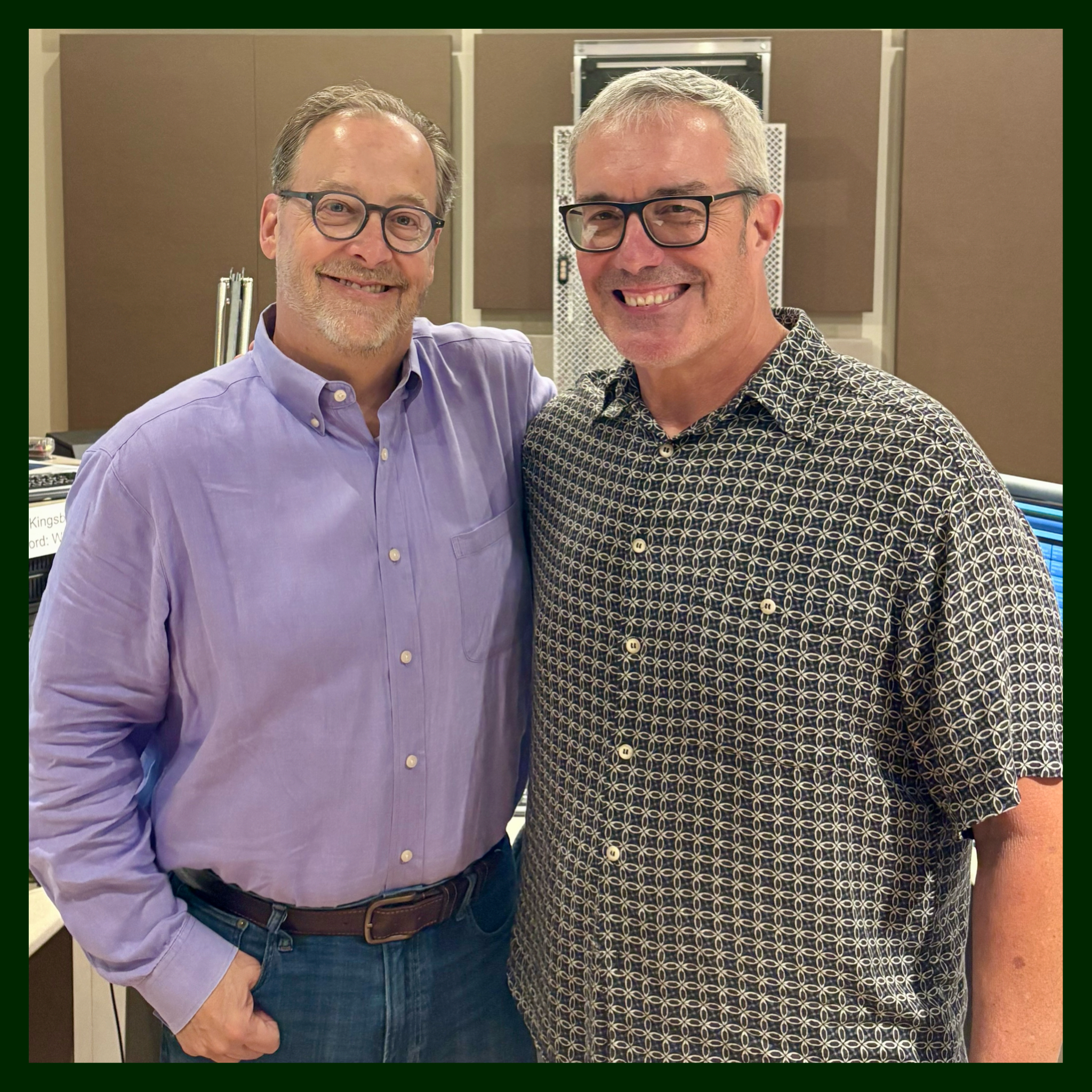
Bruce C. Bryan: My guest today on Naturally Curious is Scott Perry. I'll admit, I had more trouble than usual preparing for this week's show. Scott has so many interests, and from what I've seen, he's next level with his ability to integrate his life's mission with his daily work, and that, at times, can be intimidating.
Scott is a successful podcaster, an experienced music teacher who's also an accomplished musician himself. He has a long association with Seth Godin and is releasing what I believe to be his 11th book later this year, and he's helping others in their business journeys. That's a lot to cover, but we haven't gotten to the most anxiety-producing part yet.
Scott is a near lifelong passion for the study of stoicism. We'll dig deeper into that during this episode of Naturally Curious, and I'll just say this, we may need to plan for a part two interview sometime in the near future. My interview with author and podcaster Scott Perry is coming up next on this week's episode of Naturally Curious
Perry Segment 1
Bruce C. Bryan: Scott Perry, thank you for being my guest on the show, and welcome.
Scott Perry: Thank you, Bruce. It's a privilege.
Bruce C. Bryan: So seventh grade Latin is where a big part of the start of your story is. Will you give our listeners a little context?
Scott Perry: Sure. Well, I was a troubled youth and when I had an opportunity to switch schools and go to a very small, very unprestigious, private school, I ended up in a classroom with just seven other kids, two teachers.
And in an introduction to language class, Don Kelly, was an early mentor, remains a friend, introduced me to Marcus Aurelius through the translations of Meditations
Bruce C. Bryan: And Marcus Aurelius is really at, I don't know, at the forefront, but the most visible of the stoicism, , experts, I guess. Talk a little bit about that study.
Scott Perry: Stoicism is a Hellenistic philosophy that started in Athens, Rome. Zeno of Citium is the one that started it around 300 BC or so. Marcus actually comes at the end of stoicism's greatest period of flourishing. He was the last of the five Roman good emperors, and his notes to himself, his journal, is now one of the primary stoic documents where people are connecting with this beautiful philosophy of living and thriving.
Bruce C. Bryan: So he isn't necessarily the one, as you said, that invented it, but he perhaps made it more popular, right?
Scott Perry: Yeah, , the journal, which he insisted be destroyed upon his death, was saved, and it has become one of the most widely read books, , throughout history ever since then.
Bruce C. Bryan: So a lot of people consider it as a way of life, um, right, or as a life-guiding approach.
Why is that,?
Scott Perry: Well, I think human beings have always been programmed to ask the big questions. What does it mean to be human? What does it mean to be happy? How do I be m-more of both? And what stoicism does is it provides an operating system that allows someone to remain deeply engaged with all the things that we consider to be part of being, , an active member of society, that being actively engaged in economics and p-politics and so forth.
, But of course, human beings also are fraught creatures, and there's a lot of anxiety and stress, , that comes along with the human experiment, and so... But stoic philosophy teaches us that we can be both engaged and remain flourishing through all of life's ups and downs.
Bruce C. Bryan: And that's one of those things that you carry with you, I think, through, as a through line, all the different things you're involved with.
So we have a thing at work, where I work, where we br- we brand it as Grayson Explains, where someone of our team can take a really complex story or a movie script or situation and make it really simple in a few succinct words. So any chance you can Grayson Explains stoicism for our listeners?
Scott Perry: Well, I, I'll just share one of my favorite quotes from Marcus Aurelius.
"Love the humble art that you have learned and take rest in it."
Bruce C. Bryan: I love that. So when you think about that quote and how it applies, can you kinda pull our listeners into the mix of things you have going on in your world a little bit? Talk a little bit about some of the different things that keep you busy during the day, besides the grandkids.
Scott Perry: Well, the grandkids are the primary occupation these days. And, you know, stoicism and this idea of loving the humble art of living well and taking rest in all of life's ups and downs has been something that I've been able to do because of my association and love of stoic philosophy through a career as a schoolteacher, as a husband, as a parent, my long career as a musician and guitar studio owner, and now in the work that I began with Seth Godin, uh, as a coach in his programs now that I'm doing on my own.
But in all of these things, I am always in community. I am actively engaged with other people. And again, Marcus would, would remind himself when he woke up every morning, "Today you will meet people that are manipulative, surly, scheming, mean." And he taught himself to love people as they are, that people are not bad, they're not evil,
They're, they're sometimes misinformed, they're sometimes ignorant, and most of the time they're doing what they think they need to do. And we all have those experiences with coworkers or our kids and so forth, but if we can meet people where they are with that level of kindness and empathy and, and consideration and fairness, then we set a possibility to live in harmony even when we're experiencing discord.
Bruce C. Bryan: Well, Big Jim and I have not had much discord during our six months together doing, during this show or doing this show, but, uh, we appreciate the concept that you're sharing. If you're listening now, you know that's Scott Perry. He is mixed up in all kinds of interesting things: musician, podcaster, author, and we've been talking kind of about your approach to life.
I'm Bruce Bryan. This is Naturally Curious. And Scott, I can see even in the short time that we've been together how you've got a bit of a calm about you. Uh, you carry that with you, and I think a lot of that's related to the community that you mentioned. Um, talk a little bit about that concept of having community wherever you might be.
Scott Perry: Yeah. Well, one of the thing, the things about relationships is when we are looking at the things, stoicism teaches us to acknowledge the things that are in our control and acknowledge the things that aren't. And the things that aren't in our control are just about everything. Mm-hmm. You can't control your body.
It will fail. You will die. You will get sick. You can't control other people and their opinions and their actions. You can't control the weather. You can't control politics, economics. There's all these things that are so far beyond our control But the promise of stoicism is that you do control the only two things you need to flourish through anything that life throws at you.
You control how you see things and what you decide and do next. And if you are paying attention and you engage through the stoic disciplines and, uh, virtues of temperance and courage and justice and wisdom, you can navigate all of that with a greater sense of peace, purpose, and peace of mind. And when it comes to relationships, that's one of the things that we don't have control over other people, what they do and what they say and what they might be thinking about us.
But we do have control over how much of our attention, energy, time we allow those people to take up.
Bruce C. Bryan: And what attention you give them in return. That is one of those things that, that we can control. I can tell, as I've mentioned, that you're doing a mix of things. To me, it seems like they're all connected.
Um, I'm guessing from the outside many people question, how is all this connected? But I'm curious and hoping you'll talk a little bit about your Substack work.
Scott Perry: Oh, sure. Well, I, I think it really is all the same thing. The, the Stoics said that all you need to live a good life is to be a good person, and that if you continue to cultivate your virtues of temperance, courage, justice, and wisdom, that you will lead a thriving life, whether or not you get all the things that you aim and aspire to.
And in all of the things that I've ever done, it is profoundly about connection and kindness and teaching and helping myself become a better person by trying to help other people get the things that they want.
Bruce C. Bryan: And then, of course, as you become a better person, you think or hope, and whether it happens or not, other people will come along and be better people as well.
I mean, that's kind of part of the, the, the concept. Not why you do it, but it's one of those unintended consequences, I would think.
Scott Perry: Yeah. And the, with the community at, on Substack, the, the sub- subscriber community, which includes free subscribers and paid subscribers, it's all about just people have different levels of exposure, access, and proximity to me by virtue of how they're engaged.
But I'm sharing freely these ideas twice a week, and people can, can communicate and connect with me through the comments and through direct messages. But then we have the weekly calls where we're actually in community, in fellowship, doing deeper dives into all these things, which is just becomes a catalyst for the forward progress that we're all trying to make.
Bruce C. Bryan: That's author Scott Perry. I'm Bruce Bryan. You're listening to Naturally Curious. And I was wondering, how long do you wrestle with a concept or an idea before you get to the place where you're actually writing about it?
Scott Perry: Well, it's really funny. Um, I'm laughing because I, I've written, as you mentioned, several books.
They're short books, and they are all written really quickly. And people say, "Well, how can you write 120 pages in just 30 days or 60 days or 90 days?" And I always joke, "It doesn't take me 30 days to write a book. I've been writing this book for 60 years. It takes me 30 days to type it 'cause I'm a really slow typer."
So when it comes to ideating, going from idea to words on the page, they are things that I have-- Most of the things that I'm sharing now are things I've shared many times before. I just get better at articulating them and getting better at, uh, making sure that I write about them in a way that's engaging and connects with and inspires someone to take in-intentional action with those ideas.
Bruce C. Bryan: So when you're writing these books, I, I'm wondering what's the hardest part? Is it the research, which you said might be 60 years in the making, the writing itself, the editing, or the word spreading of it, if you understand what I mean by that, the marketing? It's, uh, if you've been in marketing, you're marketing other people's things, but marketing your own is difficult.
For you, which is the most difficult part and, and why is that?
Scott Perry: Right now, the writing comes pretty easily. Uh, I go for what I call my cemetery run every day, and so that's where a lot of the things get organized, and then I just kinda come home and type 'em.
Bruce C. Bryan: Is that because you're running through a cemetery?
Scott Perry: It's, it's, it's another... It's a stoic exercise, a memento mori, remember that you will die. It's, it's a reminder that life is finite, and the, the great gift is that's what also gives it meaning. And in whatever time I have left, I want to, to spend it wisely and make sure I take care of the things that I'm supposed to take care of.
But the hardest part for me is actually more in your game, because the writing for me comes pretty easy. The promotion, the marketing, that comes really hard. And the dirty little secret about writing books that nobody tells you is when you've completed one marathon in writing the book, nobody tells you they're gonna grab you by the hand and drag you to the next starting line, which is promoting the book.
Bruce C. Bryan: And that thing is hard. Yeah. Your new book is Stepping Into Possibility. When's it releasing? How long have you been working on it? Um, yeah, tell us more.
Scott Perry: Well, the first book was, uh, The Stoic Creative. I wrote that book while I was working with Seth Godin. Seth Godin was very kind in first telling me that The Stoic Creative is a lousy title for a book.
But even though I stuck with it, he actually gave me a really nice review and blurbed the book. And ever since then, and I guess that was 2018, I've been wanting to write a more definitive book about the power of stoic philosophy for living a life of greater flourishing. And the book came... I actually literally wrote this book in 30 days.
Last month, I gave a, a talk at the bookstore that you and I will appear at later, uh, next month, and it was called Stepping Into Possibility. It was just an introduction to stoicism, and people really connected with it, and I thought, "Oh, I sh- maybe I sh- can just take this presentation," and turned it into 100 pages.
And so that's how that all came together.
Bruce C. Bryan: When we come back, I'd like to talk more about your music career and the, and, and that background, and I'd really like to find out how stoicism, music, writing, podcasting, and marketing all fit together after this short break
Perry Segment 2
Bruce C. Bryan: Welcome back, Scott Perry. I was curious how it feels to get feedback on your books. Do you still hear from readers about some of the first books that you wrote?
Scott Perry: Absolutely. The first book, even though, , it was poorly titled, , continues to sell copies every week, every month, and, I always joke that I make enough in my book sales to take my wife out to dinner every month.
Sometimes it's McDonald's, sometimes it's a fancy Italian restaurant. But I mean, one of the things that I learned really quick, , early on from Seth Godin is write for the smallest viable audience. I'm not looking to make the New York Times bestseller list. I am writing for a handful of people that are my people.
We align with the values. I have insights for the problems that they have. And so I'm able to make a living doing work I love with people I care about.
Bruce C. Bryan: Which is one of the things you consistently say. Any chance you have a favorite book? Not a favorite person, but a favorite book, , or maybe a book you'd recommend readers start with if they're not familiar with your work?
Scott Perry: I would definitely recommend the one that will release next month. It's called Stepping Into Possibility. If, , you can't wait for that, then my book that, , I released a few months ago that I'm gonna talk about when you and I do an event together is called Intrepid: Dare to Make a Difference.
Bruce C. Bryan: Okay. I want to shift gears for a second. I love talking about your books and the prolific writing that you've done. What's your approach to interviewing others? I know you, you have a lot of guests on your show. Uh, full disclosure to the audience, I was a guest on, um, Scott's show, , earlier this year what is your approach to interviewing others?
Scott Perry: Podcasting, broadcasting, and blogging were all ways that I figured out what the heck I was trying to do. 'Cause when I was retiring from music and moving into this new thing, I didn't know what that thing was. So the secret for me was I wanna find interesting people, people that are doing interesting work, and I just wanna talk to them about what it is about what they do that lights them up, how they came to do that, what their origin story was, and just glean an insight or two about how they were able to level up in that enterprise.
And so for me, the interview process is not much of a process, but maybe the process is the shortcut. I just, I don't go in with a lot of preparation. I just sit down and I ask them a question about how they came to be doing what they were doing, and somehow, miraculously, the conversation just- It rolls through
goes from there.
Bruce C. Bryan: What happens when you have an aha moment during one of your interviews? Do you distract yourself with something you just learned or make a quick note and stay focused on what's happening and then go back and dig at that later on?
Scott Perry: I always have a little notepad next to me, and if somebody says something that I wanna either pick up on later in the interview or that I wanna talk about when the interview's over, I've got a, usually a healthy list of, two or three pages worth of things that are worth unpacking some more.
Bruce C. Bryan: Okay. So besides me, do you have a favorite guest or interview that comes to mind as you're sitting here?
Scott Perry: Oh, boy, I have had... I've been very, very blessed. It's hard to top Bruce Bryan, but-
Bruce C. Bryan: Stop ...
Scott Perry: , I've had seven conversations or so with Seth Godin. They're all amazing, And they're amazing because Seth is the GOAT when it comes to that sort of thing.
So if I had to choose one other person besides Bruce, it would probably be Seth. But there are many interviews that, , I could m- go to.
Bruce C. Bryan: You're listening to Naturally Curious. I'm Bruce Bryan. That's Scott Perry. If you wanna hear more about his connection with Seth Godin, that's gonna be in the bonus section, so you have to stick around for the online content.
, I noticed that you spent a lot of time just from tracking what you're doing in one-on-one sessions. You do it as an interviewer, as a coach, I'm gonna imagine as a music instructor. What things have you noticed about those sessions?
Scott Perry: I think when it comes to helping people identify what they're actually trying to accomplish or what they're actually trying to solve, which is what happens when you're teaching someone to play wagon wheel or when you're coaching them through a difficult challenge in their business or in their life.
, And the key is, for me, that no amount of inspiration or insight from me is going to help anybody get clearer and closer about what they want and how to get there. I think a lot of the one-on-one is just be a mirror. Hold a mirror up to somebody so that, they reveal to themselves whatever their blind spots or their faulty narrative is.
And once they identify what's the real bottleneck between where they are and where they wanna be, we can turn it into a solvable problem, and then we can work together to just do the two or three things that are necessary to make some real progress.
Bruce C. Bryan: If people wanna connect with you on Substack, it's Creative on Purpose, right?
Scott Perry: Mm-hmm.
Bruce C. Bryan: I think what's interesting about what you just shared is I see the same thing in the marketing world. The best branding, the best ideas that we might have for clients are related to their ideas given back to them, and it sounds like that's a lot of what you talk about in the one-on-one sessions you do, whether it's in any of the arenas that you're involved in.
Scott Perry: Yeah. Well, the thing about branding is nobody gets it. Everybody thinks that their brand is their logo, and that, that... Your brand is not your logo. Your brand is not what you... the story that you're trying to tell. Your, brand is the story other people tell themselves about you. About
Bruce C. Bryan: you. Yes. Man, you're good at this for obvious reasons.
So talk about your music. Um, how many students, , do you work with at any time, and how do they find you? I'm curious about those kinds of things.
Scott Perry: I got into music teaching when I had a music store in Floyd, which I owned and operated for about seven years, and I put out a shingle and started giving lessons, mostly as a means to just , make a few more bucks.
But it became something that I thought was going to be the thing I did for the rest of my life. And teaching people how to play guitar is just like teaching people how to solve any other kind of problem. And in terms of getting the word out, I didn't even have a phone listing. My first handful of students came to me because they saw me performing.
They wanted to learn how to play. I so thoroughly delighted them as their teacher so it was all completely, word of mouth. At the height, I was teaching about 55 students a week. Wow. And that became really unsustainable.
That's a lot. So I dialed it back to about 40 students a week and maintained that actually through the pandemic. All of my students went online with me when we were all shut down. And just as the world was opening back up is when I decided that it was time for me to retire that part of what I do so that I could pursue these other things, including being a full-time grandpa.
Bruce C. Bryan: So do you still create music for yourself at all, or do you focus on playing songs others have written or produced?
Scott Perry: When I was in it, I did a lot of songwriting. I played a lot of different genres. When people ask, "What kind of music do you play?" I, I would say good music, and good music was mostly American music, blues, jazz, old time country, and that sort of thing.
Bruce C. Bryan: Scott, talk about the difference music makes in your life and perhaps in other people's lives.
Scott Perry: Music is a language, and languages are used to connect and communicate and collaborate and come up with creative solutions to challenging problems. And so for me, it's no different than any other language, and I've always felt that that was the goal as a musician, was not to show you how great I was, 'cause I was not a great musician, but it was to create a moment, a shared moment with an audience where we were all celebrating, having a good time, just that back and forth, that call and response.
Bruce C. Bryan: And it's how people feel. It create a, a feeling. A- and I think it goes back to community- Mm-hmm ... which you've been talking a lot about. So even though you're not giving the lessons, you probably see students. You probably are still connected to the music community.
Scott Perry: Oh, yeah. Well, I see students, former students, parents of students almost every single day.
Some of, some of my students are now grown with kids of their own, and I started teaching them when they were five or six years old. So it's, it, it was a fantastic way to connect with the community, for sure.
Bruce C. Bryan: How do students, back in those days, how do they learn music? Is this just practice like a lot of things, or are there other ways?
Scott Perry: I always just believed in taking people where they were and getting them where they wanted to be as quickly as possible. I mean, nobody goes to get guitar lessons a- and says, "Can I please get a Mel Bay book and learn all the notes on the first string before I learn my first song?" If , they came in wanting to play "Amazing Grace" for church, I said, "Okay."
Bruce C. Bryan: Let's
Scott Perry: learn that. "We're gonna, we're gonna do that in four weeks. You ready? Let's go."
Bruce C. Bryan: So we have covered a whole bunch of turf, and we're gonna have another segment after this ends, but if people have been intrigued by what they've heard from you, how can they connect with you if they wanna learn more, hear more, and get to know your approach or more about your personality, Scott?
Scott Perry: You can always find me at my website, creativeonpurpose.com. It will take you to the Substack publication, and it will put you in direct contact with me as well.
Bruce C. Bryan: . Great. Thank you. Scott, again, thank you for being my guest on Naturally Curious this week. To listen back to the show, to hear the full interview, and links to learn more about Scott's new book, Stoicism, or his podcast, search Naturally Curious at radioiq.org.
Naturally Curious was produced and edited by Big Jim Shively with support from Sarah Hobbs and Nick Yee and is recorded at WVTF Radio IQ Studios. I'm Bruce Bryan. Thank you for listening.
Perry Bonus Content
Bruce C. Bryan: Thanks for sticking around, Scott. A little bit more about you in this segment, and I wanna start by going back and talking about the new book that's coming out. Um, what are the takeaways you hope readers will, will get from that book?
Scott Perry: The fundamental message of the book is that you don't need to control your life.
In fact, you can't control your life. But you don't have to abandon yourself just because life isn't cooperating.
Bruce C. Bryan: So you can be true to yourself and roll with it a little bit at the same time.
Scott Perry: Yeah. But it's, you're, you don't have to allow the externals, the opinions of others, the trappings of success define who you are.
Bruce C. Bryan: So earlier in the interview, you were talking about your daily cemetery runs, and I took it literally, and thank you for being kind and correcting me. That's your run in the morning to kinda clear things out. Has nothing to do with stamping white horses or holding your breath as you run by the cemetery, right?
Oh,
Scott Perry: no. No. It's just, uh, the, the, the backstory is we raised our sons on a farm way up north in the co- county, and when I would go for a run, it was completely safe. There was no cars around. When we moved to town, on my very first run in town, and I was so excited, "Oh, there's sidewalks, and I can plan out a, you know, three-mile run," I literally almost got hit by a car.
And my run took me to the cemetery, and I decided, "Well, if I don't wanna end up in the cemetery, maybe I'll just drive the half mile to the cemetery and do my run there."
Bruce C. Bryan: Okay. Well then, it, there is a cemetery mixed in. And your story reminds me of something that I probably never thought I would share in an interview, but I remember the episode of Cheers where, uh, Woody got the, the package from home, and it was Aunt Emma's killer brownies.
Do you happen to remember that- ... from a million years ago? I wasn't expecting to tell this, but they said, "Is it 'cause they were so good," and everybody's eating the brownies, Sam and Norm, and they're all eating the brownies. And Woody says, "No, it's because Uncle Eb smelled them and came running in and got run over by a combine."
So I'm pretty sure nobody had that on their bingo card, but this is the bonus segment. So what are you gonna do, Big Jim? You can't even edit that out. So, um, now that I'm getting comfortable, Scott, it's time to kinda geek out a little bit about Seth Godin and some of the marketing. How did you connect with him?
Scott Perry: I knew that life was calling me to do something different, uh, about 20... This was 2015, 2016. I couldn't figure out what that was, and my wife w- had been a follower of Seth Godin's for quite a while. He was just launching this new program called the Alt MBA, and she sent me the link. I took a look. It was at that, you know, an expensive program.
I think it cost $2,000 or $3,000 to do this 30-day program, and I remember thinking, "Well, I'll just go ahead and fill out the application. There's no way I'm gonna get in." And of course, I got in, and then I said, "Well, we can't do this, 'cause if we pay for this program, we can't go to the beach." And my wife said, "No, you're, you're going to do this."
Bruce C. Bryan: Do this.
Scott Perry: And-
Bruce C. Bryan: As wives often do. "No, you're going to do this."
Scott Perry: Yeah.
Bruce C. Bryan: And you're a good listener.
Scott Perry: And it was the, it was the, the best thing I've ever done. And after the program was over, I got tapped to be a coach in the Alt MBA or to go through the training. I never actually got a gig, but when he started his Akimbo workshops, which started off with the marketing seminar, I was asked to be a part of the original coaching team.
And as other workshops unfolded, like the Freelancers workshop and the Creatives workshop, I eventually became a head coach and for all the programs, and it just was a phenomenal experience. I mean, in terms of getting in your 10,000 hours, there's no better way than to spend every day coaching thousands of students online.
Bruce C. Bryan: And it's gotta be k- kinda crazy because you have Used a lot of those lessons, I guess, to help other people, right?
Scott Perry: Oh, absolutely. I mean, Seth has this really wonderful way of packaging wisdom in a way that is very sticky and spreadable. He calls it idea virus, and it was something I picked up on early on.
I was applying the lessons that I learned from him as a guitar teacher in my daily interactions with my family and friends, and it's something that became a skill that I was able to hone for myself in doing my own thing.
Bruce C. Bryan: And so clearly it's helped you personally and professionally, and he wrote a blurb, I think you mentioned earlier, for at least one of your books, right?
Scott Perry: He's blurbed a couple of them. He, he, he blurbed the, the one that's coming out. He even, uh, said something to the effect of, "This is Scott Perry's most important and generous work." And when you get validated by someone that's a hero, I mean, it's just... You know, I was already excited about the project. I, I do.
I'd already believed it was the best thing I'd ever written. B-but when your mentor says, "This is really good stuff," then, then you know you're on the right track.
Bruce C. Bryan: I would agree with him. I, I read that first section and I thought, uh, Scott's onto something, so good for you.
Scott Perry: No, I really appreciate it.
Bruce C. Bryan: Yeah. So have you always been so upfront about your approach to and your involvement with stoicism?
Scott Perry: Not really. Uh, I think Epictetus had a saying, "Keep your philosophy to yourself for a bit." And right now-
Bruce C. Bryan: Wait, wait. I am so sorry. I don't usually interrupt guests, but I have got to say, would you say that again? And then I know you're gonna remember what you were gonna say, but that was so, that was a great quote that you shared.
Scott Perry: Well, one of the things about- Who, who wants to learn philosophy, right? And so right now their stoicism is in a period of resurgence and renaissance, and there's lots of people talking about it. A lot of them look like younger versions of me. And so sometimes it gets tagged as bro-icism and like these guys that treat it basically as a life hack.
And I initially was doing a lot of waving my stoic flag ahead of things, and that quote from Epictetus, "Keep your philosophy to yourself for a little bit," was this reminder that you don't actually change people's minds or get them interested in things you're interested by telling them that this is really interesting, you should listen to me talk about it.
Instead, just again, creating these little idea viruses and just practicing this in the work that I was doing, and people would say things like, "Scott, you're always so calm, cool, and collected. You always seem to know what the right thing to say. Like, where does all that go?" Well, now they're asking me. So through inception, I've got them interested because it's now their idea.
And I think that's the, the fundamental idea behind what Epictetus was saying. You change minds by getting people to change their minds for themselves.
Bruce C. Bryan: That's not just really good radio. That's really interesting And a very powerful concept to hear. So I appreciate you sharing that. It feels like you're making it approachable to people individually, but you're also making it approachable to people in a more universal way.
Is that important to you, Scott?
Scott Perry: It's really important to me that especially for people that have heard about it, maybe done a little investigating and said, "Eh, I don't know if that's for me," based on who the messenger was. I wanted to make this a very personal book, uh, to show how it changed my life, but also to give people principles and tools that they could apply in their lives right now and experience a change in the way that they feel and the way that they show up in the world for themselves and for other people.
And so it's, it, it's very anecdotal. It's very, uh, non-dogmatic, and some people will probably say I'm playing fast and loose with some of the, the academic approaches to the, the philosophy, but Stoicism was never meant to be for academics. Yeah.
Bruce C. Bryan: The bro is, bro-icism and the Stoicism, maybe you're shooting the gap a little bit there and making it approachable.
Scott Perry: Well, if you wanna stand out, do the opposite of what everybody else is doing, and so that's what I'm really gonna try.
Bruce C. Bryan: So let's see. We have talked about Stoicism. We've talked about your podcast, your books, your music, your teaching, a little bit about your marketing, and it still feels like we might have missed something.
What did we miss, Scott? Was there anything we didn't talk about? Grandkids maybe?
Scott Perry: Yeah, we didn't talk about the grandkids, and that's what I'm all about. I mean, at my home- Ages? So my grandson Hudson is gonna turn one next month, and, uh, my grandson Jasper is going to be five in January.
Bruce C. Bryan: Nice.
Scott Perry: And my life and business has been completely reimagined and reorganized around being full-time daycare providers for those two young men.
Bruce C. Bryan: So is there anything you were sure I was gonna ask you that I didn't?
Scott Perry: Oh, boy.
Bruce C. Bryan: Anything you were expecting like, "I know he's gonna ask me about this. I gotta have this one ready." I know you're chill. That's probably not the Stoicism way to say it, but I know that you kinda roll with things, but...
Scott Perry: Well, the truth is, Bruce, I, I came in with no attachments or expectations 'cause that's what a good Stoic does.
Bruce C. Bryan: And no attachments and expectations are good. Most of the listeners have low expectations, so that's a little different. So thank you for having no expectations. So you were kind enough to have me on your podcast, and I really have enjoyed having you, uh, on this show and getting to know you better and giving my listeners the chance to hear your story and to learn more about you.
So Scott, thank you for being my guest on Naturally Curious.
Scott Perry: Bruce, it's been a privilege and a pleasure. I really appreciate you and the difference that you're making. Thank you so much.