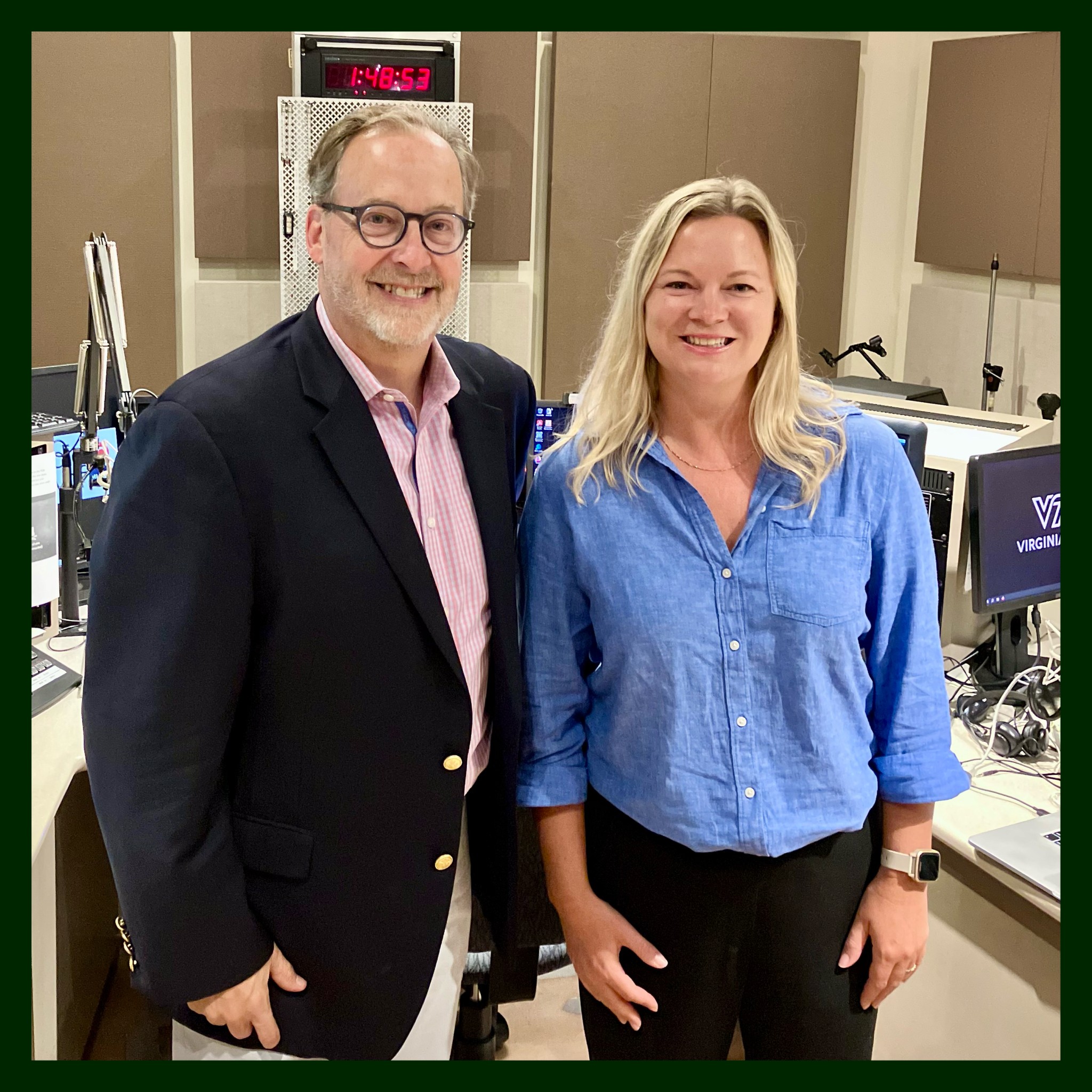
Bruce C. Bryan: My guest today on Naturally Curious is Sarah Quarantotto. She's a force in Lynchburg as the CEO of Miriam's House, and she's involved with the Central Virginia Continuum of Care, which is a group of cross-sector leaders who are addressing housing insecurity in the area. Sarah will talk about poverty, homelessness, these uncertain days, and the help her organization provides.
We'll address the issues both on a macro level and more directly and personally as we get to know her and hear her story. It'll be great to get to know a genuine expert in this difficult subject field. And I'm excited to hear what's working and what elements can be transferred to other communities.
Let's roll up our sleeves and talk in a focused way about shelter. My interview with Lynchburg leader and Miriam's House CEO Sarah Quarantotto is coming up next on this week's episode of Naturally Curious.
Quarantotto Segment 1
Bruce C. Bryan: Sarah Quarantotto , thank you for being my guest on the show, and welcome.
Sarah Quarantotto: Thank you so much for having me.
Bruce C. Bryan: Okay, I have to ask, who was or who is Miriam?
Sarah Quarantotto: So in Lynchburg, after World War II, there was a, a pastor of a small church, Reverend Bev Cosby, who started just a ton of really wonderful nonprofits, everything from, um, housing to ca- you know, camp for urban children, and he, um, really had a passion for homelessness, started a program for homeless men called The Gateway, and then wanted to start a prof- a nonprofit helping women and children, which was Miriam's House.
The benefactor for that was Elizabeth Forsythe, and she wanted to be anonymous, and so they sort of agreed together on the character of Miriam from the Bible, who cared for Moses. Um, and even though Miriam's House is not a faith-based organization, um, that sort of symbolism of caring for others in their time of need has sort of carried on.
Bruce C. Bryan: So here was a person who started out by doing good, and now, gosh, 80 years, however many, 90, 70, 80 years later, it's still going on, and you guys have been around as an organization through that time. I'm guessing we didn't just do breaking news with Elizabeth being named as the benefactor, so clearly that's been more known, but probably well after she was involved, right?
Sarah Quarantotto: Yeah. It wasn't until years later that sh- you know, sort of it was identified that she was the one who really was, um, the impetus for starting the, the work of Miriam's House.
Bruce C. Bryan: How does that story, I mean, not necessarily named Miriam, but how does that story of the start play into the work you all do on a daily or on a regular basis?
Sarah Quarantotto: I think that story of compassion and, um, selflessness really carries on. All of our staff are so incredibly passionate about the work that we do, about caring for others, about coming alongside people, um, at their very worst moments and, and making sure that we're a source of help and aid and, um, and that's really important.
Bruce C. Bryan: I saw that your work has a theme of ending homelessness, but there's a lot more to it. What role does not having an address play in people's lives?
Sarah Quarantotto: Yeah. I think, you know, homelessness is so pivotal to someone's ability to do everything else, right? If you don't have a home, you can't shower and get ready for a job or go to school.
You can't prepare food and have proper nutrition. Um, the last thing you're thinking about if you don't have a home is how to take care of your mental health or your physical health, like going to your primary care. So really having a home is so foundational to everything else that someone does.
Bruce C. Bryan: So what leads to these types of situations where somebody finds themselves in a place where they're, I, I think the, uh, where they're unhoused?
Sarah Quarantotto: The simple answer is it's usually a crisis coupled with poverty. So that crisis could be the loss of a job, it could be an illness, um, it could be a domestic violence incident, it could be, um, just really a number of, of unexpected occurrences, and then coupled with, um, the household or the individual or family not having the resources to really weather that storm, that can lead to homelessness.
And so we see that often with folks who never imagined they'd be homeless. They've worked their whole lives, they've always had a home, and then just a series of crises can occur that just tip them over the edge.
Bruce C. Bryan: That's Sarah Correntodo. I'm Bruce Bryan. This is Naturally Curious, and we're talking about Lynchburg.
Well, we haven't started really talking about Lynchburg too much, but we're talking about homelessness and kinda how people get into that situation. And this may be a far stretch, so stick with me for a second. But, you know, the World Cup recently ended, and we were talking a little earlier about, um, your connections to Argentina.
So I've seen when I watch soccer games how a goal usually happens not with one mistake, but when there's even two. But if there's a series of three or four kinda mistakes, the buildup, if you will, it leads to a goal oftentimes. And it feels like what you were just describing is like that. Like, a lot of us can put up with one crisis or one challenge, but when you start stacking two or three up, th-that has to just create such a, a traumatic experience and situate somebody for these kinds of situ- or a family for these kinds of situations, right?
Sarah Quarantotto: Yeah. That's exactly right. And so it's usually not just, like, one thing, but it's... Yeah, you're right. It's usually a series of things that have occurred.
Bruce C. Bryan: How heart-wrenching are these stories, though, for you and for your team also working in the middle of this?
Sarah Quarantotto: Yeah. I think, you know, we do a lot of work with our team to make sure that they feel supported and have proper supervision and a chance to staff cases and sort of not carry the burden of each story because you're right.
It's really hard to every day hear, um, the story of someone experiencing the worst period of their lives, right? And that's what homelessness is. It's, it's a period of someone's life that is the worst, the most traumatic, and, um, and carrying that is really hard. I think on the flip side, though- What is really encouraging for our team is that we, the majority of folks move out of homelessness, right?
And so we're able to help people get back on their feet. They're able to see that success over the long term and know that we didn't just leave them on their very worst day.
Bruce C. Bryan: Yeah, I think it's an appropriate time to step back and talk about what you're doing in Lynchburg and in downtown Lynchburg because, um, you're not just working in homelessness, but you're trying to solve problems for people.
So maybe talk a- on a higher level a little bit about Miriam's House.
Sarah Quarantotto: Yeah. So when Miriam's House opened, um, in the early '90s, we really started focusing on just families or s- single moms with kids, and we would provide transitional housing over the course of two years to help those families get back on their feet.
And that program worked for a number of years. And of course, what happened is we had a recession in 2008, and all of a sudden, in Lynchburg and all across the country, more and more families were experiencing homelessness. So when I came to the organization in 2010, we had a waiting list of 30 to 40 families who needed help, had nowhere to go, were sleeping in their car, were sleeping in homeless shelters, and really needed assistance to get back on their feet.
And so we, as an organization, um, really were committed to being innovative, to expanding our imprint, and so we started looking at other ways to serve homeless families. So we started rapid rehousing to quickly get families into housing, and maybe they never lived at Miriam's House, but we could help them right from a domestic violence shelter or right from their car, get into housing, pay for their rent for a couple months- Yeah, because-
have them connected to a case manager.
Bruce C. Bryan: Yeah, sorry to interrupt. No. But I, I think it's not just getting the rent, but you have to probably get a security deposit, and show you have a job, and how do you have a job if you don't have a place to live, right?
Sarah Quarantotto: Exactly, yeah. You are so correct. That, that really, that sort of initial move from homelessness into housing is so huge and, and can really feel overwhelming, 'cause you're right.
And especially now, you know, it's often double security deposits. The, um... It's income at a, a really high rate, which many of our families don't have because they've lost jobs while they were experiencing homelessness. So helping them move into housing, um, really leads to their long-term success.
Bruce C. Bryan: So is Miriam's House an actual house?
Is it, is it, is it helping people find housing? It sounds like it might be both.
Sarah Quarantotto: It's both. You're
Bruce C. Bryan: right. Okay. All right. So it's an actual house. I got one thing right. Finally, I got something right. Yes.
Sarah Quarantotto: We have a family shelter on site. We help homeless families have a safe place to go for the short term while we help them get into housing.
Um, and then we just have a number of community-based programs.
Bruce C. Bryan: Okay. This is Sarah Correntodo from Miriam's House. I'm Bruce Bryan. You're listening to Naturally Curious. And I was curious, uh, double curious, extra curious about the, the role that government should play in these situations, in your opinion.
Sarah Quarantotto: Well, we know that government, through policy, has created some challenges, right? And so we, um... So we don't have enough affordable housing in the Lynchburg community and really in most communities. Right. Um, and we haven't had major investment in a federal level in housing for a number of years.
So after World War II, we had the VA Bill that helped a lot of families get into their, um, home for the first time. We've, we had a lot of investment during that period of time with homeownership and with investing in housing. Um, and we, we haven't seen that. So I would love to see Um, sort of an increase in investment in housing, um, really for all levels of households, right?
For those who are making really low wages to, to our middle-income households, um, because that's a safety net for communities, and that's really where government can, can play a role.
Bruce C. Bryan: Do you get any support from local, regional, or even state or federal government for the work that you all do?
Sarah Quarantotto: So Miriam's House, about half of the funds that we operate on are, are state or federal grants, um, which is fantastic.
They're highly competitive. Um, each year we apply, we compete with, you know, communities and organizations all across the country and the Commonwealth. Um, and the really great thing is that we've continued to be competitive with those because our outcomes have always been really strong, which we're proud of.
Bruce C. Bryan: So probably the better you do, the more likely it is that you'll continue to get or get funding that's available, right?
Sarah Quarantotto: Exactly. That's right.
Bruce C. Bryan: And you probably have a rhythm with that now as well. How does the other revenue come? Is it, uh, donation-based or grants or other ways?
Sarah Quarantotto: Yeah. The other half of our revenue is donation-based, so it's, um, local foundations.
It's corporate foundations, um, based in Lynchburg. It's individuals making, you know, a $5 pledge, uh, a month and, and paying that each month. So there's really quite a variety of ways that the community has stepped up and, um, and helped support the work of Miriam's House.
Bruce C. Bryan: This is Naturally Curious. I'm Bruce Bryan.
That's Sarah Correntodo. And Sarah, we've had guests talk about food scarcity, but talk about the homelessness challenges that urban areas face.
Sarah Quarantotto: Yeah, so, you know, as I said before, there's really hasn't been a strong, um, investment in affordable housing in communities for a number of years. And so what that means is that for many families, they're paying, um, high rates proportional to their income for, for rent.
And so when that happens, when a family is paying, you know, 50 to 80% of their income towards their rent, it's really just doesn't leave a lot of room for anything else to happen in. And so any crisis can then lead to them losing their housing because rent is so disproportionate to their income.
Bruce C. Bryan: If people are listening and they don't know the proper percentages, what is a considered a reasonable or a, a manageable percentage to be- Connected to housing for a particular family
Sarah Quarantotto: Yeah.
The ideal that was set is like 30%, right? So if 30% of your income as a household is going towards your housing, that leaves enough remaining for things like caring for your health, making sure you have access to nutrition, caring for, um, your children, making sure they have access to like, um, enrichment activities or educational activities.
So that 30% is really kind of the key that we work towards.
Bruce C. Bryan: So how do you strike, Sarah, a balance between the massive big problem that exists and the help you provide to a family or to two or a handful of families, however many you work with at one time?
Sarah Quarantotto: Yeah. So on the micro level, it's really sort of straightforward.
The work that we do is moving a family or an individual out of homelessness into housing, providing them with whatever wraparound supports they need. That can be really a light touch for some families, or that can be really intensive assistance for someone who maybe has experienced chronic homelessness and has a lot of challenges.
So that sort of model is, is really straightforward. On a macro level, we do a lot more around, um, advocating for more, um, housing funding, advocating for more homeless assistance funding. We work really hard to build a strong homelessness coalition, um, in Lynchburg, recognizing that the work of Miriam's House is not enough to address such a large issue.
Bruce C. Bryan: See, we're perfect 'cause you set me up for the next segment- ... after the break when we're gonna talk about the consortium. Uh, and before we do, quickly, I wanted to ask, it must get exhausting at times, right? I'm sure you get tired doing this. You're doing good, but I'm sure it gets tiring.
Sarah Quarantotto: Yeah. You know, I think when you're addressing any sort of large major social issue, it can be really overwhelming and exhausting.
Um, and I think what always sort of, um, I use to encourage myself and encourage my team is recognizing that we are not it, right? That there's so many other partners, so many other entities all working on the same issue, um, and the burden does not just lie on us alone.
Bruce C. Bryan: Well, when we come back, I'd like to talk more about the work of Miriam's House and how it compares with other similar organizations and what things make your nonprofit extra special.
Quarantotto Segment 2
Bruce C. Bryan: Welcome back, Sarah Correntodo. Do you see other organizations in other cities who are also doing excellent work?
Sarah Quarantotto: Yeah. The, the cool thing about the world of homeless response is that there's really a great network of organizations working together, sharing best practices, sharing everything from, you know, a really great intervention that they tried that was successful to, um, just simple things like tools that they've used to help folks.
And so there's lots of sharing and collaboration.
Bruce C. Bryan: What do you see in them that inspires you or the work you do?
Sarah Quarantotto: Yeah. I think we're always learning new things from other communities. You know, whenever... So for example, a few years ago we started seeing an uptick in youth homelessness from young people, and so we met with organizations all across the country who'd been doing that work for years.
You know, we were really experts in family homelessness and chronic homelessness, but hadn't done a ton with young people, which is a really different population. And so we were able to learn from them to be able to adapt some of their interventions for our community and really serve that population well.
Bruce C. Bryan: One of the things I like to do is to ask leaders like you, um, about the calls that you get because I'm sure you're also an expert in your field. Are people reaching out to you and to Miriam's House to kinda learn some of the things that you're doing well?
Sarah Quarantotto: Yeah. The cool thing about Miriam's House is that because it's been doing this work for over 30 years, it is really r- well respected.
Um, we've always been really innovative, um, really willing to adapt to, to meet growing needs or changes. Um, and I think that's well respected, and so we often get calls from other organizations that are saying, "Hey, we also need a change to meet this growing need amongst this population of those experiencing homelessness.
How did you do it? How did you convince your board? How did you get the community behind you?" Um, and we're able to share some ways that we've made changes, um, to really impact homelessness in our community.
Bruce C. Bryan: And you're doing that. You're making that impact. Um, what, Sarah, makes Miriam's House extra special?
Sarah Quarantotto: I think Miriam's House has always been really special because we've always had the right people at the table. There's been that incredible combination of philanthropy, of those who are really compassionate about the work, about experts in different sectors such as, um, healthcare and mental health, and that combination of people being at the table, having the resources we need to do the work that we need to do, having the expertise that we need to do the work that we do.
Um, having everyone there and having a really holistic approach to addressing the problem makes, um, our organization really special.
Bruce C. Bryan: And is there any sort of secret weapon that's happening with your organization? You know, something that people m- behind the scenes thing that makes it extra special.
Sarah Quarantotto: I think what's really special about Miriam's House is just the culture.
Everyone... If you walk in the doors and meet any of our team, you're going to feel so, um, so welcome. You're gonna understand that you have dignity and worth, and that we are there to support you in whatever way that might look like for you, and I think that's really incredibly special because it means not only the people that we serve are feeling that and experiencing that, but it also means that the team itself is experiencing that, and that's really special.
Bruce C. Bryan: You're listening to Naturally Curious. I'm Bruce Bryan. That's Sarah Correntado. I have a feeling that you might actually be the secret weapon. So that's why you couldn't answer that question very well. What do you think people are surprised to learn about Miriam's House?
Sarah Quarantotto: I think people are surprised to learn that such a small nonprofit can have such a big impact on such a major issue.
I think we are often still thought of as sort of one house, um, in a small part of Lynchburg that maybe is serving a couple families at a time. Um, and the surprise factor is that we have so much more to offer, that we're helping with starting other shelters. We're s- we're working with street outreach.
We're working with affordable housing developments to have more units for people experiencing homelessness. That we're working on such a macro level I think is still really surprising.
Bruce C. Bryan: Do you have media reaching out to you trying to get your opinion on things? Does that happen also, or do you fly under the radar still a little bit?
Sarah Quarantotto: I think homelessness in general as an issue in Lynchburg is a little bit under the radar. We don't necessarily have a large population camping outside. Most of our folks who are unsheltered are in their vehicle, which is a little bit more invisible. Um, and then of course, we have a number of shelters that are providing help for people.
So I think in general, homelessness in Lynchburg is, um, is a little bit under the radar.
Bruce C. Bryan: So you might find yourself having to actually draw attention to it. Um, recently we had, uh, Joey Donovan on from SML Gives, which provides food to people in the more rural part of, uh, central Virginia, and he said a lot of people are really surprised when they hear that food scarcity is an issue.
Do you find people are surprised in Lynchburg to hear that homelessness is an issue?
Sarah Quarantotto: Yeah, I, I really do, especially for families because, you know, family homelessness is really invisible. You know, it's families that are staying in a car somewhere parked that's hidden so that they're safe or staying in a shelter where the general public is not going to see them.
Um, but we know of course there are a number of individuals and families experiencing homelessness.
Bruce C. Bryan: So I wanna shift gears just a little bit and, and spend a few minutes talking about Lynchburg. Um, and I asked earlier what people might be surprised to learn about Miriam's House. What might our listeners who are not as familiar with the Hill City be interested in knowing about Lynchburg?
Sarah Quarantotto: Ooh, that's a really good question. Um, I think Lynchburg is... You know what I really enjoy about Lynchburg actually is that it is a city, we have about, um, 80,000 people liv- living there, but it's small enough that you can get at the table everyone that needs to be there to make a difference. And so when we work with our homeless coalition, we have our healthcare system at the table, we have our school system at the table, we have our mental health system at the table, our police department, all of our service providers.
It's really easy to get everyone, um, around the table, and everyone really wants to collaborate, and maybe that's... I think when I talk to my colleagues in larger cities, that's a challenge, or even in smaller places it can be a challenge because there's maybe not the capacity to all get together. And so it's kind of the sweet spot of, um, of size to have that happen.
Bruce C. Bryan: And to make an impact, right?
Sarah Quarantotto: Totally.
Bruce C. Bryan: Is it a generous community from what you've seen?
Sarah Quarantotto: It is a very generous community. I think... You know, I am a social worker by training and education and wanna make a difference, of course, and wanna have im- impactful programs and, um, services. And fundraising would not have been what I would have choo- chosen as a profession years ago.
Um, but fundraising in a community that is so generous and for a cause that is so worthwhile, I think is really, is, is easy because people want to give to causes that make a difference, um, that are important to them, and I think everyone can agree that we shouldn't have folks sleeping outside.
Bruce C. Bryan: And when they help you and help your organization, they can see they're making a difference, obviously.
Sarah Quarantotto: Totally. You know, the rates... You know, 98% of the families we serve never become homeless again. Really? And that's incredible. And so they know that people just need that, that little bit of help to get out of homelessness, and then they're gonna be able to sustain it. But without that help, we have folks remaining homeless for a long period of time.
Bruce C. Bryan: I think that's part of what's interesting is you do have the shelter still, and that's a real practical way, but, but the way that you're helping families transition back into their own ability to care for themselves I think has to be really appealing to donors.
Sarah Quarantotto: Exactly. Yeah. We're not trying to, you know, keep anyone sort of homeless for years.
We want everyone to get back into housing and give them the right amount of support they need. And then families figure it out, right? They're able to get the training they need maybe for a better job. They're able to get the services they need. Um, and they are thriving in our community.
Bruce C. Bryan: Do you hear or see families that you might have helped two years ago or five years ago or 10 or 12 years ago?
Do you run into them every once in a while? Um, describe some of those kind of exchanges if you do.
Sarah Quarantotto: Yeah. We'll have folks stop by. You know, we had a woman stop by the other day to Miriam's House with a donation of items that we needed, and she said that she had lived there as a child, right, that her family had struggled.
She remembers living there, um, and they needed that help, and now she's thriving. And I think that's so cool to know that, um, that even as a child experiencing s- such a traumatic event didn't really have to be so traumatic because Miriam's House existed.
Bruce C. Bryan: Are there any newer tools or supports you've been able to uncover or utilize as you, you've alluded to some of the work you've done in, in the youth homelessness Arena.
Are there other new things out there that have been able to help you in the work that you guys are doing?
Sarah Quarantotto: You know, we're always looking at trends and gaps and identifying what needs to happen to really address the problem. Um, so we, a couple years ago, had more folks experiencing unsheltered homelessness in our community, and so we worked with a local health clinic, Community Access Network, to start a street outreach program.
So they were able to, um, build in showers and laundry into their design when they built their clinic. Um, and then we were able to help really inform them with homeless services to make sure that folks that were experiencing unsheltered homelessness were not as invisible. They had access to help and services.
So we're always looking at ways, not only that we can address the problem, but sort of who the best partner in the community is to address an issue.
Bruce C. Bryan: You mentioned it a little bit earlier, but talk about your involvement in the Continuum of Care group that's, that's organized in Lynchburg.
Sarah Quarantotto: Yeah. So back in the early '90s, Miriam's House started, um, the Continuum of Care, which was a coalition of agencies and non-profits and organizations working to end homelessness.
And over the years, the leadership of that has sort of transitioned to different non-profits. We currently are the lead agency for that work. Um, and really, we see that as so important to meeting our mission of ending homelessness. Because again, we can do really great work as an individual organization, but we can't do it all.
And so we need everyone at the table working, um, to address homelessness in their specter. So for example, with veteran homelessness, we don't have a program to address veteran homelessness because a great program already exists. But what we need to do is make sure that program is connected with the folks who need it.
And so we really serve as like a conduit between veterans experiencing homelessness in the Lynchburg area with the service provider that specifically can serve them.
Bruce C. Bryan: So you don't have to do everything for everybody. Oftentimes, you merely need to connect people with the help that might already exist that they don't know about.
Sarah Quarantotto: Exactly. That's exactly right. And we also operate a homeless information line just for that reason. Because a lot of times, um, the service or the intervention exists, but we just need to make sure that the folks that need it have that connection.
Bruce C. Bryan: Is that a number you have memorized?
Sarah Quarantotto: Yeah, it is. Will
Bruce C. Bryan: you share it since we're here?
Sarah Quarantotto: Well, it is, um, 427-CHIA, which, which stands for Coordinated Homeless Intake and Access. So 434-427-CHIA. Um, and we've operated that for a number of years now, and it-- we have a really fantastic person who answers that phone and helps get people the services that they need.
Bruce C. Bryan: Sarah Correntoto, thank you for being my guest on Naturally Curious this week.
To listen back to the show, to hear the full interview, and links to learn more about Sarah's work, the challenges the unhoused face, or Miriam's House, search Naturally Curious at radioiq.org. Naturally Curious was produced and edited by Big Jim Shively with support from Sarah Hobbs and Nick Yee and is recorded at WVTF Radio IQ Studios.
I'm Bruce Bryan. Thank you for listening
Quarantotto Bonus Content
Bruce C. Bryan: Sarah, thank you for sticking around. A little bit more about you in this segment. So I've heard And it's quoted that you're an amazing leader. So apparently... That wasn't the joke part. I'm coming to it. No.
Sarah Quarantotto: That is very generous.
Bruce C. Bryan: Apparently, though, you're sharp and you're mission-focused. Those are attributes that are great for a leader, especially in the nonprofit arena.
Um- Wow. Talk about that a little bit.
Sarah Quarantotto: Yeah. Well, that's very flattering. Um, you know, I think, again, I am so lucky to be surrounded by so many great people, our staff, our board. Um, it's a good group to lead, and I think, um, the mission is really profound in ending homelessness. I think there's not... You know, and when you look back at sort of what work you want to do, I think there's not much that can be more gratifying than helping to end someone's homelessness.
Bruce C. Bryan: You mentioned that you had started, I think, in social work. So have you spent your whole career in addressing homelessness or just the, the, the last, you know, 15, 20 years?
Sarah Quarantotto: You know, I started out, uh, wanting to work in international development and so, um, went to school for a master's in social work. Um, did an internship that summer of my, um, sort of between the two years at USAID in DC.
Of course, that's no longer. Um, and thought after I graduated, I would go into international development work with sort of a major, you know, NGO and kind of help with that work. Um, and in my last year of social work school, I worked at a domestic violence shelter in Bedford, Virginia, and really, that was my first interaction, um, with families experiencing homelessness.
This, of course, was specific to domestic violence. Um, and was introduced to Miriam's House through that. And it just so happened that right as I graduated with my master's in social work, there was a clinical director position available at Miriam's House. And I thought, "Oh, I'll, I'll do it for a year. I really don't wanna leave my friends yet and move to DC.
Let's just do it for a year, and then I can move on." Um, and here we are 16 years later, so, you know- Yeah, be careful ... the joke's on me.
Bruce C. Bryan: Yeah. Yeah, be careful .A year can become a little bit longer.
Sarah Quarantotto: Yes. It really can. I don't know how it happens.
Bruce C. Bryan: So a lot of people would think that the questions we asked about homelessness and about building an organization and creating, um, a coalition, those are the hard questions, but I have a question I think might be a hard one for a humble person like you.
But what do you think is your secret power or your special power? Like, what's the thing that you fall back on that helps you move things forward or move your organization forward?
Sarah Quarantotto: Wow, that is really hard. I think it's, um, a clarity of focus. I think I'm really able to identify what our role as an organization and what my role is and what is not.
And I think being able to be really focused on our mission and the work of Miriam's House in ending homelessness has allowed us to not drift into other areas, has allowed us to really, um, be the very best at what we do, and that's important. I,
Bruce C. Bryan: I... It's so interesting because, um, the, the attributes we heard earlier about you, sharp and mission-focused, really do come into play in that exact situation because- It's such a big problem.
You get pulled in so many ways, and if you can help you, yourself, and your organization to stay mission-focused and to say, uh, sharp on what you're trying to do, it seems like it would be beneficial. So it, it, it does kinda take us full circle to that other answer. Yeah. It's interesting.
Sarah Quarantotto: Yeah. And sort of preserving is for me and for my team and not being burnt out, right?
Because you're not taking on every issue of poverty, which is really, really big and we couldn't do. Um, but this sort of one issue in a, in a smaller space is one that we can really do.
Bruce C. Bryan: In the ad business, we call it scope creep- Oh ... or project creep. But in yours, it's really quite similar.
Sarah Quarantotto: Yeah, definitely. I agree.
Bruce C. Bryan: Oh, man. That- It's, it's a big, deep subject. But I wanna switch to something a little more comfortable for a second, and the rumor has it you love the outdoors. So I was wondering if you found some places in your area that you wanna share with our listeners.
Sarah Quarantotto: Yeah. Well, you know, I think it's sort of one way to decompress and kinda let the work go is being outside.
Nature is so healing. You know, going for a hike, camping, sort of disconnecting is, um, is really restorative for me, and so I have two, um, young children, and so it's a way to, as a family, that we can really connect and spend time together, whether it's kayaking on the James or hiking the Appalachian Trail or camping at one of our state parks here in Virginia.
We do, um, we find lots of ways to kinda get into nature, especially on the weekends.
Bruce C. Bryan: What are some things you love about Central Virginia?
Sarah Quarantotto: I think, you know, Central Virginia is really beautiful. I grew up, um, in Connecticut near the coast, which I loved, but being here in the mountains is really special.
There's so much opportunity to, um, to be outside, and the really cool thing about not having as severe of a winter is that you can really go on a hike any day of the year. I mean, you can hike in, you know, December. You can hike in July. Might be a little bit hot and a little bit cold, but you can do it.
Bruce C. Bryan: You can do
Sarah Quarantotto: it.
Bruce C. Bryan: Which is really cool. When I was recruited to Virginia, I remember the person that, that was trying to get me to move here said, "You can golf every month of the year, but you can't golf every day of the month." And hiking's probably the same, right? It's true.
Sarah Quarantotto: Yeah, definitely, which is really nice.
Bruce C. Bryan: Where do you think your region is heading, um, and what would you love to see next for Central Virginia?
Sarah Quarantotto: I would love for Central Virginia to invest more in affordable housing for sure. I think that's gonna really be the key to making sure that folks of all income levels have access to housing that is affordable to them.
Um, and I think, you know, we, we've done a lot in our community to grow, trying to grow the economy, growing job opportunities, um, but without a strong sort of network of housing providers, we're, we can only go so far.
Bruce C. Bryan: Have, um, you been able to stay connected with... You shared one story about a person who came in and, and made a donation, but have you been able to stay or remain connected with some of the people that your organization's helped?
Sarah Quarantotto: One cool thing that we do is we have a consumer advisory council that's comprised of households that we have served in the past, and they are paid for their time, and they come back every quarter. And they contribute to everything from, "Here's a new policy that we want to enact. What do you guys think?"
Or, "Here's a program. How would you run this program?" Um, and that has been a really cool way to make sure that we honor, um, the folks that we serve by listening to their voices and not just sort of taking a we-know-it-all approach, which is really harmful.
Bruce C. Bryan: I really like that, and it, it's min- reminds me of the, the focus group concept.
Yeah. And, and that's- Definitely ... really a lot of cases what you're, what you're talking about there. Yeah. Um, I bet you have some transformational stories. Does one come to mind as you're sitting here? You don't have to tell us their name or anything like that, but-
Sarah Quarantotto: Yeah. We just... You know, it's probably... W- When you've done this work for 16 years, there's so many stories, but I'm gonna tell you one that just happened this month.
Um, we served a family. It's a, it's a mom, and she has five children. Um, and they had a house fire, and had been... She'd been working two jobs. She had been making it, and then this house fire happened. She was renting. Um, and that, of course, led to her homelessness because she wasn't saving up the double security deposit she needed to get a new apartment.
The landlord didn't have somewhere else for her to move into. Um, so we were able to take her in at Miriam's House, in our shelter, and then within just a few weeks help her get back into a home that works for her and her family, and that's incredible. So now there's minimal disruption for her kids. She's able to return to work, um, and she showed us this really beautiful picture of her and her family with this welcome home sign.
Um, and it's just really incredible to know that that family does not have to sleep in their car for months and months while they try to figure it out.
Bruce C. Bryan: That's a great story 'cause it could've been catastrophic-
Sarah Quarantotto: Yeah,
Bruce C. Bryan: definitely ... and it wasn't, thanks to Miriam's House. Sarah Corrento, I'm Bruce Bryan. Sarah, I wanted to ask you, you're known as a leader, and I love talking with leaders.
Who helps you to be a better leader?
Sarah Quarantotto: Hmm. I think it's my team that are always, um, sort of pushing to do the next right thing. They always want to continue to grow and to expand our impact, and I think it's our board of directors that has always been really supportive and innovative, um, have never said no, have sort of been like, "Okay.
Yep, let's do it. Let's take on the next thing. Let's grow." Um, and that's really encouraging and inspiring to, to sort of keep up that pace.
Bruce C. Bryan: How did you learn to lead?
Sarah Quarantotto: Um, you know, I think I've been really lucky to be around a number of really good leaders in my life and to recognize that, um, that no matter what the world is that you have, that you have an opportunity to make a difference.
And so, um, so I'm just really lucky to be able to lead Miriam's House.
Bruce C. Bryan: And how difficult is it to spot leadership traits in, uh, in an employee or in a manager? Are you able to kinda look out and see those, or is it a hard thing to do?
Sarah Quarantotto: Yeah. I think we've been really lucky at Miriam's House in having so many great people that have come in and have really been strong leaders.
And sometimes that means they might need to move on, right? Because we're a small organization, but that's been really cool to see them move on from Miriam's House, grow and expand their impact in other areas.
Bruce C. Bryan: And then you're able to stay, I bet, knowing the little bit I know about you, connected with them and, and- Yeah
build more bridges along those-
Sarah Quarantotto: Totally ...
Bruce C. Bryan: paths and ways.
Sarah Quarantotto: Yep.
Bruce C. Bryan: What's your favorite part of the work you do, Sarah?
Sarah Quarantotto: Oh, there's so many favorite parts. I think it's really just knowing that the work that we do is making a difference in our community. That, um, that, you know, I haven't s- ended homelessness yet, but that so many families and so many individuals are now back in housing and have the dignity and the safety that they need to thrive.
Bruce C. Bryan: Well, I hope you'll stay in touch with Big Jim and with me, and keep us informed on what's happening with Miriam's House, and maybe come back and talk some more about this. But if people have been touched or moved by what you've been discussing and what you've been sharing, can they donate through the website?
Can they learn more that way? Maybe share some of the get in touch with me ways.
Sarah Quarantotto: Yeah. So we have a website, miriamshouse.org, and there's a Get Involved section that has everything from if you wanna donate an air mattress for someone who's moving into their own home and doesn't have a bed yet, to coming on site to help with tutoring or preparing a meal for our shelter residents, to helping throw a big event.
So there's, there's really something for everyone. And of course, you're right, there's monetary donations that we always need. There's in-kind donations that we always need. Um, but we love having volunteers and having folks come alongside of us.
Bruce C. Bryan: Well, thank you for sharing your story, and thank you for being my guest.
Sarah Quarantotto: Thanks so much for having me.