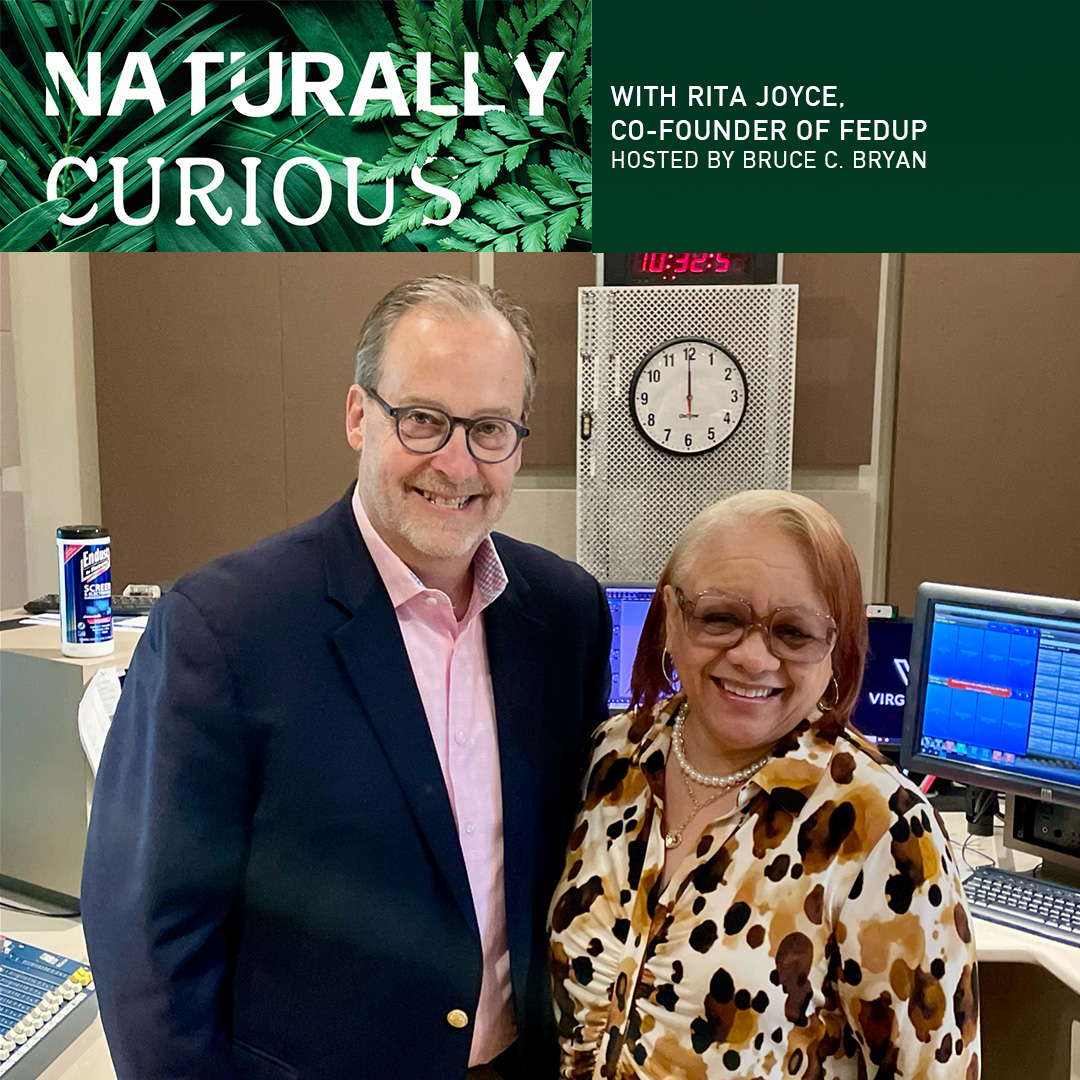
Joyce Segment 1
My guest today, on naturally Curious, has faced the toughest of challenges. She's faced the murder of her son Joey, almost 20 years ago, and turned that horrific tragedy into something positive and helpful for others. I'm Bruce C. Bryan, and I'm honored to spend time today with Rita Joyce. I'm also honored to call her my friend.
Rita has a long and successful career in the banking industry. Currently she's a VP in community development. It beyond that. She's the founder of a nonprofit fed up with gun violence. She stays active in business with her family and helping others with whom she interacts. Many of you may have heard about her story or her story
today. We're going to dig in and get to know the person. Rita Joyce is you'll appreciate hearing from her and learning about her. My interview with Rita Joyce is coming up next on today's episode of Naturally Curious.
Bruce C. Bryan: Thank you for being my guest on the show today, Rita, and welcome.
Rita Joyce: Thank you.
Bruce C. Bryan: So we want to talk about community banking and financial literacy, but I wanna start by being direct and honest. If it weren't for the tragedy that you faced, uh, earlier in your life and that you're overcoming, I'm not sure we'd be doing the interview about all these other topics.
And so I wanted to ask you to tell me a little bit more about Joey Joyce, your son,
Rita Joyce: Joey. Was my baby boy, and he was the baby of the family for 12 years, and then his little sister came. Uh, Joey, you know, he was, he was my challenged child, you know. He was the one that I had to stay on all the time about doing his homework, cleaning up his room, and keeping his hands off his brother's stuff. But he was. A harmless. He played basketball.
Bruce C. Bryan: He was busy.
Rita Joyce: He was busy, busy, busy. And you know, when he walked, when he came into a room, he just had everybody laughing.
That's who my Joey was.
Bruce C. Bryan: So, um, as he got a little bit older, um, it's been pretty well documented. He was, uh, I think, uh, 24 years old when he was murdered. What was happening at the time in his life and in your life, kind of help us understand what, what was going on in the early two thousands for you?
Rita Joyce: You know, Joey, you know, he was still trying to find his way.
He was just 24. He had already started a family, so he had children, four. So he was still trying to find his way. And you know, it's, it's always known that boys take longer to mature.
Bruce C. Bryan: That's right.
Rita Joyce: And, you know, so he, he was, he was just trying to figure it out. He was kind of like a, I
He would be from one place to the other. He, he couldn't stand on the go. Still on the go. Couldn't stand still. And I never knew where he was. You know, I said, where are you? Mm-hmm. What are you doing? What are you doing? Are you okay?
Bruce C. Bryan: Yeah,
Rita Joyce: ma. He called me Ma. Ma, I'm fine. Okay. Just checking in, you know? Yeah.
Because I hear things and I just wanna make sure he was okay. So he wasn't living with me at the time of his death, but I always tried to keep up with him and what he was doing and where he was at.
Bruce C. Bryan: I think any of us that have kids know that there, there are always some children that are, it just. Seemed to have more challenges or in more difficult situations.
Um, and I did, I do know that, um, he was murdered on Herschberger Road. Um, how did you hear the news, Rita?
Rita Joyce: Whew. My sister-in-law called me. I had just transitioned outta my home, was on the market. It was actually had already sold, and I was at my home that Thursday evening, packing up for a final walkthrough and moved most of my stuff, and it was my second or third night in my new place.
So nobody, not a lot of people had my phone number. Of course, that's who we had
Bruce C. Bryan: back when we
Rita Joyce: had homephones, right. And so when the phone rung after two o'clock in the morning, I knew something was going
Bruce C. Bryan: on. Nothing good happens after midnight.
Rita Joyce: Right? Nothing happens. So when my sister-in-law called me, she said, there's been a shooting, and I think Joey was shot.
I don't know anything else. I'm coming to get you.
Bruce C. Bryan: Okay.
Rita Joyce: And she came to get, oh, when she came and got me, I was just nervous wreck. I said, where are we going? She said, going to the hospital. And she had heard that he was taken to. The community hospital. Mm-hmm. Not the Memorial Hospital. And so when, when we got there, the security guard met me outside.
I never forget this security guard. He's not here, but his best friend was sitting on the curb. Ms. Joyce, he's in there. He's in there because a couple of of. People bought him there in their car.
Mm-hmm.
Rita Joyce: He didn't stay on the scene. He ran when he got shot.
Bruce C. Bryan: Gotcha.
Rita Joyce: So when he ran, he jumped in someone's car and uh, Mia told, Mia told me the story later on of her last time with Joey, she said, and it was probably maybe five, seven years later when she saw me at the bank and she said, I just wanna share something with you.
And she told me his last words and what he said. And because he was that. That fun guy. Oh, Joey, you just, you just playing. Stop playing.
Bruce C. Bryan: Mm-hmm.
Rita Joyce: He said, no, I've been shot. Take me to the hospital. And when she told me that, and I said, did he say anything else? She said, no. He just fell over like that. And so she.
Dropped him off at community. You know, I guess they didn't know that was not the trauma house hospital.
Bruce C. Bryan: Right.
Rita Joyce: So by him being at community and that security guard would not let me in, I said, I know my baby's in there. Please let me in. I need to be with him. He said, go to Ronald Memorial.
That's where he's at. By the time I got to Ron Memorial Hospital, he had not gotten there. He drove up in the rescue squad. We were in the emergency room because they were
Bruce C. Bryan: transferring him.
Rita Joyce: They were transferring him because two other people were already there. You know, three people got shot.
Bruce C. Bryan: Gotcha.
Rita Joyce: And so I saw him come in.
I saw him come in. I didn't see his face. They had him covered up. I saw him come in and it was just so traumatizing because that hospital was so full of people. I bet you was over a hundred people in that hospital emergency room. And I just said. I just need to know what's going on. And when I saw the doctors come out and they said, we need to speak to the family of Joey Joyce, I knew it wasn't good.
Bruce C. Bryan: That's, yeah.
Rita Joyce: I knew it wasn't good.
Bruce C. Bryan: You're listening to Naturally Curious. I'm Bruce Bryan. This is Rita Joyce. And she was just telling the story of the 2002 murder of her son, Joey Joyce. Joey Joyce, Sr. Which, um, I've heard you say. Rita that you make it one day at a time and to date, there've been over 8,000 days.
Right? Some are likely much harder than others.
Rita Joyce: Yes.
Bruce C. Bryan: For you, I bet. What powers you through, um, the good and the bad ones. Rita.
Rita Joyce: The good ones are the bloodline he left behind.
Bruce C. Bryan: You see those babies,
Rita Joycethose babies who have now grown up Yeah. And have babies on their own. But just being there with them and making sure that I was a part of their lives, um, staying in touch with them, doing whatever me and my, uh, other children would do to help them along the way.
Mm-hmm. Because mm-hmm. Because they were missing their father.
Bruce C. Bryan: Right.
Rita Joyce: Maybe one of them remembered him, but the other ones were still so young that they don't remember him. But they heard all the stories,
Bruce C. Bryan: heard the stories from you,
Rita Joyce: right.
Mom
Rita Joyce: heard the stories.
Bruce C. Bryan: I'm sorry, right, ma?
Rita Joyce: Yes. Right Ma, yes. Heard those stories.
Bruce C. Bryan: Do your other kids call you MA or do they call you other things?
Rita Joyce: They call me Ma. All right. I don't know where it came from, but they call me Ma.
Bruce C. Bryan: Okay.
Rita Joyce: Yeah.
Bruce C. Bryan: Oh, and what about the bad ones, Rita? How? How? Because here's the thing, when you're talking to. People like right now who are listening. People are in e every different place.
Some are having great days, some are sitting in a corner crying. Listen, listening to this story, how do you make through, make it through the really bad days?
Rita Joyce: Well, it's, it's a, it's a old gospel song that say, my good days outweigh my bad days.
Bruce C. Bryan: Okay.
Rita Joyce: So that helps. But there are bad days. Mm-hmm. And there were a lot of bad days.
A lot of those bad days were. In my own private time, in my moments alone.
Bruce C. Bryan: Mm-hmm.
Rita Joyce: And it probably was maybe five, six years after Joey's death that my real breakdown came.
Bruce C. Bryan: Mm-hmm.
Rita Joyce: And I was a home alone and I just kneeled down in the floor and I just cried. And it was, it was my release. '
Bruce C. Bryan: cause you had to be strong for so many other people, for so many situations.
Rita Joyce: Yes. Wow. And I think that's what I, I didn't even feel my own pain because I felt like I had to be strong for everybody else, and I just kind of, just kind of just kept my pain inside. But that release helped me, and I'm a, I'm a believer, I'm a Christian. I, I believe, and I higher being and that particular day, Bruce.
When I kneeled down in my bedroom beside my nightstand, I opened my drawer and there was a journal that I had been using for years and hadn't, hadn't seen it in a long time. And I'm like, what is this journal? And I opened it up and there was a letter from my Joey that he had written me while he was incarcerated for about 30 days for doing something crazy.
And it was around Easter time and he sent a card and a letter. And in that letter. At the end of that letter, Bruce, it said, ma. I'm okay.
Bruce C. Bryan: Mm.
Rita Joyce: And that was my message that he was letting me know that he was okay.
Bruce C. Bryan: He got it that day.
Rita Joyce: Six years, years
Bruce C. Bryan: later, seven years later.
Rita Joyce: Six years later.
Bruce C. Bryan: Wow.
Rita Joyce: Yes.
Bruce C. Bryan: Well, you're listening to Naturally Curious.
Again, that's Rita Joyce. And I'm Bruce. Bryan. And, and Rita. 15, 20 years later, I don't know the exact date. You saw similar shootings mounting and with the help of friends started fed up for gun violent, fed up with gun violence. Can you talk a little bit about that work and some of the people you work with?
Rita Joyce: Yes. Well, fed up was started because of the loss of Joey and another mother. She lost her son, and I reached out to her and went to the funeral and I knew of the family but didn't know her like personally. But I reached out to her. I handed my business card. I said, please gimme a call. I really want to talk with you and Deborah McGaugh, who named Fed Up.
Okay. She and I just got together and we just started talking and from there we met the Penn Sisters and we got on this radio show with Mac McCadden.
Bruce C. Bryan: Oh, I remember Mack.
Rita Joyce: Yes.
Bruce C. Bryan: The referee official and kind of PA announcer and kind of man about town.
Rita Joyce: Yes. What a
Bruce C. Bryan: good,
Rita Joyce: The NAACP had a, okay, a TA radio, a TV show.
So we ended up on there and that's how we ended up meeting the Penn Sisters and Alita Sap. And so in that parking lot, we said, we got something here. We all are sharing the same thing. Let's, let's do something about this. Let's reach out. Like we have reached out to each other. And that's how Fed UP started.
Bruce C. Bryan: Oh, that is, and so it's organic. Yes. It was out of love and support.
Rita Joyce: Out of love and
Bruce C. Bryan: support. And I said 15, 20, but that happened a while ago. You just formalized things a little bit later. Right? So, yes. So was that. Around what time were you at that or what, you know, what year were you in that interview with Mac?
Rita Joyce: That was in 2005.
Bruce C. Bryan: Oh, it was right, right after. So a couple years
Rita Joyce: after, we were all, I was, Deborah and I were fresh out of our loss.
Bruce C. Bryan: Okay.
Rita Joyce: The pen sisters had happened, uh, before that, but we were fresh out of the loss. And so when. Decided to do this. It was like, oh wow, this is something that we can really reach out and help some other families because it helped us.
Right. So we just started meeting and just kind of collaborating on our loss, telling our stories to each other, and it was a part of our healing to talk about our loved ones. You know, we just kept that going.
Bruce C. Bryan: So you, you've alluded to, but how do you all help families?
Rita Joyce: We help families. First of all,, when when someone is killed, we go to the families, we reach out to 'em either by home visit or we meet 'em at our office or at our grief support meetings, and we talk to them.
We let 'em know what fed up is and what we do, and that we offer a grief support meeting on the fourth Tuesday of every month that they're more than welcome to come because it is a group of people with shared feelings. And a commonality of a loss of a, a loved one. So we go meet 'em at their home and we take a, a sympathy card and we try to help them financially if we are able to, with some of the funeral expenses.
If it's nothing but the opening of the grave or, you know, paying for a cremation. So we do try to help those families that are unable to bury their loved ones.
Bruce C. Bryan: Rita, thank you for sharing a little bit, little bit more about Fed Up and when we come back we're, we're going to talk about June. I know that's usually a special month for you.
Talk some more about Fed up and about community banking, and that'll be coming up after this break with Rita Joyce here on Naturally Curious.
Joyce Segment 2
Bruce C. Bryan: Welcome back, Rita Joyce, we're happy to have you here on Naturally Curious. And, , June is a special month for you, as I alluded to earlier, and orange is a special color. Can, can you tell us a little bit more about what's coming up? Next month?
Rita Joyce: Yes, in June, it's National Gun Violence Awareness Month and it is a really a national entity that does this, and we found it on the website.
So we said we need to implement that as well to acknowledge, you know, every illness, everything has a month, but June is orange. Orange is for gun violence. And it is National Gun Violence Awareness Month. And every June we try to, uh, bring awareness to gun violence as well as, uh, make sure that we honor the loved ones that were lost within the last year,
So we do that every June. And you know, we had our 20th year gala last year, uh, You know, we, we. May not have been 5 0 1 C3 for 20 years around.
Bruce C. Bryan: But you were around
Rita Joyce: helping people
Bruce C. Bryan: for 20 years. Yes. Which is what's most important. Yes. When in June is the, uh, is the event, have you settled that yet?
Rita Joyce: It's always the first weekend in June.
Bruce C. Bryan: First weekend in June. And where will it be this year?
Rita Joyce: Well, this year we're not doing a gala.
Bruce C. Bryan: Right. Thank goodness.
Rita Joyce: Oh, yes.
Bruce C. Bryan: But you do have a a, a breakfast or an event of some sort, right?
Rita Joyce: Yes. We have a breakfast. We have not set the place yet,
I think still at Refreshing Church like we did last year.
Bruce C. Bryan: Okay. So. It. Looking these families in the eye after the murder of their father or daughter or brother or sister has to be really difficult and probably bring up some thoughts and memories for you.
How do, how do you and the other leaders of, of fed up manage that?
Rita Joyce: For me personally, when it's a mother that lost their child. That's when it hits home to me
Bruce C. Bryan: for sure.
Rita Joyce: That's when the, the, the feelings and all that comes to surface because I actually know how that mother must feel to have lost someone that you gave birth to and whether they live for 24, 44, 50 years, they are still your child.
You know, they always be your child. So that's, that's where it, to me, it impacts me the most. But all of the families that have experienced that loss, when we, we just there to embrace them, to let 'em know that they are not alone in this walk
Bruce C. Bryan: and you sort of can help them for what might be coming next because you've been through the journey that.
Hopefully nobody has to experience twice, but that you've at least been through, so you can help them figure out what's next in some ways
Rita Joyce: . The court, the court hearings
Bruce C. Bryan: mm-hmm.
Rita Joyce: We, we get those resources in front of them so they understand what the next steps would be and how to handle those,
Bruce C. Bryan: and the need doesn't let up.
Gun violence is, we could do a whole show on that and we might come back and do one of those if that's a, an option for us. But I, I did want to just share with you, and I think you know this, but it, it, it's close to home. Close to home for me as well. My bonus son is Lee Anthony Gates and his father, um, Edward Lee, Anthony Gates senior was, was murdered in his home nearly three years ago.
And, and you helped the woman LA calls Granny.
Rita Joyce: Yes.
Bruce C. Bryan: And there are so many grannies that your team has helped through the years,
Rita Joyce: Deborah is dear. She comes to the grief meetings and I love Deborah. She's passionate and fed up, has really helped her to get through some really, really bad times.
Bruce C. Bryan: This is continuing to be a heavy topic, but I know there are people that have helped you as well.
You're helping others and people help you. Who are some people that have helped you, Rita, on your journey?
Rita Joyce: Ooh, well, you know, I've had my, my pastor, um. You
Bruce C. Bryan: can shout 'em out.
Rita Joyce: Okay. My Pastor Dowell from Shiloh Baptist Church, uh, but he was not my pastor. When my son was killed, uh uh, pastor Charles Hash was my pastor and that, that hash family helped me so much during that trying time.
Mm. They were there. They opened up their voices to sing. They opened up the church to make sure we had repass, so they were a huge support and you know, so having that. Relationship with the church is very helpful. I would just say that. And you know, in my family, you know, we don't talk much about it anymore, but I know they always got my back.
Bruce C. Bryan: Mm-hmm.
Rita Joyce: And everything we do for fed up, they are there to support.
Bruce C. Bryan: That's awesome. And, and it's so good when your, your team, your people have your back. I also know, um, you're listening to you naturally curious. I'm Bruce Bryan. This is Rita Joyce. She's, uh. A VP for community development for Bank of Botetourt
She's also the founder of, um, fed up for Gun with gun violence, and we've been talking about a whole bunch of things related with fed up and gun violence in June. Is gun violence victim awareness month? Did I get that right?
Rita Joyce: Gun violence awareness
Bruce C. Bryan: month awareness mark. Mm-hmm. Um. I also know, Rita, that affirmations are an important part.
I know you didn't invent those, but it's something you're invested in. Can you tell me why a little bit?
Rita Joyce: Oh, I'm a firm believer of affirmations, what I do when I teach financial classes, of course it's reach one, teach one. I come up with the new one this year.
Bruce C. Bryan: Okay.
Rita Joyce: You know, we going to, we gonna s strive to thrive.
Okay. You know, so, uh, you know, we are gonna just move to thriving instead of surviving, We've been a, a cultural of surviving. So let's thrive then let's
Bruce C. Bryan: move to thrive. Yes. I love that. Well, if you stick around for the bonus cut coverage, everyone, I'm a little, little preview.
I'm gonna ask Rita to share her affirmation if you're willing to do that, Rita. So we'll see how that goes. But, um, I know role modeling is really important for you and I know you're a role model for other people. Um. You're building into young people now with the community banking work that you're doing and the financial literacy work that you're doing.
Talk a little bit about both the role models that have helped you, but more specifically about the people that you're kind of looking after, especially on the financial side of things.
Rita Joyce: Well. Again, I believe that financial literacy, financial education is a, a subject that people tend to not to make it a priority,
Bruce C. Bryan: you don't wanna think about it,
Rita Joyce: right?
Yeah. You don't wanna think about it. You say, if I don't think about it, I just don't have to worry about it. But I think it's something that needs to be implanted. In certain communities that I think are lacking the education. So, you know, if you don't know, then you don't know how to do better. So knowledge is very powerful.
So I'm always trying to reach one, teach one a mentality to say, you know, if I can just help one person along the way. Then my work is not in vain.
Bruce C. Bryan: No, that is awesome. And I know you're helping more than one. Recently you had four sessions of 40 minutes each at a high school. So I know that you're out in the community sharing that message.
Alright, so reach one, teach one, and then the new one that you have, tell me again, is strive to thrive. Yes, I love that. Yes. So I like to ask other people about, my guests read it even when I know 'em myself. Like I know you and here's some things people said about you. You ready? Rita is a spark plug. She has enormous heart for helping people. Her passion shows up in her work, her friendships, and the connection she makes in the heart of a community. I'm proud to call her a friend and a colleague, somebody else said she's passionate, resilient, committed to bettering people's lives.
And that was from another banker, by the way. Oh, how about that competitor? The other person I talked to said she's an uplifting voice who makes life better for people. This person was grateful for considering you to be their lifelong friend. So that's the kinda stuff people are saying about you. Does any of that resonate or, or kind of bubble up in your mind?
Read as you hear it.
Rita Joyce: Oh, you know, you always wanna know what people think about you, and sometimes people don't even know what you think about 'em. Until you're gone.
Bruce C. Bryan: Mm-hmm.
Rita Joyce: And then they are saying it at your funeral.
Bruce C. Bryan: Right. Little late for you to hear it.
Rita Joyce: Then night, little late for me to hear it. So, you know, I hope that when I hit the floor in the morning that I'm making a difference.
That's all I wanna do is make a difference. I think that if we are not out here trying to do our best, be our best self. 'cause when you can be your best self, you can always help someone else. Do I get it right all the time? No Bruce. But I'm gonna ascribe to thrive and do the best I can. And like I said, if I can help someone along the way, then my work is not in vain.
Bruce C. Bryan: Well you are definitely thriving and it's impressive Rita. And you know, it's a journey. We're never arriving, but we're arrived, but we're always working on arriving. You're listening to Naturally Curious. That's, uh, Rita Joyce. Uh, she's with the bank of botetourt, top and fed up with gun violence. I'm Bruce Bryan, your host of Naturally Curious and.
Um, Rita, I was curious if people are struggling financially, what kind of resources are out there for them that they might not even know exist?
Rita Joyce: There are always resources, you know, at the Melrose Plaza, which is where I'm located.
Bruce C. Bryan: Okay.
Rita Joyce: Um, always offering, we call 'em Bob Fundamentals and that's Bank of Botetourt Fundamentals. I've done a credit 1 0 1 class. I've done an investment class. I've done a fraud identity theft class, so we are always doing those classes to bring knowledge to the community. I got a first time at home buyer class coming up April 25th and just being out there, I go to villages at Lincoln and teach their after school program.
Oh, that's
Bruce C. Bryan: Oh, that's great.
Rita Joyce: Just whatever needs to be done, you know, if I can just teach 'em a little bit. Something about financial education may not seek in right away. But it
Bruce C. Bryan: eventually does
Rita Joyce: Right? Hope. Eventually it does.
Bruce C. Bryan: Maybe, uh, big Jim and I can get one of your cards.
Rita Joyce: Yes.
Bruce C. Bryan: Uh, you can maybe help us. So what kind of counsel do you give people trying to dig out of debt or to buy their first home?
Um, what kind of, uh, wisdom do you give them?
Rita Joyce: Well, first of all, you, you, you got to start with the budget. You.
Bruce C. Bryan: That's no fun. Rita
Rita Joyce: No it's not. It's boring.
Bruce C. Bryan: Why are you making us do this hard work?
Rita joyce: But it's your GPS.
Bruce C. Bryan: That's right.
Rita Joyce: It is your lifeline. If you don't know where you got to start, so if you don't know, have a direction of where you're going, guess what?
You're gonna get lost. And there's nothing worse than getting lost financially. So you having a budget definitely helps. And I sit down one-on-one counseling and I go over their debt and I say, what is it about credit you don't understand? Don't you know when you borrow money, you pay it back?
Bruce C. Bryan: So here's the thing, thank you for the advice and the reminder.
As we wrap up, I just have to say there's so many questions I didn't get to, so y'all are gonna wanna stick around for the bonus coverage on this episode. Rita Joyce, Thank you for being my guest on Naturally Curious this week to listen back to the show, to hear the full interview and links to more about her, about fed up with gun violence and this financial literacy information.
Search naturally curious@radioiq.org. Naturally Curious was produced and edited by Big Jim Shively and recorded at WVTF Radio IQ Studios. I'm Bruce Bryan. Thank you for listening
Joyce Bonus Content
Bruce C. Bryan: I'm really glad you stuck around as I continue my conversation with Rita Joyce, I'm Bruce Bryan. This is naturally curious, Rita. I think that it seems to me people who help others often receive a lot of goodness and blessing for their investment. Um, that sounds like it's the case for you. Can you, can you talk about how giving feels for you personally?
Rita Joyce: Well, first of all, I think all it was was put on this earth to be servants. You had to have a servitude mentality. I always say, you know, do not just always looking for help. Be a help. So reach out and help someone. Then your help will always come. So I'm, I'm just big on servant. Being a servant to the community, to the people that I'm around, that gives me the best.
Joy in my life.
Bruce C. Bryan: It lasts for you, right?
Rita Joyce: It lasts
Bruce C. Bryan: and it kind of, it kind of spills over into other parts of your life.
Rita Joyce: Yes. Yes.
Bruce C. Bryan: Do you reflect back on how that giving feel? And I don't think I, I know you well enough to know you're not giving to get, but I think you, you acknowledged it when you give, you do get.
Do you see that that's still the case, um, in your leadership positions, both at work and with the way you invest at church and in volunteer time?
Rita Joyce: Yeah. Given should not ever be, it's not a, a a, a selfish act. It's, it's, it should come natural.
Bruce C. Bryan: Mm-hmm. And
Rita Joyce: when it comes natural, it comes back seven times.
10 times. So. Sometime I say, well, why did, why did that happen to me? Then I think about it. I said, well, look at all what you've done. So I have to take that with grace and not think that I'm not deserving of it. I don't look for it. So when it comes, it's like, wow, did that just happen?
Bruce C. Bryan: You have to receive it.
Did I just that which is receiving it as hard.
Rita Joyce: It's very hard.
Bruce C. Bryan: Somebody, um, bought dinner for my wife and me the other week and we were not expecting it. It was done. It was a surprise. They had already left the restaurant and I was like, what in the world? What? Just, and you had to just accept it. You have to, they were to, they were gone and they, you know, it was like, what?
It's hard to receive someone's, like you said, we don't feel worthy. Right.
Rita Joyce: Right. And a lot of people think giving is monetary givingness of your time. You know, giving of your love.
Bruce C. Bryan: Mm-hmm.
Rita Joyce: Giving of your heart.
Bruce C. Bryan: That's right.
Rita Joyce: So those things, you don't have to, it's not hard, but when you do it, it just has a, such a release.
I can't explain it exactly, but it's a release of, of satisfaction that you actually lend yourself to something or someone that benefited from it.
Rita Joyce: That's the difference.
Bruce C. Bryan: I think one of the things that's interesting, interesting to me as I track your profession, I, I don't know exactly how long I, I've known you, but as I've watched over the last decade or so.
E, every part of your life, you're giving a little bit. And it all started in Bassett, Virginia. Bassett. Huh?
Rita Joyce: Bassett.
Bruce C. Bryan: Come on now, Virginia. Now let's talk about Bassett.
Rita Joyce: Born and bred. Okay.
Bruce C. Bryan: Bassett
Bruce C. Bryan: you're this far in and you're listening Bassett, you can't spell basketball without Bassett.
Rita Joyce: That's right.
Bruce C. Bryan: And we're gonna talk about hoops in a little bit, but recently, I know. Um. You were nominated and even featured on the Remarkable Women Campaign on WFXR, which is a national campaign, uh, that is being done there. Um, that had to feel pretty good, even though I know you don't like to give credit to yourself, but that had to felt pretty nice to have that happen.
Rita Joyce: It was, and it was a, a banker, uh, it works for another bank. He said, I'm nominated you. I said, you did what? And
Bruce C. Bryan: he might have been the one that I quoted.
Rita Joyce: It could have been. And I was, I was really surprised at it. And so. When I got the call and said that you were the top five, so we are gonna interview you.
And I'm like, what? So, you know, it just comes, when it comes like that, the, the overflow of it, it's, it's really sometime overwhelming 'cause. I said, I don't wanna be on TV again. Again, everybody said, I saw you again on tv. And I, when they say it sometime, I say, are they being smart or arrogant when they say it?
Or are they really great that you know, please that they see me? I don't know how to take it Bruce
Bruce C. Bryan: I think they're encouraging you, Rita, because, um, I, I think people know your heart. Just like we started out this bonus segment talking about, um. Have there been other recent, not to make you more uncomfortable, but have there been other recent recognitions too?
Things that I might not have seen or caught up with? Or is that, is that remarkable women? Kind of the, the,
Rita Joyce: well, two years ago I was the, you know, Roanoke Regional Chamber, uh, Athen Award
Bruce C. Bryan: yes. The Athena Ward.
Rita Joyce: That was a shocker.
Bruce C. Bryan: Yeah, that was incredible. Yes. Um, I was there that day. Yes. I think Nancy, um, ag spoke Ag Yes.
And that was a, a powerful day. I, I don't, like you said earlier, I don't think you do that to get recognition, but I think you can embrace it because your heart is, is a good one and it's a pure one. Um, you've done a lot of local news interviews. Um, what. Like a lot of them. I know that. Yes. And, and it's usually I'm friends with Jill Harrington also, and she's done a lot too, for different reasons with, but um, what's that like, have you gotten used to those, like a look behind the curtain?
Have you gotten used to those TV interviews?
Rita Joyce: No.
Bruce C. Bryan: Okay.
Rita Joyce: And if you don't get nervous, then you're too much for yourself. And I never wanna feel that way. I'm always nervous. Even coming here this morning, Bruce. I was nervous,
Bruce C. Bryan: so. All right. And now that you're comfortable, what's the strangest thing that's happened to you while you're being interviewed by the media?
Anything that was unusual or. Or maybe a an odd question or a weird question besides today, like, I specialize in weird questions, but besides these questions today, anything that kind of caught you off guard during all those experiences?
Rita Joyce: Well, you know, I've done some live, we are live with, you know, one of the TV stations and we are live, live,
Bruce C. Bryan: live, live,
Rita Joyce: live.
And you know, those are always very nervous because they don't tell you and they don't prep you, what they're gonna ask you. So it's like. What did I just say? And I go back and look at it like, oh my God, I should have never said that. So
Bruce C. Bryan: you're 20 years into it now, and you know your way, but the, the advice I would give you is answer the question you want to answer, not the question they ask you.
How's that, that part, that's the tip. So if you're listening in, you're 30 some minutes in. That's the key is to answer the questions you want to answer, except on this show, and, and don't answer the ones they ask you. So we knew each other at least three ways, and that's a Roanoke thing, but it's also wherever you live thing.
Uh, we talk a lot about how our listeners could be all over the world because, you know, uh, w vtf.org, uh, website. But also, um, the, the footprint of the station's really big. So this is not a Roanoke thing, this is a life thing. So we knew each other through, fed up. We know each other through the chambers and whatnot.
Through basketball, through Bridget and Tay. Through Tony and Dom. Yes. So, um, how else could we possibly be connected?
Rita Joyce: Ooh. Wow.
Bruce C. Bryan: I don't know.
Rita Joyce: I don't neither.
Bruce C. Bryan: So tell everybody about, uh, a little bit about basketball, about the rest of your family that you might wanna share.
Rita Joyce: Oh yeah. You know, I, my kids were always in sports, you know, I, even at Bassett, I was a cheerleader and ran track.
Uh, but my sons were involved with Coach Joe Gaither and Coach Paul Creedy, Paul Moyer in basketball with Inner City Athletic Association. So they were always into basketball and I was always at the game. I was one of the moms that you. When, where were they going? I was always there, traveled with them. So being a part of, of that family and being a part of.
My children being involved was just, to me, that was rewarding to me because I wanted to do whatever I could for my sons. Uh, that was before my daughter was born, my sons, because I wanted to keep him off the streets and outta trouble. And when you have mentors like Coach Joe Gaither and he's something all Mo.
Uh, raising your boys helping. That's right. That was a lot.
Bruce C. Bryan: Maybe you could help me. I'd love to talk to Coach Joe sometime. Yes, because we go
Rita Joyce: to church together.
Bruce C. Bryan: Okay. Well, tell him I was asking about him and I'd love for him to be a guest and tell him it's not as bad as you might think it is.
Rita Joyce: Okay.
Bruce C. Bryan: Coach Joe took care of Shannon.
Yes. Who married your daughter, Bridget?
Rita Joyce: My, my niece.
Bruce C. Bryan: Niece. That's your niece. Uhhuh. And, um, and her daughter Tay. Played at Wake Forest. Wake Forest. Forest. Mm-hmm. And then Tony, um, that's, that's your son? That's my
Rita Joyce: son.
Bruce C. Bryan: Right. And Tony's son and my son played basketball together at Patrick Henry. So we, we, I got to know Tony pretty well through those couple of years of cheering our sons on basketball.
Mom, basketball Dad,
Rita Joyce: how about that
Bruce C. Bryan: Man, it is. Now I've got some grandkids that are moving up into the basketball granddad phase. So do you still get to go to some games of nieces and nephews and grandkids and stuff?
Rita Joyce: You know, believe it or not, I cannot believe that most of my grandchildren, the were the ones that are grown now, went to Doms and you, vte they played.
But get back to Tony, you know, he was on that championship team at Roanoke Catholic. He was the quarterback. Okay. Coach Cook. Okay. That won 12 and oh, they went. Uh, they didn't lose one game that year and they won the state championship for the V, the Virginia Independent League. But my grandsons, Dom and Devonte both played, and Devonte and Tay were both on the Salem Championship team.
Don't get me, ask me what year? 'cause that's, I can't go back that
Bruce C. Bryan: far. Yeah, yeah, yeah.
Rita Joyce: So that basketball and, you know, sports. Football, all that. I'm, I'm a fanatic with it.
Bruce C. Bryan: Yes. It's so different when it's your own kids. Yes. I would be Laurel, my wife gives me a lollipop sometimes when the, I can watch a game and I'm usually okay, but when my own son's playing or LA was playing, I was, I was not always the best example.
Right. And so she started giving me a Tootsie roll so that I could like, okay, this is her way of saying you go be quiet. So I don't know what kind of basketball, mom and grandma and aunt you are, but maybe you could do, maybe you do better than I did. Um, tell me what you love about being in this part of Virginia.
You've been here most of your life, right?
Rita Joyce: Yeah, I've been in Roanoke, um, since I graduated from high school. So I came to Roanoke at 17 years old, right outta high school. Went to National Business College and just kind of really just didn't wanna go back to Bassett. Um, and I was tired of the country life and mm-hmm.
And I just, I thought Roanoke was a big city. Now, of course it's not. When I came here, I said it, whoa, it's a big city. And I just, my roots are here. Now. Everything that I've done in my whole adult life has been right here in Roanoke. I love Rooke, Rooke and the mountains and, and then we, the valley, we have so much to be thankful for in Roanoke and you know, people shed a light on some of the bad things, but it's so many good things that Roanoke offers that raising a family.
And it may not be the fast life, but. For me, I don't need that fast life. I like it just where it is.
Bruce C. Bryan: Right where it is.
Rita Joyce: Yes.
Bruce C. Bryan: That could be the, that could be the tagline for the city. Right? Just where it is.
Rita Joyce: Just where it is.
Bruce C. Bryan: So, Rita, as we kind of wrap things up, I wondered if you had any parting thoughts or guidance or wisdom for people who are listening and we lifted them up a little bit, but maybe they're facing some challenges.
Like what kind of encouragement would you have for, for other people right now?
Rita Joyce: Well, you know, I'm a firm, a believer. First of all, look at the woman or man in the mirror. Take a good look at yourself, reexamine yourself and find out what is it that I can do to be a better person in my community. My family and in the world, what can you do differently that can make a difference?
And all we need to do is just one person. One person at a time, one day at a time, one month, one year. But do something just to make a difference. And I will tell you I'm a firm believer and I know it for a fact that it would make you such a better person.
Bruce C. Bryan: Thanks again for being my guest, Rita Joyce.