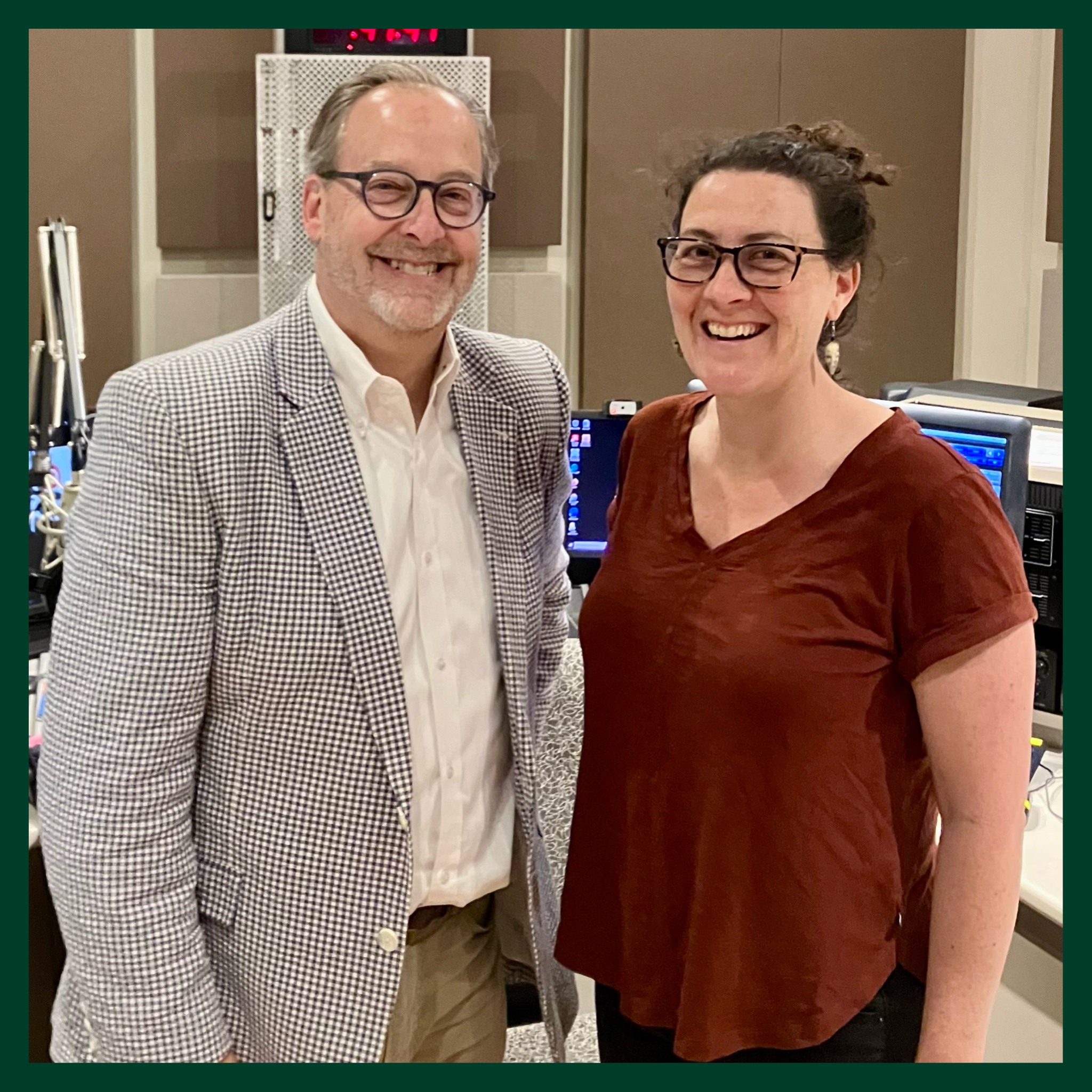
Bruce C. Bryan: My guest today on Naturally Curious is Maureen Best. The long and big name for LEAP is the Local Environmental Agriculture Project, and they're standing in the food gap. The work this organization does in Virginia is far-reaching and has a mix of layers and audiences. During today's interview, we'll discuss farmers markets, agritourism, access to fresh food, and how LEAP connects people with local food sources.
In the process, you'll get to know a gifted and steady leader who remains at the forefront of all things food. Food gets listed before clothing and shelter, so we know its importance. On today's episode, you'll be impressed when you hear about Maureen Best's background, her involvement in the food community, and as you learn all about LEAP.
Join me for my conversation with LEAP's Maureen Best, coming up next on today's episode of Naturally Curious.
Best Segment 1
Bruce C. Bryan: Maureen, thank you for being my guest on the show, and welcome.
Maureen Best: Thanks for having me.
Bruce C. Bryan: So people hear a lot about food, things like farm to table, and organic, and food deserts, and farmer's markets. And during this interview, we're gonna talk about all of that. But start with that kind of 30,000 foot view.
What are the biggest things that LEAP does?
Maureen Best: That's a great question. Since we do work across the whole food system, it can be overwhelming to talk about all of the different parts of food, especially 'cause, um, as a culture, we don't really think about the big picture of food. Um, so with LEAP, we really focus on three parts of it.
We look at food access. How can people l- get food easily? How can they afford it? And then how can we help also make sure that it's food that's, uh, culturally appropriate or the food that people want to eat? So that's our food access bucket. And then we also work on the farmer side, so supporting farmers so that farmers who are in our community and our region can choose year over year to continue to grow for our community.
And so we look at farmer viability, what are fair prices of food, and how can we support them so that they- their businesses thrive. And then our third big area is community. So what does it look like to have community support for local food? How do we have spaces where people feel comfortable exploring new foods, talking to people about recipes, getting to know their farmers, and farmers to have direct connections with the amazing people who are choosing to purchase and eat and enjoy the food that they're growing.
Bruce C. Bryan: It feels like you might have done this once or twice, right? Uh, b- to be able to describe all that. Tell me... Tell us a little bit more about what, what else does LEAP do?
Maureen Best: Yeah, so within the food access space and farmers space, we operate fixed-site farmers markets that bring together farmers and consumers and build community.
So since 2009, LEAP has been running the Grandin Village Farmers Market that is behind the Roanoke Natural Foods Co-op. And the Grandin Village Farmers Market was originally a project of the co-op. People approached the co-op and said, "Hey, we'd like... You all support local food and farmers. We'd like additional ways to, to access that food."
And so LEAP grew out of the Grandin Village Farmers Market. And then we also have the West End Farmers Market, which is on Patterson, Patterson and 10th, or Patterson and 11th, between those two. And, uh, we have a mobile farmers market where we purchase the food directly from farmers and then, um, well-
Bruce C. Bryan: Kind of make stops around town, right?
Maureen Best: We make stops yep. So we're year-round now because the low-income seniors that we serve, we used to just be seasonal, and they said, "Hey, our needs are the same in the winter." So in conversation and in community with a lot of our regular stops, like Mallory Towers, um, we have built out what we purchase, what we sell, what we move, and our schedule.
So we are year-round. We, uh, focus on a lot of, um, specific, like, h- higher density, um-
Bruce C. Bryan: Parts of town
Maureen Best: sort of Parts of town or like neighborhood or complexes, so apartment complexes where there are a lot of immigrants and refugees, and then a lot of senior housing. And, um, it's really so people who have a harder time, maybe they don't have regular access to a vehicle, uh, so that they can have consistent regular access to food that, that nourishes them.
Bruce C. Bryan: So it's really interesting. You're listening to Naturally Curious. I'm Bruce Bryan, your host. This is Maureen Best. She's the executive director, is that right, of LEAP? And you just described in your overview of the farmers market that there's one that gets set up every week, one where you take the food to people, and one that's fixed in a fixed location.
So, um, you really are, are doing it in a variety of ways. Not asking you to be an expert on what's happening all around the state, but are there organizations like LEAP that are happening throughout our listening area, which is, uh, pretty broad, two, three-hour in any direction?
Maureen Best: Yeah, that's a great question, and it's something that we get asked a lot, uh, because people see our work and they say, "Oh, is there another LEAP?"
And the answer is no. However, there are lots of different organizations who are working really closely in community and working with the strengths and the needs of their community to build, uh, programs and projects and relationships and networks. So Project Grows is in the S- Stanton/Waynesboro area. Uh, and they have a mobile market, and they have...
They focus also... They have a farm, so they're growing food, and then they- Okay ... also work ASD, Appalachian Sustainable Development. It's out towards Abington, and they work all the way up towards Pulaski. So they have a food hub that's pretty big, like, like LEAP does also, and they do a lot of farmer support work.
So there are a lot of, I would call them partner organizations across the state. We have strong relationships, and everyone looks a little bit different 'cause they're all reflections of the needs and strengths of the community. So I think that's, that's great that we can share and learn, and also, um, they're all different because every community's different.
Bruce C. Bryan: Every little locality has its own intricacies. I f- I feel like, you know, Maureen, I've been doing this now for about a half a year, and I feel like this would be a great time if we had listeners calling in because- ... you know, it would be great, uh, in some ways. When you described all the things you do, I thought of about 50 different questions, and I can't imagine somebody listening to this show thinking, "Well, I hope we're gonna get to talk about farmers."
And yes, we will. And I hope we're gonna talk about food de- And we're going to talk about all those things, but to me, it's just so fascinating. You've been at LEAP, I think, for maybe around a decade and in- Mm-hmm ... in charge for the last five or six years, right? Um, can you talk, can you talk a little bit about what you did before that?
Maureen Best: Sure. So I Went to North Carolina State University and lo- uh, studied high school agriculture. So I taught high school agriculture in Raleigh for a couple of years and worked with FFA and, uh, students. And then from there I worked with migrant high school youth. I've always been really interested in agriculture and food and the people who are, uh, interacting with the food from all the sides of the food system.
So I worked with migrant high school youth, so kids whose parents are moving to work in the fields, and it was in Colorado, so it was a lot of meat packing- Okay ... and sugar beets. And from there I went and got my master's in anthropology at Colorado State University and looked at local food and economic viability of local food systems.
And then I spent a couple years at Boulder County Public Health in food safety and food re- restaurant inspections. And from there, uh, my husband and I moved to Roanoke. And so I just reached out to LEAP online in 2013, and, uh, was, um, brought on as the first paid staff, and have been slowly growing and learning and building and shifting and changing ever since.
Bruce C. Bryan: That is a fascinating career. And it's also interesting how all your different backgrounds, if you will, fit into what you're doing now. That has to be kind of fulfilling. And, and Big Jim gets to listen to all these, and hopefully you're at home listening as well, or in your car, and you hear. That's kind of a theme that seems to fall with a lot of people that I'm talking to.
Do you kinda feel like you're in the right place right now, without putting words in your mouth?
Maureen Best: Yeah, I do. I feel like every day is a little bit different, and I really enjoy looking at food from a systems perspective, stepping back, what are all the big picture scale, you know, 30,000-foot sc- scale, and then also the tiny, tiny details.
And I'm really thankful and fortunate to have great partners statewide, regionally, in the community, and amazing team, because it is a lot, and, uh, definitely no one person can do anyth- all of it.
Bruce C. Bryan: So we, we heard how you describe the LEAP from a high level, and then it sounds like you're also very interested in some of the intricate parts of it.
And I, I do love that mix. You're listening to Naturally Curious, and I'm Bruce Bryan, your host. This is Maureen Best, the executive director of LEAP.
And Maureen, I was curious about how LEAP is run, and h- like, how you're funded, how it's run. How does the magic over there happen?
Maureen Best: Yeah, a lot of what we do is behind the scenes, I would say. Uh, we have earned income, so that is maybe somewhat atypical for a nonprofit. So we really strive for a third of earned income, and a third grants, and a third community support.
And when we first started, it was much heavier on the grants. If you know anything about the nonprofit world right now and grant funding, it's really, really hard. It's getting tighter and tighter, and there's more and more need in the community. Uh, and so we are fortunate that we have that diversity of support, and we can provide...
You know, we can focus more on our earned income 'cause w- you know, we have business, um, models built into it.
Bruce C. Bryan: Where there's revenue coming in- Yep ... because of the markets and-
Maureen Best: Yep ...
Bruce C. Bryan: and the f- the, the, the farm transactions, the- Yep ... field transactions and all that. Yep. It makes perfect sense. Are other regions or other parts of the state seeing what you're doing and tapping into it?
Or are they... You, you know, is there curiosity about what's going so well at LEAP?
Maureen Best: Yeah, there definitely is. I get a number of requests Every month, just, "Hey, can you tell me more about what's going on? What does this look like? Could we do something similar?" And I love sharing what we've learned and supporting other people on their own journey to really work in partnership with the community and with farmers.
And one thing that is, maybe it's not atypical, but it seems like it's atypical for, for the Roanoke region, LEAP, in addition to our local work, we also co-founded Virginia Fresh Match, which is the statewide network of i- farmers markets, farm stands, mobile markets, and independent grocery stores that accept SNAP and then provide the matching funding.
So if somebody has a dollar to spend on their SNAP EBT, then if it's a Virginia Fresh Match outlet, then they have $2, um, with the second one for fruits and vegetables. So LEAP co-founded that, and we continue to be the fiscal sponsor for Virginia Fresh Match. And so that means that we're managing the, the funds, uh, for over 150 different outlets across the state.
Bruce C. Bryan: Wow. And you're directly kinda, uh, supporting and, and making sure that goes, that goes well. Um, the Fresh Match related to SNAP and EBT, could you just even go back an, a, a step and explain what SNAP is? 'Cause people might have read about it in the news but might not know about
Maureen Best: it. Absolutely. Yeah, so SNAP is the Supplemental Nutrition Assistance Program.
Some people still refer to it as food stamps. It is designed to be supplemental assistance for people who have, meet specific income, uh, requirements. And for most people who participate in SNAP, it is their full food budget. And so during COVID, there was a big increase in SNAP, uh, amounts. Uh, in the past year, those, uh, it, the amounts are, have decreased for SNAP, and there's a lot of uncertainty for what that looks like.
There's a lot of concern and fear in the community right now about food and how people will continue to be able to purchase food, or if they can't afford to purchase it, what are their options? And so what are called nutrition incentives, like Virginia Fresh Match, they help stretch the dollars that people do have.
So for seniors, most seniors, they only have 12 to $16 in SNAP a month. So it's not very much. And, um-
Bruce C. Bryan: It's gotta stretch a long
Maureen Best: way ... it has to stretch a long way. So for a lot of the seniors that we serve on the mobile market, we have s- senior vouchers that gives them-
Bruce C. Bryan: To stretch it a little bit.
Maureen Best: Yeah. We have some- Brilliant
initial funding, and then they can also stretch it with the funding they have available.
Bruce C. Bryan: When we come back, I'd like to talk more about LEAP and the programs and some of the challenges you just described. I, I'm also hoping to talk a little bit about your work as a leader and draw some infor- uh, some inspiration for people about the work that you do at LEAP.
Best Segment 2
Bruce C. Bryan: Welcome back to Naturally Curious. Maureen Best, glad again that you're here in the studio with us today. Were there some things about LEAP you wanted to share e- right before the break, other programs you're involved with, maybe some of the farmer support stuff?
Maureen Best: Yeah. Thanks for asking. So in addition to the fixed-site farmers' markets and the mobile market, we also have a store that we opened almost two years ago now at our, at the LEAP Hub location on Patterson, and so that's been a really nice way to provide an additional access point for anybody.
Anybody can shop at any of the locations. And then we also have a farm share where we purchase directly from, uh, um, about 50 farmers, and we aggregate it, and then community members purchase it. At the beginning of the season, they get a share all season long. And-
Bruce C. Bryan: And then each week they get food.
Maureen Best: Yep.
Bruce C. Bryan: Right?
Maureen Best: Yep.
Bruce C. Bryan: And, uh, people are talking about food deserts and the, the lack of access to fresh food. I know it's a big concern for you that you end up addressing a lot. Is, is... What's LEAP doing to help in those kind of situations?
Maureen Best: So we work in really close partnership with community, regional, and we also do statewide and federal advocacy around food access.
Food access is complex, and so there is no single solution to any of these challenges. And so we have been a big supporter of the Market on Melrose, and, you know, the community wanted a full-service grocery store there. What could we do to support it? We're not gonna operate a full-service grocery store in that location.
It, and, um, we work in partnership. So Market on Melrose and the Roanoke Co-Op, Salem Farmers Market, Downtown Farmers Market, they're all Virginia Fresh Match partners, and so we've really helped facilitate those relationships, build that up so that people have a wide, uh, range of choices 'cause no one thing works for everybody.
So we really wanna have a diversity of options around food access, and then also a diversity of options for farmers. So we work with farmers directly at farmers' markets where they come, and they sell. We also purchase wholesale for the farm share and the mobile market and the store. And then, uh, we also do, we connect a lot of farmers to each other or to other buyers, so we do a lot of relationship connections and building.
Bruce C. Bryan: So a lot of ways that provides kind of the foundational support for growers and farmers and purveyors, whatever they might be called, right? Yeah. And so that, that obviously helps with the food cycle. Um, and when you're, when you're talking about these local food sources, one of the things that seems to be bubbling up around the country is agritourism.
Is that happening in Southwest Virginia also?
Maureen Best: Yeah. It is. And one thing that we have been working with... So LEAP also co-founded over about 10 years of relationship building, and co-founded and continues to be the fiscal sponsor for the Roanoke Food Shed Network, and they just launched an amazing website.
It's Roanoke Food and Farm Trail. And that was years in the making. Uh, and so on the Roanoke Food and Farm Trail, farmers list their locations, their stores, if they have agritourism, where they sell to, and then anyone in the region can just go to Roanoke Food and Farm Trail, and they can, um, find options that work for them.
So the RFN is working with the, um, tourism to help promote, um, options. Uh, Roanoke is really well known for the outside and our outside amenities, and that includes food and farming, and just trying to make some of those links a little bit more explicit.
Bruce C. Bryan: Well, you're listening to Naturally Curious. I'm Bruce Bryan.
This is Maureen Best, and we're talking about food, one of my favorite subjects. And I'm not trying to get you in trouble, but I was wondering what you like to buy at the farmers markets.
Maureen Best: I really just wander around and pick a little bit of everything, and then I take it home, and I figure out what to make from it.
What
Bruce C. Bryan: What you're gonna do next.
Maureen Best: Yeah. So I'm not a meal planner in that way. Uh, so I, whatever looks good, and if I wake up early, then I'll get different things than if I come a little bit later. But-
Bruce C. Bryan: You get what's there.
Maureen Best: Yeah.
Bruce C. Bryan: Um, and where do you and your family like to go out to eat? I'm just curious.
Maureen Best: Yeah. So we really love Bloom.
Uh, we've worked with Nate for years, and he has supported farmers and, you know, his parents were one of the first farmers market vendors at Grandin. So he's really been in this space for a long time. Um, and so that's probably one of our favorite ones. And then my kids also really love sushi. Um, we make it at home sometimes, but I, um, I, I don't explore with as many toppings and options as we can get locally.
Bruce C. Bryan: So when you go out, you guys can, can go and grab-
Maureen Best: Yeah ...
Bruce C. Bryan: grab that as you go. So what's, w- what's coming up for LEAP that you might wanna tell people about?
Maureen Best: I think one of the things that is An opportunity and also a challenge is that with food and farming and community, things are always changing. Mm-hmm.
You know, during COVID, a lot of people really looked at food in a different way because what we expected, uh, in grocery stores changed, you know, because there were shocks to our system, and what does that look like? And so we really continued to build a lot of relationships. We built redundancy in our systems.
Because we work with a lot of farmers, we could call on the farmers to address local community needs. And so s- uh, since COVID in particular, during and since, we really have tried to look at what does it... how can we build resiliency into not only our organization, but also our local food system, and what does that look like, and how do we build partnerships, um, in, in new and different ways.
And so one thing that we have done since 2015 and continue to improve on and learn from is, um, a Food as Medicine program that we call Southwest Produce Rx in partnership with Carilion and Feeding Southwest Virginia and Radford University and Virginia Fresh Match to really connect the health in our food systems, uh, in order to provide more options and also, um, nutrition education to people who participate in the Produce Rx program.
Bruce C. Bryan: So it sounds like there are a lot of resources and things and maybe food out there, but part of what you're doing is pulling all these different pieces together into, into one kind of solution?
Maureen Best: Yeah, yeah, really looking at what are the strengths that we have in our community, and then how do we connect them more effectively.
It can be really overwhelming, uh, uh, to navigate all of the resources from a person who's looking for resources and then also from a farmer standpoint or a consumer standpoint. So how do we do all of that on the back end and then help make it a little bit more accessible, whether it's information or food or services.
Bruce C. Bryan: So clearly LEAP has adjusted and grown and shifted. Is there room for LEAP to continue to grow?
Maureen Best: Absolutely, and we have a lot of ideas. Uh, and we are also practicing saying no, because we want to do things well. Uh, one area that we ha- piloted a couple of years ago and continue to work on is our sh- our commercial kitchen.
So we, if we have internal food that we can't sell because, you know, it, the market days didn't line up or we bought more of it or if farmers have seconds or if, um, uh, there's an abundance of something, then we take that food and we process it, so to make it easier for people to consume. So we have a line of frozen soups that we sell- Oh, interesting
in the mobile market and in the store.
Bruce C. Bryan: And that commercial kitchen's in the West End, right? Mm.
Maureen Best: So it- Or is it
Bruce C. Bryan: in the building?
Maureen Best: It's in the building. I
Bruce C. Bryan: Interesting. Okay,
Maureen Best: yeah So we built a commercial kitchen on the West End Center for Youth's property that was co-located with Freedom First. We've transitioned that to r- the Rooted Collective, a nonprofit that it continues to manage it as a shared commercial kitchen, uh, because we built a, an additional commercial kitchen in our building at 1027 Patterson.
So we're all in-house now and then, so the kitchen really allows us to decrease food waste and also allows people to have different types of access to food. So if you think about a butternut squash, it's really hard to take a raw butternut squash and cut it, especially if you have, if you have limited manual dexterity, and so we'll do minimal...
We'll cut it and, uh-
Bruce C. Bryan: Get it ready.
Maureen Best: We'll steam it, and then we'll freeze it. And so then you can just put it in the microwave. You m- don't need a full kitchen, or you don't need to have all the tools. And also frozen keeps longer than fresh does. And so if people can only shop once a month, they have more options.
And then the soups are just delicious and amazing, and it's a really quick, easy meal that is chocked full of vegetables.
Bruce C. Bryan: Yeah, and so you're breaking down some barriers that might be out there in some ways. How has the unrest in DC shifted, uh, what you do and how you help?
Maureen Best: So we continue to diversify our funding options so that we're not 100% dependent on, on choices that are outside of our control, especially with federal funding.
And as funding shifts and priority shifts nationally, we see those effects statewide, regionally, and locally. And so we keep a pulse on that, and we know, we know how it is affecting people. And so last year, we really focused on fundraising for our Harvest Bucks program that provides the, the matching dollar for dollar match for anyone who participates, um, in SNAP, and then additionally WIC and Medicaid.
And, uh, so that seeing that there was likely to be higher need this year, um, we, we wanted to be able to continue to serve our community, and so we continue to fundraise to be able to help more people stretch their food dollars because it is, it is more expensive. There are fewer services. There are fewer resources, and our community has told us that it's hard.
Bruce C. Bryan: It's a lot of unrest.
Maureen Best: Mm-hmm.
Bruce C. Bryan: Maureen, I had so many questions I wanted to ask you about your leadership style and, and a little bit more about you, and we're just gonna have to do that in the bonus section. So we're gonna encourage people to stick around for that. Thank you again for being my guest. Um, so to listen back to the show, to hear the full interview and links to learn more about local food, the work of LEAP, and other topics we covered, search Naturally Curious at radioiq.org.
Naturally Curious was produced and edited by Big Jim Shively and recorded at WVTF Radio IQ Studios. I'm Bruce Bryan. Thank you for listening
Best Bonus Content
Bruce C. Bryan: Maureen, thanks for sticking around. A little bit more about you in this segment and some of the leadership things that we couldn't quite get to in the radio show. So I did ask someone who knows you well to use some words to describe you, and here's kind of a partial list. They said you were thoughtful, compassionate, principled, humble, articulate, community-minded.
Curious, how does that sit with your soul?
Maureen Best: That's beautiful, and it's what I strive for. Uh, and I, I appreciate that at least somebody out there can see those things.
Bruce C. Bryan: Well, it sounds like, not that you've arrived, none of us have, but that if those are the kinds of things you're striving for, that those are the, the attributes that are happening.
It is hard, I think, sometimes for people to be humble and articulate, and during our interview I've already seen that. I mean, of course I, I've known you, but you covered some very complex topics in a very approachable way. Thank- You must do that a lot.
Maureen Best: Yeah. Thank you. And it's, uh, it's definitely been a work in progress at trying to figure out how to communicate things and, um, in a way that people can hear.
I understand So I,
Bruce C. Bryan: yeah. I, I joked earlier about food, um, but there are some elements of, of this discussion that really are kind of heartbreaking. Uh, Karen Pillas from the West End Center recently told our audience about some of her kids' struggles, and she, uh, asked, "How can you learn when you're hungry?"
How does that strike you?
Maureen Best: Yeah, and it's so much, uh, i- that is the why behind what we're doing. How can we support families? How can we support individuals? And how w- can we support other organizations that are serving the community in really intentional, uh, and important ways? And where are our strengths, and how can we lend our strengths to meet other people and organizations' strengths, and to do it with dignity?
Bruce C. Bryan: I think one of the things that's interesting about LEAP and about what you do is you're helping people, if you will, on both sides, 'cause you're helping the farmers and their families and, and giving them foundation, and you're helping the people that need access to the food. So you really are a connector in the purest sense, right?
Maureen Best: Yeah. We are, and that's r- what I would say is the, the systems part of it, because if you're just focusing on access, and it doesn't matter where the food's coming from, then there are other, uh, there are unintended consequences. And if the focus is all on production and regardless of how much people can afford, then it becomes an elitist food system, where you continue to have tiers of what is available based on income.
Bruce C. Bryan: Does the job sometimes, Maureen, feel a little bit too big?
Maureen Best: Yes. And I also enjoy having different things to think about and reflect on.
Bruce C. Bryan: Keep your brain going.
Maureen Best: Mm-hmm.
Bruce C. Bryan: What do you do as a leader, as a person, when you feel overwhelmed with some of the, the things coming, or all the things coming at you?
Maureen Best: I've tried to continue to build some practices, uh, some days better than others, of how do I step back?
Um, when do I have some quiet time? Um, I really always try and meditate, but I'm not very good at it. But I can have quiet if I'm swimming or if I'm in the woods, just something to kind of disconnect a little bit and step back. I also find a lot of support in my board. I th- I really have appreciated having strong, uh, supporters, advocates, and counsel, uh, in the community because it's, it is, it is challenging, and it's also really fulfilling.
And so to be able to listen to a lot of different perspectives on a regular basis, that's how I kind of sort through- Um, I make sure that, that when I do make a decision, I've considered a lot of perspectives.
Bruce C. Bryan: So you're absorbing a lot of opinions and information, and then using your quiet space to process it and, and, and make those decisions later.
You know, we- I'm sure we have a lot of listeners who are either on boards of directors or work for a nonprofit that answer to board of directors. Sounds like you have a really good relationship with yours. Can, can you just maybe give a little encouragement or guidance or whomever for those board members, not yours, but other nonprofits, or for executive directors like you?
Maureen Best: Yeah. No two boards are the same. LEAP really st- LEAP for the first four years was volunteer-run, and then when I started in 2013, we had a very, what I would call a working board, where there are people that provided their skills and services to help the organization. And we have continued to grow as an organization and as a board to make what are the things from a governance perspective that we can have it as simple as possible and also very clear.
And then what, on the staff perspective, who's doing which things and those roles and responsibilities. And then what do I, as a leader, need from the board, and making sure that the board is reflective of the community and of all of the different perspectives that we have.
Bruce C. Bryan: It's a lot to juggle. It's a lot of pieces to kinda fit together, right?
Maureen Best: Yeah.
Bruce C. Bryan: Are people in other regions noticing what's happening in Virginia, uh, or even in this part of Virginia in particular?
Maureen Best: Yeah. We are... I would say that at a, at a state level, a lot of people do look to Roanoke for the work that we do collaboratively around food, food access, supporting farmers. And it's really cool to see that.
Uh, I think sometimes this part of Virginia can get, um- Uh, you know, it's far from Richmond and decision-makers. And so what does it look like for us to show up and be part of conversations? So I am really honored to be able to represent Southwest Virginia, uh, nationally and statewide in a lot of really key conversations.
And I will say that with COVID, things did move online, so it did make it a little bit easier.
Bruce C. Bryan: Little more level of the- Yeah ... perception- Yeah ... playing field. Are you being asked to lead other leaders in this arena?
Maureen Best: I'm part of the Virginia Food Access Coalition, and I'm, uh, co-chair of the Food Is Medicine Coalition.
Uh, and so that's been interesting to, to be able to meet what other people are doing and also to say, "Oh, wow. Like, this group is doing this great thing, and we're doing this great thing, and how do we share those resources?" We work closely with the Roanoke Valley Allegheny Regional Commission also, just to, uh...
On the food side, how can we help? And so, um, Amanda and I have been working together for years just talking about food and farming and, you know, they're gonna approach it from a different perspective. We're gonna approach it from a different perspective. How does, how do all of those strengths come together?
And that's one of my favorite things about Roanoke. I just have found it over and over again to just be so collaborative and really wanting, people wanting to figure out how to do things together and make best use of limited time resources.
Bruce C. Bryan: So what's next for you, Maureen, with this work?
Maureen Best: I w- would really like to see additional support for Food Is Medicine.
And there are a lot of community-based projects all across Virginia and nationally that really came from the community to tie community health and healthcare systems and food systems together. And so what does that look like when there's additional funding interest, uh, from larger, more, bigger national partners?
How do we continue to support the work that's happened at the community, has really grown from the community, so that the community can continue to serve the community and also get, uh, support at a, um, whether through insurance companies or maybe Medicaid one day in this area. And, and th- those are just a lot of layers and a lot of skills.
And so community-based organizations, it's, it's a, it's just one more thing to navigate, and it can be hard. S-
Bruce C. Bryan: so when you think about LEAP, um, y- what's next or e- even is there anything that you didn't talk about during our time together that you're like, "Oh, I should've mentioned this about LEAP. People might be surprised to know that's happening"?
Or did we cover it?
Maureen Best: I think we did a pretty great job. All
Bruce C. Bryan: right. Well, we'll give ourselves a ... I'll give you an A, I'll give myself, like, a B+. Solid B. Big Jim will fix it in post-production, so an A+ for him. So, uh, Maureen Best, uh, executive director of LEAP, how do people link up with LEAP if they wanted to?
Maureen Best: We have a great website, uh, leapforlocalfood.org.
And so you can go to the About Us page. You can go to Find Food. Uh, there's also, uh, you know, how to contact us or how to get engaged. We do work with a lot of interns and volunteers, and that's been really fun, too, especially the interns, to be able to provide experience for people. So we work with a lot of colleges and universities and community colleges, and then a lot of volunteers.
So if you wanna get your hands dirty in the gardens or, uh, in the kitchen, we are always looking for help.
Bruce C. Bryan: And you shared earlier, there are plenty of places they can cross paths with LEAP in markets that come to you, or they could go to them. There's a lot of ways to make it happen. So thank you for being my guest.
Yeah. It's great to have you.
Maureen Best: Thank you.