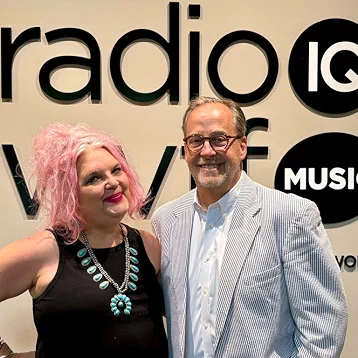
Hunsaker Segment 1
Bruce C. Bryan: Lee Hunzeker, thank you for being my guest on the show, and welcome.
Lee Hunsaker: I am so honored to be here. Thank you.
Bruce C. Bryan: So it's a turn, 'cause I get to ask you the questions.
Lee Hunsaker: Yes.
Bruce C. Bryan: I love asking interviewers questions. , We started our programs on Radio IQ on the same Sunday back in January. Yes. What was it like when you first heard your program on the air?
Lee Hunsaker: Okay, the honest truth is that I put my dog in my car, and I drove all around the streets of Roanoke until I was so overcome with tears.
Bruce C. Bryan: Did you have to pull over at one
Lee Hunsaker: point? Totally pulled over. Okay, good. I, I got into a, parking lot and cried my face off.
Bruce C. Bryan: Was that because the storytellers that day were really sad?
Lee Hunsaker: No. It was just such a thrill to hear these stories in a whole new way. Because usually it's very visual for me. You know, usually I'm right there in the room, and there's a stage, and there's an audience, but to take all of that away and just hear it through the speakers, ooh.
Bruce C. Bryan: Isn't that kind of the power of radio?
Yes. Is the, the theater of the mind is what I'd been told for decades. I won't tell our listeners how old I am by saying that, but that theater of the mind happens. And I bet that was a different experience, because in your Hoot and Holler Programs, you can look out in the audience and see or hear what, you can hear the gasp, right?
Lee Hunsaker: That's right.
Bruce C. Bryan: But in this situation, you were just absorbed in what you were listening to.
Lee Hunsaker: Absolutely. And so, yes, it was like a whole other muscle to take away the visuals, to take away the room. You know, we have a DJ on stage with us at the shows. There's photos being projected on the screen. And to really strip it down to the words, which of course I'm always paying attention to.
But to have that experience, especially that first show, I was overcome. I was verklempt.
Bruce C. Bryan: I remember that line. So was it a situation where you weren't sure it would translate to radio, or did you always in your heart know that it was gonna translate to radio?
Lee Hunsaker: I absolutely knew that it would translate, but I had to learn a- and am still learning a lot of new terminology, and how to get close enough to the mic, and all of that stuff.
But yes, those first few shows, and still, I haven't missed one yet, - I
Bruce C. Bryan: was gonna ask- Yeah ... do, do you get excited still each week when a new show launches?
Lee Hunsaker: Beyond, beyond. I put each storyteller on text together. So the way we do it is we pair stories that were not in the same stage show. So we randomly sort of assign them to each other.
So quite often the storytellers have never met each other. So I usually- So they're
Bruce C. Bryan: listening for the first
Lee Hunsaker: time- Yes ... in
Bruce C. Bryan: a way to the other half
Lee Hunsaker: of the show. Yes. And so I usually put them on a text together and give them a little, like, "I love you," , and then we rehash afterwards, and it's wonderful.
Bruce C. Bryan: What are you hearing from your followers, from your Hootenhaller fans?
Lee Hunsaker: Well, you know, and I know that you do know, , it's just going out there into the ether. So because I can't see what people are doing, are they sitting around their kitchen table? Are they in their car? Are they on the front porch? , So I get to imagine all of that, and I do hear from people, , who just say, "That was a beautiful show," or I get messages like, "That's gonna live with me forever," and yeah.
Bruce C. Bryan: Well, you're listening to Naturally Curious. I'm Bruce Bryan. This is Hootenhaller's own Lee Hunzeker, and we're talking about, , her program, Hootenhaller, and about that process. And What you were saying makes sense. You don't always hear at 7:00 or at 2:30 in the afternoon. It might be a day or two or a week or two later, or a month or two later, right?
Yes. Yes. Isn't that interesting how people are led to actually give you feedback? It would be nice if it was more immediate, but it's interesting process, I think.
Lee Hunsaker: Totally. And yeah, I'll get stopped, you know, in the frozen food section of the grocery store, you know, where, "I heard that story two Sundays ago," or, "I didn't even realize you had a show, but I happened to be tuned in."
And, , it's just, it makes it all so worth it and rewarding.
Bruce C. Bryan: Are people finding it online and with their podcast, too? And, and how's that working for you?
Lee Hunsaker: Yes. I have not really heard any statistics or numbers about the podcast. , But I do know that each and every week it gets spread a little bit further.
You know, the storytellers themselves share it. So I'm hoping that it's just going deeper and wider out into the universe, but I don't know.
Bruce C. Bryan: Well, before we go deeper and wider, let's go back a little bit. Okay. And go back to the start of your endeavor. Small rooms, some bumpy nights, right? Can you talk a little bit about the, the beginnings?
Take us back to how it all started and began for you.
Lee Hunsaker: Yes. And those, of course, were some of my favorites. , I had no idea what I was doing except that I was a lover of writing and stories and community. So the whole thing really unfolded so organically. , I had friends that owned a local coffee shop here, and I said, "Can we just try something in your front yard?"
, And I came up with the name and made a Facebook page and came up with a theme. And our first night it was packed. Like, we could not have fit another human being in that yard.
Bruce C. Bryan: And for context-
Lee Hunsaker: Yeah ...
Bruce C. Bryan: I believe you're referring to the coffee house in South Rowan.
Lee Hunsaker: Yes.
Bruce C. Bryan: Sweet Donkey.
Lee Hunsaker: Sweet Donkey Coffee.
Bruce C. Bryan: Right.
Lee Hunsaker: Yes.
Bruce C. Bryan: And it's an outdoor setting. Yeah. Was that hard for the storytellers?
Lee Hunsaker: No, our first show had to be postponed a week for rain. I mean, it was, you know, having outdoor events is an anxiety like no other.
Bruce C. Bryan: Always. Did you have other small room...
Well, that wasn't a room. That was the great outdoors. Yeah. But did you then move inside over time? And like, how did it progress? Yes. Like, 50-person rooms, 300-person room, you know.
Lee Hunsaker: Yeah, yeah. So we did as many as we could out there until it started getting really cold, and realized that we were onto something, and I wanted to keep this going.
So we moved over into Old Southwest, into the old Phoenix spot, which is now a coffee shop called Second Cafe. And we sold that out- Immediately. And then we moved over to 5 Points Music Sanctuary, and then we outgrew that. And then lo and behold, we made our home stage over at the glorious Grandin Theater.
Bruce C. Bryan: And about how many times a year are you doing the show now?
Lee Hunsaker: It's pretty sporadic, but it averages about six.
Bruce C. Bryan: Six a year.
Lee Hunsaker: Plus a couple of one-offs, uh, music festivals, and yeah.
Bruce C. Bryan: How do you find your themes and your topics- ... and your participants, too?
Lee Hunsaker: Yeah. So my themes are me driving down the road, hearing something, , overhearing a conversation, listening to a song.
I love to incorporate music, and so some of our themes have kinda direct... Like, we had one called Friends in Low Places, so I'm just- And DJ
Bruce C. Bryan: can mix, that.
Lee Hunsaker: Yeah.
And I have each storyteller choose a theme song to walk out on stage.
Bruce C. Bryan: Their walk-out music, like in the baseball world. Walk-out music.
Lee Hunsaker: Totally,
Bruce C. Bryan: But it seems, Lee, like it's more of a system now, and I know that might be a dirty word for a creative and for an organic, growing entity person like yourself, but you've either found your groove or you're finding it, right?
H- how has it evolved? How have you gotten it to where it is right now?
Lee Hunsaker: Yes. Well, I can assure you that each and every show I lose sleep for days. I never take it for granted that people are showing up for this, ever, not even for a second. So each show feels like the first time, literally.
Bruce C. Bryan: But isn't it one of the hardest tickets to get in Roanoke?
I mean, you might think- ... nobody's gonna show up, but they've already bought the tickets a month or two ahead of time. They sell out in days, minutes, hours, I don't know, right? It's a pretty tough ticket to get, but still you have that anxiety, are they actually gonna come? Yes. Is that what it's... Okay.
Lee Hunsaker: Yes, and I don't wanna lose that.
I don't wanna get comfortable or cocky, um, because I want each show to have all of that fresh energy. Um, and so by now, getting storytellers, usually our shows are about half people who have told before and half first-timers.
Bruce C. Bryan: Okay.
Lee Hunsaker: Yeah.
Bruce C. Bryan: So you are listening to Naturally Curious. I'm Bruce Bryan, this is Lee Hunsanger, and we're talking about Hoot and Holler.
And Lee, if people have never been to a Hoot and Holler evening, how would you describe it to them? And can you kinda get people into... And maybe they haven't listened to your radio show, Sundays at 2:00, right? But how, how would you describe what is happening at Hoot and Holler?
Lee Hunsaker: Yes. So I call us the rowdy little sister of The Moth Radio.
Um, the energy in the room, I always say, and I get very woo woo about this, so, you know, just- No, that's coming. Okay. Um- We're ready ... it feels, for me it's literally the definition of magic inside the room. It is palpable good vibes. Um, I call it somewhere between like a rowdy rock show, a family reunion, and some kind of mystical church.
Bruce C. Bryan: Okay. A mystical church, a hoot and
Lee Hunsaker: holler. There's a cer- there is a holy feeling in the room that is indescribable, really, each time.
Bruce C. Bryan: And it's, how long are the stories? How many speakers usually-
Lee Hunsaker: Yeah ...
Bruce C. Bryan: uh, tell everybody a little bit about some of the nuts and bolts.
Lee Hunsaker: Yeah. So typically, each show is about eight storytellers.
Um, the goal as we are in preparation is for each story to be around 10 minutes long, knowing that stories, of course, will stretch out with an audience for laughs, for tears, for surprise. So each story ideally ends up somewhere around 12 minutes by the time it hits the stage. Um, and that- that's sometimes a wrangling job, for sure.
Bruce C. Bryan: So I have so many questions. Yes. Like, how far ahead of a program do you line up your speakers?
Lee Hunsaker: Yes. So I usually start teasing the themes probably about six or eight weeks in advance. Um, there are people who I know personally who will have a story for a certain theme, so sometimes I have to go behind
Bruce C. Bryan: the scenes.
Mix those in and kinda- Yeah, yeah. Yeah ... encourage. Yes. Is
Lee Hunsaker: that the
Bruce C. Bryan: word you use?
Lee Hunsaker: Uh, encourage/stalk. Yes, yes, exactly. Do you
Bruce C. Bryan: sometimes have too many- Oh, yes ... participants or too few? Is it- For sure ... or is it ever just right?
Lee Hunsaker: It- it y- it ends up being just right, but yes. Um, if I have too few, I know, you know, I have the tactics to go around behind the scenes and, and find them.
But when I have too many, that breaks my heart, because I can't stand saying no to anyone. Um- But
Bruce C. Bryan: there are times- There- ... where you probably have to do that.
Lee Hunsaker: For sure, and it, and it's, it's painful for me, really. Yeah.
Bruce C. Bryan: So do you have concepts or themes that come to you randomly, like you were saying earlier?
Or do you work with a bit of a, a backlog of ideas so that you always have something simmering in the background?
Lee Hunsaker: Yes. I have an ongoing, you know, note in my phone that I've been adding to for, I don't know, seven years. I mean, it's ridiculous, yes.
Bruce C. Bryan: Okay, I have time for one more question. Okay. But I wanna sneak one in before that.
Lee Hunsaker: Okay.
Bruce C. Bryan: I'm really curious, will you do, give us some breaking news, and give us maybe one or two that you're percolating on that- Ooh ... are out into the future? Is there any chance you'd just, you know, for our listeners that wanna hear more. Like, what's an idea of one that you've toyed with?
Lee Hunsaker: Okay, here's one that's kind of percolating to the top for 2027.
Hot tip, flirting with disaster.
Bruce C. Bryan: Okay. I love that. And we have a chance to go to break, and people can think about if they might wanna participate. When we come back, I wanna talk about the fact that it's showbiz, and a little bit about how you handle the hiccups that always come- Sure ... that night. So when we come back, we're gonna talk more about that, and your recollection of talks, and what's next for Hoot and Holler after this short break.
Hunsaker Segment 2
Bruce C. Bryan: So welcome back to Naturally Curious, and I'm with Lee Hunsacker, and we're a couple of radio pros now, right, Lee? Absolutely. We've got, like, 30 episodes each under our belt. So, we left our listeners wondering about what do you do in showbiz when there's a hiccup? And I'm sure, knowing you, that you roll with it, 'cause you're an organic roll-with-it kinda person.
But what do you do- ... when the inevitable hiccup comes?
Lee Hunsaker: Yes. It's live. As much prep as we have, , there's only so much we can control once everybody is, , up there , on the stage. , One of our m- the major hiccups that actually turned out to be one of my favorite shows is we were invited out to the coves at Smith Mountain Lake, and it had been days of thunderstorms
and so everybody was watching, with bated breath, of course, and it looked like things were gonna pass us by. Well, we're out there. It's a metal roof. There's cords and all the things out there, and after our first storyteller, which was going great, the skies darkened black and lightning everywhere, like danger.
The entire audience scurried up onto the stage with us while rain and lightning pelted all around, and they kind of circled around like the coolest front porch party
Bruce C. Bryan: ever And it was storytelling in the round.
Lee Hunsaker: Totally. I mean, literally everybody was having to yell over the thunder, and we were certainly risking our lives with the lightning-
and all of the sound equipment. We kept it rolling, and it was one of the most kind of bonding experiences for all of us. Yeah.
Bruce C. Bryan: Let me try out my FM radio voice. You're listening- ... to Naturally Curious. That's Leigh Huntziger, who will go to great depths to bring you the best stories. Yes.
Lee Hunsaker: Yeah. The
Bruce C. Bryan: show
Lee Hunsaker: must go on,
Bruce C. Bryan: Bruce.
That's right. The show must go on. So when did it occur to you that these presenters could make for a good radio show, and how did you decide initially who to feature?
Lee Hunsaker: Yeah, so of course, so this is our 10th year. So of course, there have been hundreds of stories that have lived in my heart.
Um, so really it had to do with what was recorded well. I was gonna say, what
Bruce C. Bryan: was recorded
Lee Hunsaker: well. Yes, because t- heartbreakingly, some of our earlier stuff either was recorded on cell phones or not at all. You know, it was sort of like if you weren't there, you missed it. And I have regrets, don't get me wrong.
So a lot of it had to do with can we make the sound work for radio?
Bruce C. Bryan: Are there some that you can't wait, the ones that you have recorded, that you can't wait to circle back and feature on your show?
Lee Hunsaker: Absolutely, yes. And now that I'm thinking about it with that kind of new perspective and thinking about will this one make it to the radio, you know.
So I have a new lens to, , to be listening and watching these stories. Yeah.
Bruce C. Bryan: So who are a few of your favorite presenters, if you don't mind me putting you on the spot? Oh, man. I mean, I know you're gonna say, "I can't pick. Those are gonna get..." But there's, there have to be a couple that kinda come to mind as you sit here and think about this.
Lee Hunsaker: Yes. I mean, I can say in a kind of a generic way that there have been a handful who start off Terrified. And sometimes those are my favorite, , who know they have something to say. They know the story's in there, but they're terrified to stand up on that stage. They're quaking, they're shaking, their papers are rattling, and they get up there, and I can see them literally transform in front of me.
Bruce C. Bryan: That's the magic you talked about. I mean,
Lee Hunsaker: it g- it makes the hair- Right ... stand up on my arms every time. And they literally step off the stage as different people.
Bruce C. Bryan: I've done this.
Lee Hunsaker: Yes.
Bruce C. Bryan: Right? Are there some where the stories are so funny that you've- ... laughed out loud and you can't emcee effectively as you introduce the next speaker?
Has that ever happened?
Lee Hunsaker: 100%. I'm pretty good now at programming it, so I put those people just before intermission so people can rush to the bathroom, or, just try to collect themselves. Yeah. Or put th- or put them last.
Bruce C. Bryan: And how about the other way? Are there some that were so hard to listen to that you couldn't gather yourself because they were so emotional?
Lee Hunsaker: Certainly, we have had some tearjerkers. , As curator, and this is something I've learned and am continuing to learn, but we never wanna, like, trauma dump on an audience and make them have to carry the weight of a heavy story. But that doesn't mean I want storytellers not to tell the truth.
Bruce C. Bryan: So that's part of the curation process.
Definitely. Well, you're listening to Naturally Curious. Storyteller and master curator from Hoot and Holler, Lee Hunsaker, is my guest today, and we're talking all about storytelling, and we're talking about Hoot and Holler, and we're just talking. 'Cause that's what it feels like. It's like we're letting people in on our little conversation.
Yes. , Have you ever gotten so wrapped up as the emcee and the curator that you forget to get back up there and do your thing? Does that happen? I could see where that could happen. It
Lee Hunsaker: has, because usually I, after I introduce them, I come out to the side of the stage so I can watch from the audience, and I definitely get caught up, or else I'm crying or I'm laughing or I'm looking at, around at the other audience members, you know, giving them high fives and I'm like, "Oh, r- r- right."
Bruce C. Bryan: I better get up there. Yeah, I
Lee Hunsaker: gotta do this.
Bruce C. Bryan: Yeah. You alluded to this, Lee, but have you ever really been surprised with how great somebody's presentation ended up being? Like, there have to have been some where you thought, "Oh, boy, this could be messy," and they surprise you.
Lee Hunsaker: So many times, so many times. In particular, I did a show for teens last summer, and that was a bit like pulling teeth to get them interested, and then to, like, kind of follow through.
And a couple of them were just so nervous, and their confidence was just not there. But I believed in them. And to see, again, to see them stand up and to receive the love from the audience, which is palpable. The audien- our audiences are on your side.
Bruce C. Bryan: Yeah, they welcome- Absolutely ... those stories, and they are cheering for you, and nobody wants to be uncomfortable- Right
with an uncomfortable presenter. Right. So they're like, "You can do this," right? Yes. There's a little momentum- ... there. So back to the radio show- Yeah ... where the audience is remote and they listen- Yeah ... after it's produced. Will you tell our listeners about the format and how the program works, Lee?
Lee Hunsaker: So we feature two stories each week, , and we are, at this point, we're pulling stories from different shows.
So the storytellers have, did not perform in the same show. , And what I have known and what I imagine our listeners are seeing is that there's always gonna be a common thread between stories. We don't intentionally say, "Oh, this one talks about New York, and this one talks about New York," or whatever it is.
But
Bruce C. Bryan: it happens organically?
Lee Hunsaker: There's always- Yeah ... something that ties them together, no matter how you mix and match them.
Bruce C. Bryan: So then are you talking to the people that were speaking? You, you do an interview with them like we're doing right now, right? Talk about that if people haven't heard.
Lee Hunsaker: Yeah. So we'll play their live performance, um, assuming that they performed on the Hoot stage.
We'll play it, and then we invite them back to the studio to talk about the process of getting the story ready, um, their lives, , off stage, and what the experience was like for them. So it's sort of like the story behind the story.
Bruce C. Bryan: So Leigh, here might be the most difficult question, because I know your heart and how-
good it is, but do you, there's not a but. And do you ever dream of Hoot and Holler being picked up around the state, or maybe with NPR as a network? Because it feels like when you listen to this show, that it has that kind of vibe to it.
Lee Hunsaker: Nothing would thrill me more. It would be incredible to have a showcase for these local storytellers, but as well, I do have big dreams of expanding it into the region and further.
Um, I'm going to expand it so that if they have not performed on stage, but they still have true stories that they've written that are around the same length, uh, I'm gonna start asking people to submit those and read them, um, on the air.
Bruce C. Bryan: Oh, that's interesting.
Lee Hunsaker: Yeah.
Bruce C. Bryan: So there is a measure of that, , the possibility that could happen.
, What is it about this work that draws you in and keeps your attention?
Lee Hunsaker: Yeah. I think because it's different all the time. I was in the film business for 20 years. Ev- every day was different. Every day was exciting, and I feed off of that, and I feed off of meeting people. , And for them to trust me with their stories, it's such this kind of sacred space that I really honor and take very seriously.
-
Bruce C. Bryan: I would think the people presenting can sense that too, and they find you trustworthy with their stories. And is that part of what makes you coaching them a reality? Because they're open to their, the things that you have to share with them. Do you see that in the process?
Lee Hunsaker: So much. So much. It's so important that they trust me, because- So much of what they share in the beginning of the process of getting the story ready does not make it to stage.
So they have to trust me to walk with them through the process, and I have heard so many vulnerable stories. People saying, "I don't think I can share this because my husband and I blah, blah, blah," or, "We lost a child," or, "This is, our town's too small," or whatever. And so I really take it so seriously, and it becomes really a special bond.
Bruce C. Bryan: So if somebody labeled you as a coach or as a curator, which is what I did in the introduction- Yeah ... I'm sure those both resonate, but is there one you're more of than the other?
Lee Hunsaker: Gosh, I guess if I had to pick one, it would be coach. Yeah. , I've been referred to as a story midwife, which is- Oh,
Bruce C. Bryan: I love that
Lee Hunsaker: the greatest job title ever.
Bruce C. Bryan: Do you have a business card with that on it? I do. Good. You should. I literally do. That's perfect.
Lee Hunsaker: It's really about helping people birth the stories.
Bruce C. Bryan: So you've also talked about this, um, there is , a measure of vulnerability, , when these stories are shared. Does that translate from the stage to the radio show and the podcast?
Lee Hunsaker: I think it does. , And especially if you're just, tuning in. I mean, again, there's an energy in the room when the stories are being told, but if you're tuned in and really listening, I think you can pick up on that for sure.
Bruce C. Bryan: Lee Hunsaker, thank you so much for being my guest on Naturally Curious this week.
To listen back to the show, to hear the full interview, and links to learn more about Lee's program, search Naturally Curious or Hoot and Holler at radioiq.org. Naturally Curious was produced and edited by Big Jim Shively, with support from Sarah Hobbs and Nick Yee. And today, I'd like to give an extra special thank you to Bill Trifiro, who produces Lee's shows and helped us both to get our programs off the ground.
Naturally Curious is recorded at WVTF Radio IQ Studios. I'm Bruce Bryan. Thank you for listening.
Hunsaker Bonus Content
Bruce C. Bryan: Thank you for sticking around, Lee. A little bit more about you during this segment. We call it the bonus segment. So I was wondering, is it hard to tell someone their story doesn't quite measure up, or can you coach just about everyone who has a decent story to tell?
Lee Hunsaker: That is a great question.
Bruce C. Bryan: Imagine that.
It took me this long. All this time, and finally I had a great question.
Lee Hunsaker: No, they've all been great, Bruce. Okay, whatever. They've all been great. Sure,
Bruce C. Bryan: sure, sure.
Lee Hunsaker: Um, but it's also a complicated question for me. Well, we have time. It's the bonus segment. Yes. So I guess the first thing I wanna say is that I never want people to feel like their story isn't, quote, "good enough."
, That is just, you know, a spirit crusher, and that, that's the opposite of the person I want to be. , However, sometimes either I get tons of submissions, and there's only so long we can hold the audience in the room before...
Bruce C. Bryan: You can't keep 'em after class. Yes. 'Cause I went to one that was l- I, I wanna say it, well, it was later.
Let's just say that. Yeah. 'Cause I don't wanna scare anybody away from tickets. Yeah. I was like... But it can get long, right? It can. So you have to be careful- Yes ... about how you curate and how the stories fit together. Definitely. And make sure there's a flow.
Lee Hunsaker: Yes.
Bruce C. Bryan: All
Lee Hunsaker: of that. So
Bruce C. Bryan: most people have a story that could work, it just may not work.
But if they have a decent story, then you can work your magic, right? I,
Lee Hunsaker: I don't wanna toot my own horn, but I do- Go ahead. We're here ... I like to think that I can. , As we said before, I'm, I'm called the story midwife, and so someti- and sometimes I call my own self a story scab picker.
Bruce C. Bryan: Oh. Which means- That, that is great.
I'm gonna- I'm glad you stuck around for the bonus. So yeah, you're gonna tell us, but what does it mean to be a story scab picker?
Lee Hunsaker: So that means, that means that I might push you into territory that, um-
Bruce C. Bryan: Oh, man ...
Lee Hunsaker: is not in your draft. I have this kind of sixth sense when I'm reading a story draft where I'm like, "They're-"
Bruce C. Bryan: There's more to this?
Lee Hunsaker: They are dancing around the actual story. Oh, man. They're dancing, and that is where the trust comes in, and that is where only the, the strong survive.
Bruce C. Bryan: I am sitting here getting anxious because I'm the one that gets to ask the questions. But I feel like- He's folding his
Lee Hunsaker: arms
Bruce C. Bryan: across his chest ... I'm like, "What is her superpower?"
And I think we, it took us 35 minutes to hear what her superpower is. So yeah, be careful if you wanna be on Hootenhound. But, but the cool part about it is you genuinely are a kind person with a good soul who's trying to help and birth these stories. So it's, as my late mother used to say, "It's for your own good," right?
Lee Hunsaker: I mean, right. Exactly. Suck it up, buttercup. No. Um, no, truly, truly, truly, I want every storyteller to shine up on that stage.
Bruce C. Bryan: That's right.
Lee Hunsaker: The last thing that any of us need, audience, storyteller, and me, you know, the nervous Nellie mama bear, is to see someone struggling up there or for their story to fall flat.
And that does not mean that it needs to be a Broadway performance- Right ... or a stand-up comedy. It means the more we can tap into the truth, yet keep it universal, you know, so again, like we mentioned- Truth with a
Bruce C. Bryan: capital T.
Lee Hunsaker: Yeah, like we're not trauma dumping. Um- It is, it's such a nuance, and it's so hard to describe.
But yes, so the, the answer is that I hate saying no. Normally, it just means not this time.
Bruce C. Bryan: Yes.
Lee Hunsaker: , But there's only so... Again, there's only so many people who can stand up there. There's only so much energy I have to devote.
Bruce C. Bryan: And who needs that stress and anxiety? Ain't nobody got time for that. I know. You want it to go well.
I know. And everybody in the audience wants it to go well.
Lee Hunsaker: I know.
Bruce C. Bryan: And the rest of the presenters want it to go well.
Lee Hunsaker: Absolutely.
Bruce C. Bryan: Do you ever get the urge to tell your own stories?
Lee Hunsaker: Great, another great one. So people have so f- throughout the years, just like, "Who even are you?" Like, "How is this even a thing for you?"
And I imagine somewhere in my subconscious I choose the themes because I have a story for it, you know? Um- If I
Bruce C. Bryan: were to ask myself to speak- Yes ... this is what I would say. And
Lee Hunsaker: it would be brilliant. However... No, I'm just kidding. However. However, I have z- no, talk about no energy or kind of bandwidth because it, I am working with eight people behind the scenes- Yeah
which doesn't sound like a lot, but- No, it's a lot ... it's, it's also kind of psychically, physically, spiritually involved for me. Yeah. And so I don't have the capacity to get up there. , I'm thinking about sharing one for our anniversary show.
Bruce C. Bryan: That would be appropriate. I
Lee Hunsaker: feel like that's
Bruce C. Bryan: the one. And the question was, do you get the urge?
And the answer is yes- Ugh ... exclamation point. But you don't have maybe the bandwidth. I don't. You might need a coach. Like Big Jim- 100% ... on the side is a, is a, is a, also a storytelling, um, wizard, and he might be able to coach you- Okay. That's- ... 'cause, you know, coach the coaches, something like
Lee Hunsaker: that. Great. That's, okay, it's happening.
Bruce C. Bryan: It's gonna happen. So I've been to some of your storytelling sessions, like at the writers conferences, et cetera. Yes. And I was wondering, what are some of your, of your favorite prompts to get writers or storytellers going? You've mentioned lyrics, but- Yeah ... sometimes I, I've s- been to sessions where you say, "Okay, we're all gonna write-
50 words on this topic." Like, do you-
Lee Hunsaker: Yes ...
Bruce C. Bryan: where, like where do you come up with that stuff?
Lee Hunsaker: I know. It's pretty crazy. And that is something, you know, like do you use AI for that, or is... Absolutely not.
Bruce C. Bryan: Sure you do.
Lee Hunsaker: I really don't. I really don't.
Bruce C. Bryan: Good for you.
Lee Hunsaker: So I love doing writers conferences, by the way, and writing workshops, because it all ties in.
It's one of my most favorite things. Do you
Bruce C. Bryan: still do workshops?
Lee Hunsaker: I do. I do.
Bruce C. Bryan: So where do some of those prompts come from? Is it music? Is you driving down the road thinking, "Oh, this would be an interesting prompt"?
Lee Hunsaker: Sometimes, or sometimes it's kind of a more universal theme. I've started doing some, um, writing toward the body.
Um, I'm a breast cancer survivor, and so, um... And I find in a lot of my writing circles body stuff is a, a very universal thing. You know, we all have bodies, and we all have issues. Um- Nobody likes
Bruce C. Bryan: their own. Or- Pe- people like others, but don't really like their own.
Lee Hunsaker: Right. Right? But, or sometimes I'll say, "Please write a love letter to the part that breaks your heart," you know, or something like that to kinda reframe.
Um, so I've, I've really started getting to this kinda somatic-
Bruce C. Bryan: Okay ...
Lee Hunsaker: writing. Okay.
Bruce C. Bryan: Okay. We have... No, not, no, I'm not stopping you. Yes. I'm excited. Okay. Because I'm sitting here thinking the only people listening to this segment are listening on a podcast. Oh. So here's what we can do. We've never done this.
I'm gonna suggest that you give our listeners a prompt, that they pause their, whatever they're listening to us on. Okay. And they, if you're driving, pull over. Yes. But if, or if you're running, stop, but then they can start it on their own phones in a text to themselves. Let's give everybody a prompt that they can write their own little thing.
So I mean, Leah, I've stalled long enough. You've had eight seconds. Oh, my God. Can you give us a prompt? Like, this wasn't on the list, but I think it could be pretty fun. I know. What's a good prompt for, for people?
Lee Hunsaker: Okay. Well, I mean, I feel like because I'm talking about the body stuff, I think I might, um, s- do that.
Um, write about a time when you swallowed your truth.
Bruce C. Bryan: Write about a time when you swallowed your truth. That's your prompt. Now, if you're a good student, you'll do it right now. If you're an average student, you'll pause, you'll jot yourself a note, and you'll do it later. And if you're the kinda student I might've been in high school, you might not ever do it, but you'll think about it some.
Lee Hunsaker: Or maybe- So- ... you're in the car with someone and y'all can talk ...
Bruce C. Bryan: you can chat about it.
Lee Hunsaker: Yeah.
Bruce C. Bryan: Start a conversation now, and then you can rejoin us w- you know, when you're done. In 12 minutes. So Leah, would you... Yeah, right. Would you re-share that prompt?
Lee Hunsaker: Yes. Write about a time that you swallowed your truth
Bruce C. Bryan: All right.
That's our first ever prompt on Naturally Curious. Whoa, that's deep.
Lee Hunsaker: That's deep stuff.
Bruce C. Bryan: So- ... not specifically about the process of Hoot and Holler, but related to the radio show- Mm ... what are you loving about the process?
Lee Hunsaker: Revisiting the stories, first of all, um, in a, in a way that I'm just listening. I'm, I'm loving that, and I love having the storytellers come back in to the studio and seeing them again after some time has passed.
Um, I love to listen to the stories with them in the room. Usually, we try to do that, so we revisit it together- Oh, that's fun ... so that it's super fresh. So it's like a reunion. Yes. Right? And I love watching them watch themselves because usually there's been a fair amount of time that has passed between their show and when they come in here.
And, you know, sometimes they're covering their eyes or sometimes, and quite often, they are crying. They cry, which then makes me cry, of course. Tears of joy or tears of
Bruce C. Bryan: sadness
Lee Hunsaker: or- Pride ... pride. Good. Pride. That's awesome. Um, uh, you know, there's just this, like, "I can't believe I did that. Look at me." And so it's sort of a whole new reminding them how powerful they are and how important their stories are, so that's-
Bruce C. Bryan: Well-
Lee Hunsaker: been wonderful.
Bruce C. Bryan: Leah, I distracted myself- ... because of that prompt. Yes. And so now I feel like we, we might have bonus, bonus coverage. Okay. But I was curious if there's something you wanna be doing more of.
Lee Hunsaker: You know, I love the idea of taking the show on the road. Uh, you know, we've talked about Charlottesville maybe, or Asheville.
Um, I love meeting storytellers throughout the state regionally and even further. Um, so in, in like a dreamiest dream, we could take a show from here that, where the storytellers are ready and on fire, and we could somehow like kind of a band of merry wordsmiths get in some kind of, you know, tour bus.
Bruce C. Bryan: And do the thing.
Lee Hunsaker: Which would be most of us driving ourselves probably. But, you know, I mean, a girl can dream, and show up on another stage, and just keep spreading it and spreading it and spreading it. Do the same thing
Bruce C. Bryan: in a
Lee Hunsaker: new- Yeah ... new
Bruce C. Bryan: town.
Lee Hunsaker: Yeah. Or have a theme and invite storytellers from that area, of course, you know.
So yeah.
Bruce C. Bryan: Earlier you talked about the organic beginning of Hoot and Holler. Yeah. But I was wondering what you were doing before that, that maybe led you to this or prepared you for this chapter- Yeah ... of your life.
Lee Hunsaker: Yeah, so I was an English major with, you know, concentration in creative writing, which was always something I loved.
Um, but I kind of veered off into the film industry and doing costumes, which in my mind is visual. You know, movies are visual storytelling.
Bruce C. Bryan: Right.
Lee Hunsaker: And doing costumes was me helping bring characters to life, and so it all tied in. I just kind of put my own writing and my own words on a back burner to help other people with their visions.
So after my breast cancer diagnosis, um, I was living in Texas at that point. Um, I missed-- I'm from Roanoke. I missed the mountains. I missed my people. And so I kind of came back here to collect myself and do some soul searching. What do I really want now, you know?
Bruce C. Bryan: And almost 15 years later-
Lee Hunsaker: Yeah ...
Bruce C. Bryan: in Virginia.
Lee Hunsaker: Yep. I took-
Bruce C. Bryan: Haven't left.
Lee Hunsaker: Yep. And- I took some writing classes at Hollins. Beth Macy let me sit in on one of her classes, and I just started coming back, literally coming back to life. Yeah.
Bruce C. Bryan: Oh, it- It's a, it's an incredible story of... And I see that as a theme, how often people have different segments in their life, but when they pull back and look at it, they do fit together in a way- Yes
that people might not always think about for themselves. Yeah.
Lee Hunsaker: Yeah, for sure.
Bruce C. Bryan: Well, um, I know you help other people tell stories, but I wanted to tell you I've, I've been to enough of the Hoot and Holler events that I do a lot of public speaking when I'm, I'm not doing Naturally Curious, and I intentionally shifted One of the talks I give where I just put a picture of the, the person I'm talking about up on the screen, and it has helped me so much because now people aren't focused on the PowerPoint over my shoulder- Right
but on listening to the story and to the value that that other person that I'm talking about might bring. Yeah. So you've helped me too. Aw. I bet there are a lot of people that you've helped that, or people that were in the audience that didn't even know. Do you hear about the, the ripples of Hoot and Holler ever?
Lee Hunsaker: That's one of my... I mean, that could make me start crying right now. That's one of my other most fa- I mean, I can't pick a favorite part, but to hear how people carry the stories out of the room and into the world. And I'm actually about to start a side hustle, another side hustle, where I am going to be doing story coaching for people for public speaking.
Bruce C. Bryan: Oh, that's
Lee Hunsaker: great. Um, eulogies, yes, public speaking, to really bring heart and soul into it. So- Oh ... that's gonna be a little branch of what I offer.
Bruce C. Bryan: Well, so we know you can't have favorite children- ... unless there's only one child. Um, but do you have a favorite episode or a favorite session? Oh my gosh. Um, since we were talking about favorites earlier.
Lee Hunsaker: Oh my gosh.
Bruce C. Bryan: Come on, you can do it.
Lee Hunsaker: Truly, truly-
Bruce C. Bryan: Just one that just- ... impossible ... comes right to mind. Oh my
Lee Hunsaker: gosh. I mean, our most recent one, um, with Matt Chidam, who's a local, um, reporter, you know, a newspaper guy. Mm-hmm. Um, he has shared throughout the years. He was even at the very first Hoot and Holler. He's a personal friend.
He has always shared these kind of fun- Great guy. Mm-hmm ... funny stories. But the one he shared last was his most vulnerable about having to cover, um, a tragedy that happened very early in his career, and he was assigned, you know, the beat. And he told a beautiful story of where, um, reporter, you know, where you're a voyeur and where you're- A community member and how to bring that tragedy, w- at what point are you crossing the line while telling the truth?
And he talked about how much that story has stayed with him his whole career. He got choked up telling it, and it was just a really cool way to hear from someone behind the scenes, um, because you don't think of a human being who's writing these news stories.
Bruce C. Bryan: Right. They're a machine.
Lee Hunsaker: Yeah. Uh, but he had to cover the death of a five-year-old girl, you know, in Vinton, and meeting her family, and it was just a beautiful, raw, vulnerable story, and that one's sticking with me right this minute 'cause it was so recent.
Yes. Yeah.
Bruce C. Bryan: That makes- Yeah ... that, that makes perfect sense.
Lee Hunsaker: Plus, he did a beautiful job, of course, but yeah.
Bruce C. Bryan: Yeah. Yeah. I would not expect anything less- Yes ... from Mr. Matt. Yes. He, he is, uh, an inc- an incredible person. Leigh, w- when we start to pull this all together, I, I love that you shared that. I'd also love to hear one of those examples of a time where you were so thrown off because you were laughing so hard.
If, um, and I don't know if it happens to be one of your episodes, and we can, we can direct people to listen- Sure ... to a funny one too. Yes. So we, we leave the traveling show on a bit of a high. Yes. Is there, is there one that people will laugh so hard they cry?
Lee Hunsaker: Yes. I would recommend looking up Joe Stanley. I
Bruce C. Bryan: knew you were gonna say Joe Stanley.
I just knew it.
Lee Hunsaker: Yes.
Bruce C. Bryan: Yes. Okay. He is a
Lee Hunsaker: fan favorite. Is
Bruce C. Bryan: that the mama one?
Lee Hunsaker: Or- He loves to tell stories about his mama and grandmother, and he is a master. Okay. Um, he is absolutely up there, and another, uh, wonderful storyteller named Hailey Hendricks, and I believe we only have one of hers so far, but we'll get her back.
But-
Bruce C. Bryan: Okay ...
Lee Hunsaker: those two are masters.
Bruce C. Bryan: Yeah. A lot of times people ask me, "Well, which episode of- ... Naturally Curious should I listen to?" Yeah. And it's hard for me to- Yes ... pinpoint one, but I might start leading them to this one. Hey. Or perhaps the Big Jim, Turn the Mic on Big Jim one. That was a lot of fun too. I bet.
So you wanna do this again sometime? Please. Let's do it. Yes. We'll do it again. It was great to spend a little time with you and to get to hear the story of Hoot and Holler, and Lee Hunsaker , thank you so much for being my guest on Naturally Curious.
Lee Hunsaker: Thanks for having me. Can't wait to see you on the Hoot and Holler stage.
P.S.
Bruce C. Bryan: So if you happen to be listening to this on a podcast channel, we thank you. Keep listening to Hoot and Holler Radio and/or Naturally Curious. But the easiest place is to listen to both on wvtf.org. How about that?