Campbell Segment 1
Bruce C. Bryan: Gary Campbell, thank you for being my guest on the show, and welcome.
Gary Campbell: Oh, I am honored to be here. I appreciate, appreciate you taking the time with me and having me here today. Looking forward to this, uh, discussion that we're gonna have today.
Bruce C. Bryan: So I have to start here. Who is Mr. or Mrs. Johnson? Tell our listeners about the basics about the Johnson Health Center.
Gary Campbell: Happy to. Mr. Johnson was Dr. Johnson that, uh, was the first African American physician to be granted privileges in, uh, Lynchburg General Hospital. , now I'm, blanking on the year, but it was, , it was, he was the very first physician to be, , to privilege there. He was also a legend.
It's Dr. Walter Robert Johnson. He was a legend in tennis. He, uh, he trained Althea Gibson and Arthur Ashe.
Bruce C. Bryan: Okay.
Gary Campbell: And he had his, in his home, he had tennis courts outside of his home where he r- really was moving on the inner city and the African American kids, uh, and he became known as Whirlwind Johnson, so-
Bruce C. Bryan: What a great nickname
Gary Campbell: it, it's amazing. And then Johnson Health Center adopted that name, uh, when they, we became a federally qualified health center.
Bruce C. Bryan: So we've had a lot of guests on, but that might be the best nickname. And of course, it's hard to be any sort of American and not know of those two athletes that you were just talking about.
We're gonna talk more about Johnson Health Center, but one of the things I was curious about is the geographical area that you serve because, it is a, a varied- area that you're talk- that you're helping.
Gary Campbell: It is. It is the central Virginia area that encompasses Lynchburg, , surrounding counties of Bedford, Campbell, Amherst, and we're also, s- our service area is listed as Appomattox as well, although we don't have a location there.
, So we have, uh, really expanded care, and we, we see, we, last year we're seeing over 100,000 visits a year. That's gonna grow. It's projected to grow, and then we're taking care of over 30,000 patients in, in the area. So, , that has been... We've been on the, on the growth trajectory now for the last 10 years, and I don't see that slowing down any because, you know, we just built a new facility there in Madison Heights, which is, , part of Amherst County, and, , there's a lot of things that we're doing there that when you think about healthcare, it's all the services under one roof.
So I do see us, , continue to grow, and I see that the community continues to depend on us.
Bruce C. Bryan: I mean, the need is obviously great. You are what's called an FQHC. Yes. Right? I should get interview bonus points for knowing that little bit. You did really good. Right? , And I even got the initials in the right order.
I'm guessing the, a lot of our listeners might not be familiar with what that means. Could you k- enlighten everybody a little bit about that?
Gary Campbell: Yes. Uh, it's a federally qualified health center, and it was born out of the civil rights movement back in the '60s, and, uh, we're 55 years strong. It's over 1,500 health centers like us across the country.
I think there's about 18,000 sites. , Don't know if that is a, an exact number, but it's close. And if you think, if you add, aggregate us all together, it's serving over 52 million patients over the course of the country.
Bruce C. Bryan: And in, in many of those situations, it's more rurally based, or is it
Gary Campbell: across the board?
No, it's, it- It's everywhere ... it's across the board. It's, , certainly rural based, but in, urban areas, it's a combination of both, and, , and that's really how we're situated along with other health centers that are like us.
Bruce C. Bryan: And yours is interesting because you have a mix of urban and rural- We do
in, , the communities that you serve, and I think that's really interesting to people.
Gary Campbell: It is, and, you know, one of the things about health centers is we get... You know, what makes us a federally qualified health center is w- we get some federal funding, and, , we're one of the more compliant, we have to be more com- from a compliance viewpoint, there's a lot more, uh, check boxes to have to get through in order to maintain our status as an FQHC and also to maintain our federal funding, which, you know, a lot of people don't know this, but it's, , federal funding only makes up about 10% of our budget.
And so-
Bruce C. Bryan: I didn't know that
Gary Campbell: ... when you think about, you know, there's, I think there's always been misnomers that, if you're an FQHC and you get federal funding, then you essentially have all the money you need, and that is, that is a big myth as, , we as a health center have to be just like the others.
, But our charter is , we see all patients regardless of their ability to pay.
Bruce C. Bryan: Okay.
Gary Campbell: That's the separator there for us.
Bruce C. Bryan: Well, you are listening to Naturally Curious. I'm Bruce Bryan. This is Gary Campbell. He is the CEO of the Johnson Health Center in Madison Heights. And not to get you to dabble into government, but Virginia has these Dillon laws where each city and each municipality is separate.
And you work with probably five or six different municipalities- Mm-hmm ... in the work that you do. Does that kind of, , silo government situation make it difficult for you, or is it really apart from, , any of that kind of stuff?
Gary Campbell: No, it's apart from that. This is one of the areas where we enjoy bipartisan support.
We enjoy, , 'cause really the Constituents in all the communities, regardless of what side of the aisle they sit on, are somehow touched by the health center. And this is one of those, this is one of those initiatives and, movements, , going back to the early days that has always been, we always say the darling of, s- of the legislative landscape.
Although we get caught up into things with some of the bigger players that put us i, in... it can put us in peril sometimes when it comes to, you know, different restrictions that may be heaped upon us. , We're facing some of that next year with, , the H.R.1 bill. But, you know, you just, you move and you, and ebb and flow with your strategies around that.
But, , we've been very fortunate to partner really closely with the counties surrounding us.
Bruce C. Bryan: Well, and I guess the other part is even things that were nonpartisan before have a way these days of becoming partisan, especially in your case, even if only 10% of your funding is from the federal government.
I'm sure that that does create a little bit of anxiety, I would think anyway.
Gary Campbell: It does. , Now recently, it's interesting, there was, , probably the m- and maybe the most of, of this in my time at Johnson Health Center, that last week there was $102 million of funding for new health centers that came out, and w- I haven't seen that, and last week it was announced.
So there is, ... And I g- I do think that health centers are the future. They've been, , the best model of care because you have the services under one roof. And so if you're a patient there, you can get just about every service, every, every primary care service, some specialty service under one roof and not have to worry about some of the, , external referrals or going to different clinics to get different things , and dental is one of the big ones for us.
So I think that is why it's so popular.
Bruce C. Bryan: That's huge. And I think one of the things that's probably interesting for people that are listening, it's a big geographical area, and you described the area you serve, but adjacent to where you are, probably another 20, 30 counties that are listening to this station and maybe listeners, other listeners online.
Are there other similar organizations to Johnson Health Center that you could kinda name off the top of your head that might be somewhere from, from Marion up to Richmond or from Rockbridge County down to- Sure ... Danville, maybe two or three, just so people that are listening can go, "Oh, I, now I know what he's talking about."
Gary Campbell: Well, Rockbridge has their own health center. We partner with them. The, , just a little, , north of Charlottesville is Central Virginia Health Services, which is one of the biggest ones in,, , in Virginia. And, I've worked very closely with their CEO. And just , , south of us , is PATH, it's called P-A-T-H-S.
Okay. It's Piedmont Access. And in here in Roanoke, we have New Horizons. So , and then Blue Ridge is just a little north of us. So we, and the Community Access Network is, is right next door to us in downtown Lynchburg. So we have a host of health centers that- that work together. And you know, while we, we have to-- I always say that when you think about competing, , we've never really viewed this, at least in our area.
Now, in certain areas, they, they do. There's health centers , that, , can get, get a little ruffled and call it competition. We have been very fortunate that in our area there's enough patients to go around. , The staff is somewhat limited, but at the same time, that really hasn't been an issue for us, , as it may be for some in larger cities.
Bruce C. Bryan: You're listening to Naturally Curious. That's Gary Campbell, the CEO of Johnson Health Center. I'm Bruce Bryan, I'm your host, and we are learning about FQHCs. I got to drop that twice in one interview, so every once in a while I impress myself even accidentally. Gary, what types of patients are you generally seeing or would an FQHC-
Gary Campbell: , Typically, FQHCs are designed to see those that are underserved, those, uh, who are uninsured, , Medicaid, , just maybe uninsured with marketplace insurance.
But the reality is we see everybody. We see patients with insurance, with not in- that don't have insurance. My entire family goes to my health center, , and it's because they choose to. And I think health centers that can balance that and have a mix of what we call the payer mix helps us do services that support those that, , we don't necessarily get funding for.
Bruce C. Bryan: So I had a feeling you might have known the next question I was gonna ask 'cause you led pretty well into it. I was wondering if you could describe the nuts and bolts of how the, this approach works and, for example, how do you get your patients? How do they find you? What happens when their needs become too great for what your team might do?
Gary Campbell: Yeah, that's a great question. When I took over the health center back in 2014, and one of the things that I really wanted to do, and we're seeing a lot of health- we're seeing all, a lot of the health centers do this now, it's a business strategy, but how do you brand yourself? How do you, how do you get the word out there and market yourself so you don't get confused with being a free clinic?
'Cause we're not a free clinic. And, , and free clinics are great. We have a, an amazing partnership with our free clinic in Lynchburg. But, you know, we wanted to make sure we get the word out because we wanted patients to know where to come. We wanted to know how to get them there. We created transportation.
We have now two transportation vehicles within Johnson Health Center. , So that's been a real big plus for us is r- is going on outreach efforts. We have an entire team dedi- dedicated to outreach- Bringing those
Bruce C. Bryan: patients
Gary Campbell: in ... and helping them with insurance and navigating the complexities of, uh, the marketplace, , and keeping them on the Medicaid rolls because that's a big challenge now and it will be going forward, especially with some of the requirements that are coming out.
But when patients are, , and they do get... Sometimes they get, there's complexity in their care, especially if they need specialty services. We have buttoned up referral arrangements with partners all over the area, including Roanoke and Charlottesville and right there in the, in Lynchburg in the heart of central Virginia.
So
Bruce C. Bryan: in that regard, it would be like other primary care situations. Not- It would seem like similar to them?
Gary Campbell: No, we would refer out to specialists, but we handle all the primary care.
Bruce C. Bryan: You, as a primary care, you would refer them to specialists.
Gary Campbell: Yes.
Bruce C. Bryan: Yeah. We would. Okay. What about the other hospitals.
Do you build relationships with Centra and Carilion and some of the other hospitals as well?
Gary Campbell: We do. More so with, in, in my own personal relationships are primarily with Centra, but our team builds them with Carilion and with UVA, , just because they're in the immediate area. And, and there's certain things that Carilion and UVA do that m- maybe Centra doesn't do, and vice versa.
But Centra's been a good partner with us, and, we're collaborating on, , a community-wide event as we speak that I think gonna help, , a lot of our community in terms of especially around some of these requirements that we're gonna be, , dealing with come 2027.
Bruce C. Bryan: So I have a ton of questions I wanna ask you, and we do have some more time, but before we go into this break, I did wanna ask, you know, money is an issue everywhere with everything, especially in healthcare.
How are you f- I mean, you mentioned the 10%, but how else are you funded, and how are you navigating these days?
Gary Campbell: Our primary funding stream comes from the, the, the federal funding, our what's called 330 grant funding. We do get a string of other funding streams.
We get s- some from the state, uh, especially around some of our pharmacy, , programs that, , ,assist with our patients that don't have insurance. But that's probably about it. We, and we may get, , some, smaller streams, like 10,000 here, 20,000 here.
But, , we primarily have to, you know, drive a payer mixed business model to, , to operate our business and what we do.
Bruce C. Bryan: Well, when we come back, I'd like to talk more about your community, Gary, and your approach to leadership, and that'll be after this short break.
Campbell Segment 2
Bruce C. Bryan: Welcome back, Gary Campbell. I wanted you to talk a little bit about your team some. Who are the people who come to mind for you right now off the top of your head and, and why?
Gary Campbell: My team at the health center?
Bruce C. Bryan: Yes, sir.
Gary Campbell: Well, the most immediate people that come to mind are my executive team, which if it was- weren't for them, I would, I wouldn't be sitting here today.
So we're made up of our chief medical officer, our chief operating officer, and our... or I should say our executive vice president and deputy CEO sh- who also serves as our chief operating officer. And we have a chief nursing officer, chief human resources officer, our chief information officer, our chief financial officer, and our chief dental officer, and if I left anybody out, I'm gonna be in real trouble.
So-
Bruce C. Bryan: Well, we don't want you to get in trouble. No. But you have a team of leaders who are helping you i- in this cause, and they, they must inspire you sometimes too, because from what you are describing, you're not a, a m- a medical professional. You're a professional professional.
Gary Campbell: That is correct. And, and we have people c- uh, come in and out, too, of our executive team to, to s- supplement what we're doing, so we don't rely just on our own, uh, abilities.
As a matter of fact, we're putting together our strategic plan for n- the next three years, and we had all 28 of our other leaders involved in that process just this morning to help us develop our tactics around some of our goals for 2027 and 2030. So which... My style has always been very collaborative and, and getting as much input and, and empowering these people to be part of what we're trying to do going forward.
So that has helped me a lot, and, um, and hopefully it helps them as well.
Bruce C. Bryan: Well, and that makes a lot of sense. What things are consistent in the areas you serve? I mean, Bedford, Amherst, and Campbell Counties tend to be more rural, while Lynchburg is obviously a city. What things are consistent across the whole area that you care for?
Gary Campbell: Consistent? Let me think. Probably, probably just the, the, the complexity of care in certain cases because we do tend to see the most, um, challenged patients, patients as it relates to their own health. Uh, I see that, but I'm also seeing some trends where, especially in Madison Heights where we have our new building and we also have a fitness center and a cooking kitchen in that building, where we're seeing patients that are more interested in preventative care that are coming to us.
I haven't seen that so much in the other sites just yet, but I do believe that we're gonna start to see that. But I think that's the main thing, and all the patients truly care and are authentic, authentic about their appreciation for what we do. I think that is also consistent across all the locations.
That's a... See,
Bruce C. Bryan: that's a great answer. I knew you'd get a great answer. Well. Well done. It'll
Bruce C. Bryan: So here's the reverse side. Can you think of any things, or are there things that might be different in the, in the, across the area you serve?
Gary Campbell: I think when you th- in terms of difference, you know, what we have to think about when it comes to some of the patients and their challenges, because, you know, we see y- a wide variety of, you know, demo- demographics, um, socioeconomic issues, life challenges. Our patients tend to probably use more of our behavioral health services than maybe we would, uh, maybe out there o- on the norm.
But we also see that if there's a conf- conflicting, um, interest in terms of, um, can a patient come to, uh, pay $10 for their visit, um, or does it mean putting a meal on the table that night because that's what they have, then they won't show up for a visit. Not, not often, but it certainly can happen that way, but we understand that.
W- a patient shows up late, and in most other practices, they're gonna move that patient off the schedule. We don't. We know that's a challenge for our clinical teams because our physicians and nurse practitioners and, um, and physician assistants, d- uh, uh, and dental, our dentists and hygienists and the whole nine yards, they're on a schedule too.
So when they get behind, um, they're the ones that have to make that time up, but they're very passionate and mission-driven on getting those patients seen.
Bruce C. Bryan: Well, you're listening to Naturally Curious. That's Gary Campbell. He's the CEO of the Johnson Health Center in Madison Heights, and I'm Bruce Bryan.
And people probably have some significant misconceptions about the work that you all do, but what are one of the, some of the biggest ones that you see?
Gary Campbell: Yeah, I would think that one of the biggest ones, and the biggest ones I've heard since I've been there, is d- some don't believe we take insurance, and that is a big misconception because we have to take insurance.
And we-- Our, our... The last, um, sentence in our mission statement is to improve access to healthcare for all, and I've always operated and, and I have my team operate from the same mantra is we are here for all, everyone, regardless of the ability to pay, so with or without insurance. Um, that was the, that was the biggest misconception that I've had to, uh, work with our folks, uh, in the community on, and, um, and I think a lot of health centers have to do that.
Bruce C. Bryan: So Gary, w- we might have breaking news-ish. Um, it sounds like you've been doing this work for a while, and we didn't really talk about how long you've been in this position. Talk a little bit about how long you've been in the position and about what's coming up next for the Johnson Health Center.
Gary Campbell: Yeah, I would, I would love to.
It is-- I thought about this today on my drive here. It-- I've been in the health center space now for 15 years. Before that, I was always in the for-profit sector, and I didn't intend to stay in the f- in the nonprofit space long until I got here and recognized the difference and the impact that could be made with the people that I got to do life with every day, whether they be patients or staff.
And so 12 years ago, I took over the Johnson Health Center as the CEO And just fell in love with the mission. I was in, in love with the mission before I did it, but I've been doing this now for 12 years. And so at the time of our, uh, at the current time today, we're, that we're talking today, we just announced my successor because in December, at the end of December, I'm stepping down.
It's not a retirement because I'm gonna refocus and do some other things, and I got a whole bunch of grandkids running around now, even though I'm still-- I hope I still feel pretty young and look pretty young. But that is, uh At the end of December, we will have somebody taking over the Johnson Health Center that's different from me today after 12 good years.
Bruce C. Bryan: And are you ready to release that name- I am ... here in September? Tell us, tell us who's, who's gonna be stepping in.
Gary Campbell: Uh, Megan McCrickard will be stepping in to take over, and Megan has been with the Johnson Health Center for 17 years.
Bruce C. Bryan: And is she the person who had the long title or she had the- She had the long title, correct.
Gary Campbell: That's correct.
Bruce C. Bryan: You remembered that title, so she's gonna have it easier to fit it on her business card. She will. And, and I wanted to just spend a little time talking about leadership because I, I think it's interesting to people that are tuning in, no matter where they are, they're being led or, or are leading others.
Who's led you as now you lead other people, Gary?
Gary Campbell: I used to work for a company called Belcan, and they're based out of Cincinnati. And it was a ... I always call it, they have a, they were an engineering company, but they were also what's called tech staffing company, and they had a president named Lane Donnelly, who was the most intimidating human being I'd ever met in my whole life, and l- people were really afraid of him.
But f- somehow Lane and I developed a relationship to, to where I, I, I s- I tended to get things different than others did, but it wasn't, it wasn't anything that was, uh, malicious in, in face of others. But he would, he always gave me more grace for some reason, and he would pull me in, he would teach me and talk to me and let me make mistakes, and it was about how we care for other people.
It was about how we took care of our customer. It was just about how we carried ourselves professionally, and we had a strong work ethic, but how we also, uh, cared for the people around us. So I, I used to compare Lane to my grandfather, and those two people really taught me what it meant to have a strong work ethic.
Bruce C. Bryan: And when I asked you that question, you had the answer right away, which was, it was telling. Yeah. And I, and I think our listeners probably picked that up, the lightness in your voice when you answered that question. As a leader now, what gives you a charge? What, what excites you as a leader?
Gary Campbell: Unleashing the potential in others and seeing what their capabilities are and having them come to life and s- and seeing other leaders have a passion about what they're doing.
And, you know, when you look at in today's climate, there's so many distractions and things that can pull us off course, and depending on which direction you go, if you're somebody that can, that will allow themselves to be, and I don't, and I, the word manipulate is probably the right word, by the, you know, by the masses that they hear, um, and, and they can give them a little bit of an attitude that is not as a- aligned with the type of leader you might wanna be.
I think those are the people that step out and, and really wanna exercise their potential, the people that I really get, I'm on fire about and
Bruce C. Bryan: try to surround myself. And you pour more- Yes, and pour- Right, and you pour more into those people. And help us to deliver. It would seem. Yeah, so if somebody asked you to pick that special thing, what, what is it you'd say your, I don't know what the right word is, superpower is?
You know, what is it that you do really well?
Gary Campbell: Always making it about others and always having, uh, and be willing to give the credit to, to others and You know, the, the saying, uh, a good friend of mine wrote the book, The Go-Giver called. His name is Bob Burg, co-wrote it with John David Mann, but he always said money was the echo of value, and you never have to chase money because if you add the value, everything else comes with it.
Bruce C. Bryan: Real good input and feedback. I was wondering, Gary, if there's a trait or characteristic that you'd like to have or one that you're working on improving, right, as a leader or a person?
Gary Campbell: Yes, there is, and one of them is, is trying to learn to enjoy life a little bit more and trying to slow down, and I think I've been in a race now for a good bit, and there is a-- I think there's a truth to some addiction to adrenaline, and I don't ma- and, and it's not a good or bad thing, but I have to force my way to s- I wanna slow down some.
I really wanna take it all in because I'm not getting any younger.
Bruce C. Bryan: Well, I'm telling you, during the bonus segment, we're probably gonna have to pick at that a little bit, or maybe you'll agree to come back in 2027 'cause I know a lot of people that have failed at retirement, right? And I know you're not retiring, shifting your focus a little bit, but as we get to the new year, it'll be interesting to see, um, how that all fits together.
Was there anything you thought for sure I was gonna ask you that you had pre-prepared for? 'Cause this, this would be your chance in a few seconds to maybe give that quick answer.
Gary Campbell: Um, maybe just, just it's important for every leader to have a vision, and that's even leaders at the, at the, on the front lines is having a vision and having it align with your passion and just making sure you're doing good for others.
That's the main thing.
Bruce C. Bryan: Well, so that's perfect 'cause my last question's gonna be what encouragement would you offer to other people and maybe to other leaders? And you answered it without me even asking. So Gary Campbell, thank you for being my guest on Naturally Curious this week. To listen back to the show and to hear the full interview and links to learn more about FQHCs and the work being done by Johnson Health Center, search Naturally Curious at radioiq.org.
This program is also available on Apple Music, Spotify, or wherever you download your podcasts. Naturally Curious was produced and edited by Big Jim Shively with support from Sarah Hobbs and Nick Yee, and it's recorded at WVTF Radio IQ Studios. I'm Bruce Bryan. Thank you for listening.
Campbell Bonus Content
Bruce C. Bryan: Thanks for sticking around, Gary, and a little bit more about you during this segment. First of all, I wanna ask you, tell me more about what you love about the region where you live. I know you said you'd been doing this work as the CEO for, I think, 12 years- Mm-hmm ... and you'd been in the industry for 15.
Were you in that area where you live now before that, or did you relocate to Lynchburg?
Gary Campbell: I relocated back to Lynchburg. Okay. I grew up in Lynchburg and left in 1997, and took my first stop in Pittsburgh, Pennsylvania, where I spent some time working at Bayer, with Bayer, had its North American headquarters right there in, in Pittsburgh.
I
Bruce C. Bryan: thought you were gonna tell me you played for the Steelers.
Gary Campbell: I did not play for the Steelers. Okay. I met a couple of the Steelers recently.
Bruce C. Bryan: Okay. But I did
Gary Campbell: not play for them.
Bruce C. Bryan: So you left the area, went to Pittsburgh-
Gary Campbell: Yes ...
Bruce C. Bryan: and, um, and, and maybe other places, and then you came back to Lynchburg. In
Gary Campbell: 2011.
Bruce C. Bryan: Okay.
So yeah, um, 14-some years ago. What do you love about th- about the area?
Gary Campbell: Oh my gosh. I love, I love that my parents are still here. I love that, but I also just love the fact that people are just so nice, and th- and I just love what we do. It's, it's a beautiful area, and when we moved back, we, we live out in the country, so to speak now, and I didn't realize how much I enjoyed living with trees around me.
And, and, and just me- and the people are... When you meet people, by and large, it's, it's ju- it's a genuine relationship. So I've really enjoyed just being back and, and, and reconnecting with people that I knew back in the '90s, but also making new friends and working with- in the space I get to work in. I get...
It's afforded me the opportunity to meet a lot of different people.
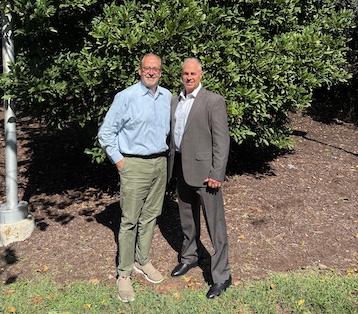
Bruce C. Bryan: Yeah, and so one of the things that's interesting is if you live out in the country with trees, and you're also the first photograph we've taken for the show that's in the forest, so that's kinda cool. I figured. How about that? I figured.
We didn't know that was gonna happen. We did not. Big Jim and I... No, we, we, we... I think he knew ahead of time. He knew ahead. But anyway, that also means there's mangy bears and skunks and possums and all that, too. Do you have a lot of wildlife wherever it is you live?
Gary Campbell: It's interesting. We have our own little Facebook group that keeps the neighbors connected, and there was a message yesterday about a big bear running through the neighborhood, and that's the last message I wanted to see.
Bruce C. Bryan: Well, make sure you update us- ... um, when this airs, 'cause by then they might have found the mangy bear, or maybe they didn't. And make sure you keep your garbage cans in until- Absolutely ... it's the
Gary Campbell: appropriate time. Absolutely. That's on the, that's on the list.
Bruce C. Bryan: So who do you... Actually, I wanna ask you a different question.
W- When it comes to recruiting talent, is it a benefit to be in the area where you are, um, or is it hard because you're recruiting against Liberty University, for example, or about University of Lynchburg? So is the area where you live a pro or a con as you think about recruiting talent to the work that you all do?
Gary Campbell: It's really a mix, and the reason being is because we are in a small to mid-market w- area when it comes to recruiting physicians and nurse practitioners and, and clin- and clinical, uh, you know, m- providers that, that take care of our patients. Because many of them wanna work in larger metropolitan areas, and we just don't have that.
But if we find the right people that wanna be in a smaller area, then yes. Um, Liberty is... We've hired people from Liberty, and people have left us to go to work for Liberty, so- Right. So it's pros and cons, right? It's pros and cons, and the same with Centra and some of the larger employers in the area. And, uh, I think it, uh, it, it's a mix.
It really depends on, you know, what your culture is like, and you have to really kind of... You really have to offer a value proposition as an employer to attract the right people. That's a
Bruce C. Bryan: part of it. That's a part of it. And the region's part of it. And the region is. Mm-hmm. And, and the, uh, a- and the situation they are coming to work for i- is a part of it as well.
I moved to the greater Roanoke area in '09. You moved back to Lynchburg in '11. Mm-hmm. In '09, it was a very different situation, but now I'll sit in meetings, and nobody in the meeting is from Roanoke area, and I'm guessing it's the same or similar in Lynchburg. And I know you're from Lynchburg, but do you run into that a lot, where the percentages have shifted- We do
where a lot more out-of-towners?
Gary Campbell: Well, you know, we-- and we have Liberty University right there, and they have infused so much external talent to the, to the region, which people move. They go to school there, and they stay, and the same with, you know, all the universities have tended to do that. They get into Lynchburg, and, and, uh, and they like it.
Bruce C. Bryan: And they wanna stay.
Gary Campbell: And they wanna stay. We've-- And the younger, uh, these younger people are staying and having kids, and, and that has been, quite frankly, a good talent draw for us.
Bruce C. Bryan: I'm seeing that around this part of the state in our, our listening area. Our, our guest coming up in the next couple weeks is, uh, from the Danville area, and we're gonna be talking about that because they're starting to see now what Lynchburg and Roanoke saw maybe a decade ago.
So it'll be interesting to see how the whole region starts to kinda transpire and shift. Gary, where does your job get particularly difficult? Do you know what I mean by asking that question? Mm-hmm. I mean, you're a leader, and you're in healthcare. There's a lot of ways it can be difficult, but where does it get particularly difficult?
Gary Campbell: When you really want to do well in all circles and you know that that is not physically possible, it's, um, you know, not everybody's gonna be satisfied with the care you provide or the service you provide. Um, not every employee is gonna be happy with where they work. Um, but your goal is to try to, um, do your very best in all that you do, and if you can, if you can really tap into that 90, 95% group and, and really do...
And hopefully they are appreciate the work you're doing, then it's good. And the other piece too is if, you know, working in healthcare, been- I've been very blessed that we haven't had issues that have surfaced that have, um, you know, 'cause it comes back to the CEO's desk.
Bruce C. Bryan: Yeah.
Gary Campbell: Whether you know about it or not.
In most cases we don't know about the things that are happening at the- Until well after ... until well after they're, they've taken place. When
Bruce C. Bryan: WSET shows up at your doorstep or whatever.
Gary Campbell: That's true.
Bruce C. Bryan: So we're gonna find wood, I just knocked on my... And, and hope that the care you provide continues to, to bring goodness.
But what's interesting to me is how often Big Jim and I do this show, and the real meaty stuff comes up in the bonus segment. Because, you know, we've been talking together for a while now, so you've really shared some wisdom there. So I, I think that, you know, people can sense that idea because it's hard for us to just accept that not everybody's gonna be happy with whatever industry we're in or whatever work that we do, and so I, I, I just wanted to underline that because I think there's real value in that answer.
Gary Campbell: Thank you. And that's the hardest thing is being a leader, you want, you want everybody to be happy with what you provide, but it's, it's just not reality. And, um, and I think that's it. And also leading people, I w- I want people to have a good experience with working, you know... And one of the questions I'd always ask years ago was, why would someone wanna follow me?
And I ask the other hour of the leaders to, to make sure they have that answer.
Bruce C. Bryan: And now you have a, a follow... or not really a follower, but a person following you in real life coming right up, so I'd be curious if she, listening to this, M- Megan, did you say her name was?
Gary Campbell: Megan, yes.
Bruce C. Bryan: She might have an answer to that.
Gary Campbell: She's good. I think she's gonna be really good. She's gonna be successful, and I'm gonna hopefully now that that announcement has come out, I can, I can take a deep breath- Yes ... and I can, uh, go shake some hands and hug some people, uh, in my last couple of months-
Bruce C. Bryan: That's
Gary Campbell: great ... at thehealth center.
Bruce C. Bryan: How do you muster the strength to face all the challenges that I know you must come against as a healthcare leader?
Gary Campbell: I drink a lot of coffee. Okay. I drink a lot of coffee. But it's real- I, I tell you, I, I try not to be in a, in a... 'Cause when you're a CEO or you're at the top, you- it- the buck stops with you. So if you, if you're not careful, you'll, you'll isolate yourself. I really try to surround myself with peers and people that I can talk with about some of the challenges that, that, that I'm facing that they've likely faced, and we really just collaborate with one another, and we pull each other through it.
And, and I th- I see this in a lot of sectors. I launched an impact leadership breakfast in downtown Lynchburg, and it happens every other month, where community leaders come together, and we support each other. And we can talk about things that can give us aha moments and help us through certain things.
And I think in all, in all honesty, I think everybody needs that. Um- I think everybody needs something, somebody they can share things with.
Bruce C. Bryan: I, I think we're almost 40 episodes in, and I haven't really shared this, but I'm a part of a CEO group down in the New River Valley that meets once a month, and we work on our businesses instead of in our businesses, and it is so helpful to be talking to other people that are facing similar challenges.
And so peer groups, whatever you do, are things you can seek out wherever you are professionally. Peer groups, uh, I'm, I, I am in agreement with you on the value, on the value of those. So y- again, you've, you've set me up perfectly for me to ask you the next question, which is, um, who do you admire or look to in your region as a leader or as leaders?
Gary Campbell: Wow
Bruce C. Bryan: Don't have to be in healthcare. Could be anybody,
Gary Campbell: but I'm just- Yeah, it's, um, in our region, I've, I've really gotten t- to know Sean Crawford, who is the, um, CEO of Collaborative Health Partners. So they're the private healthcare group in town, and, and the reason it's healthcare is because that's the group I work in.
Another one is Christine Kennedy, who is the e- a, Executive Vice President of the Regional Alliance, and, and her and her whole team there, I admire them. Uh, I, I admire their e- wisdom and advice, and she's some- she, she's someone I, I really, I really look, uh, up to at, at times. Matter of fact, we just had lunch the other- or breakfast the other day, and, and we're gonna do a leadership day together here pretty soon with, uh, with the community.
But y- those two come to mind off the top of my head that have been, um,
Bruce C. Bryan: have been really good
Gary Campbell: for me.
Bruce C. Bryan: That's perfect. That's perfect. Those are great answers, and if somebody didn't get listed, they need to either work harder or buy you breakfast or lunch. Breakfast is always good. Tell me not to feel guilty on your drive back to, to Madison Heights or Lynchburg.
You'll be thinking, "Oh, I could've mentioned that," and that's okay.
Gary Campbell: There's a lot of people to mention.
Bruce C. Bryan: It's- That, you can tag them in the post when you share this. That's- So what changes have you experienced in healthcare over the last, you know, big ones, over the last X number of years that you've been doing this?
Gary Campbell: Goodness. Um, well, there's, there's a lot of changes. I think, you know, just the m- the main thing is, um, is adapting to the, I guess the gr- the growing, um, restrictions in healthcare and, and certainly how, um, you know, the, the big pharma plays into w- what we do with the discount drugs. Um, well, a big change we saw was when the, when the w- w- when the ACA came online, and there was more eligibility for- Those were significant, right?
Big, and then we hired a whole team to do that, and we kept them. When the funding ran out, we kept that team. When Medicaid expanded in Virginia, that went right to the heart of what we do and allowed us to really, um, grow our whole dental practice, and we now have a residency program set up. I mean, we're...
There's a lot of things that I've seen along the way that have been good changes. There's, there's been challenging changes, but, you know, by and large, this is a great field to work in, but it is very... It's, it's not for everybody, and it is certainly, it'll, it'll push you to a limit that maybe you didn't know you had.
Bruce C. Bryan: I would think that's the case, and so I, I, I'm gonna change this just a tiny bit with the news about Megan, um, stepping in as CEO next year, but what changes might surprise people as they face the next five to 10 years? Not surprise your team, but maybe surprise our listeners. Like what, what, what things are out there in healthcare that are on the horizon?
Gary Campbell: Yeah. I, I think, I think the, the big unknown right now is the impact that HR 1 is going to have and what that looks like, because that affects everybody. And I think what it's gonna do, it's gonna f- it's forcing... The good side of it is it's, it's forcing more community partnerships, and it's forcing people to come together and leverage each other's strengths to deliver care, which is not a bad thing.
I think it's going to also force some systems that are, are running a, you know, running a small margin if they can survive or not, because they'll have to think of different ways to do business and, and think of different ways they provide care. I think technology and AI is going to, um, bring out some pretty significant changes, but I also think you have to embrace that, leverage it to your advantage, because if you don't, you're gonna be, you, you're gonna be left behind.
Bruce C. Bryan: So my wife last weekend said one of the funniest things I've heard in quite some time, and, uh, a friend had said that they had asked ChatGPT something about a challenge they were facing and shared the answer with us. And Laurel texted them and said m- maybe she should get a second opinion, so she checked with Claude.
Hmm. Just for a second, let that sink in. Is there a place for AI in medicine? You've already said there is. Of course, we know there is, but the bigger question is probably what's the proper place, in your opinion, as you skate out here in the next three or four months and move into other endeavors, obviously?
Gary Campbell: I think the proper place is using AI almost as a partner versus a complete go-to resource, because you hear a lot of times about using AI as a tool, and yes, it's a tool, but I think we're seeing, we're seeing the evolution of this that is faster than anything that's ever been experienced in humanity. And- And it's
Bruce C. Bryan: only gonna get faster,
Gary Campbell: right?
And it's only gonna get faster, and I think is... And I think we have to be careful to not rely solely on what we're getting out of Claude and ChatGPT I do have a fear that that may become more prevalent and, uh, versus, you know, versus just, uh, especially when you think about these, um, these students coming through school now, and this is the, this is the tool they have, and this is the...
You know, how are papers gonna get written now? How are theses r- gonna be put together? How are, how's research gonna be done? So these are all things I think about.
Bruce C. Bryan: There are people far smarter than the two of us who know what calculators were like back in the day.
Gary Campbell: I still use one.
Bruce C. Bryan: So yeah, that's right.
Well, so one of the things, I mean, I was looking at you when I asked that question, and we were both laughing about the second opinion, but I am looking to see if Big Jim was laughing too. But I thought that was pretty funny. That was a good one. You, you can steal that. Listeners, you can steal it too. We can take that joke and go viral with it because nothing's more powerful than Dr.
Google, right?
Gary Campbell: Oh, we know about that.
Bruce C. Bryan: I bet you it makes so much extra work for your physicians. I don't, we- Right ... that's a whole nother episode. That- Maybe you can connect me with Megan in 2027 and we can talk to her about that. But I, I wanna just flip it around a little bit, Gary, and talk to you about what, outside of work, what brings you joy?
Gary Campbell: My family is the number one thing. Grandkids you mentioned. I, I me- uh, yeah Shout 'em
Bruce C. Bryan: out.
Gary Campbell: Come on I better say that I've, I've got eight under six, and I've got three more on the way from my three kids. They, they just seem to be manufacturing these little ones. And so-
Bruce C. Bryan: They'll be calling you great-grandpa soon.
I,
Gary Campbell: I travel. I travel a lot. No, they're great. To get away, right? They, they're, they're, they're great. Um, and I still play competitive softball.
Bruce C. Bryan: You do?
Gary Campbell: I do. And so that brings me joy. What
Bruce C. Bryan: position?
Gary Campbell: I'm an outfielder because I can still-
Bruce C. Bryan: You're still an outfielder ...
Gary Campbell: I can still run.
Bruce C. Bryan: So guys- Believe it or not ... our age, and, you know, you can look at the picture and decide who's older.
That can be our- ... one of our contests on social media. Yeah. Guys our age, I, I, I gave up basketball about seven years ago, but I have not played softball in a long time. So you ... Or you must be a, a speedy guy. Are you, like, a leadoff hitter? Are you more the power guy and-
Gary Campbell: No, I'm a, I'm ... I usually hit either one or two or,
Bruce C. Bryan: you know- On base
five or six in the order High on base percentage. doing it.
Gary Campbell: Yes. That's me. That ... As long as they let me keep
Bruce C. Bryan: So let ... I mean, I ... You're the first person I've talked to that's playing competitive softball in quite a while, and definitely on this show. Um, what's your ... what number do you wear on your jersey? I
Gary Campbell: wear number nine.
I've worn number nine-
Bruce C. Bryan: That was the number I ... All right.
Gary Campbell: Oh, see there. We're, we have something in common there. Okay. So.
Bruce C. Bryan: And what's the name of your team?
Gary Campbell: We are the, uh, I play for a team out of South Carolina. We are the Myrtle Beach Impact.
Bruce C. Bryan: You ... So you're, like, playing on the big, in the big leagues sort of, so to speak.
Gary Campbell: We, we, we travel a little bit and- Okay ... we also have a ... It's a very interesting and competitive group down there that actually have cuts in their league. And I-
Bruce C. Bryan: Wow ...
Gary Campbell: thought that-
Bruce C. Bryan: And are you playing in like ... Is this, like, a masters league, or is this open or?
Gary Campbell: It's an open league, but we ... There's, there's graduated, um, c- classes on the, you know, where you get to play, like double A, triple A, majors and that kind of thing.
Bruce C. Bryan: Okay. Well-
Gary Campbell: So.
Bruce C. Bryan: Man, that, that- It's- I was not expecting that answer. Good for you. I, I- I'm impressed ...
Gary Campbell: I learned about it, uh, about seven years ago, and I was happy to see it because I'm not a very good golfer.
Bruce C. Bryan: Fair. Yeah, and I haven't picked up pickleball. It has its own language, and it scares me a little bit.
So how do you recharge? I'm guessing an ice bath after the weekend tournaments, right? Yeah. But how do you, in general, how do you recharge? Where do you kinda get your extra energy, maybe that competitive fire?
Gary Campbell: That helps me a lot. And, and also my wife and I still carve out time for date nights And- That's
Bruce C. Bryan: awesome
Gary Campbell: we have to. And w- we just, uh, w- and we don't turn the TV on. We just, we hang out, talk, and, and just, uh, really kind of enjoy two or thr- three hours worth of company.
Bruce C. Bryan: So what are a couple... Well, I ask a lot of out- Like Sarah, we talked about the outdoors up in Central Virginia. What are a couple g- I don't want you to give away all your top secret places, but what are a couple good potential date night spots that you might recommend up in your area?
Gary Campbell: Oh, well, now that's, that's tough because my wife likes date night spots right there on our five acres of property.
Bruce C. Bryan: Oh- And so- ... so date night's home.
Gary Campbell: It's mo- mostly at home- So- ... because I
Bruce C. Bryan: travel a lot ... you're not coming to Gary's ca- date night.
Gary Campbell: Yeah, so I mean, we're happy to entertain some people there occasionally.
But, you know, if... Yeah, I think we, you know, the, we're big fans of everything down 151 too, where if you actually go up- Oh, yeah, that, that's a great street- And it's, it's- ... or street. Great road It is. And there's, uh... So we'll pick a Sunday and then we'll do that at times. But I think the... We have such a large family now, and the key for us is when we get time to just hang out the two of us, we take advantage of it.
And we like music, so we'll, you know, we, we're into blues and we'll listen to, you know, the latest and greatest and, um, and just... And next thing you know, this time, it's time for it to be over.
Bruce C. Bryan: Well, I'm gonna make a Lynchburg connection. If you don't already know Cyrus Pace, he was our guest a couple months ago, and he's the executive director of the Academy Center for the Arts.
Yes. And so good guy for you to know if you love music. Last question, your career in healthcare, is it, is it, is it what you expected? Has this kinda been the all along plan, uh, or is it a, a, a path that you've developed as you've walked through it?
Gary Campbell: It's a path that was developed as I walked through it. I had n- never at in- one intention of being a CEO and never thought that would ever come my way.
But, um, obviously God's got different, different plans for us. So I just, it, it, I came out of the for-profit sector into nonprofit, and it has been the most rewarding time of my life and career and, and, uh, I'm looking forward to the next chapter now.
Bruce C. Bryan: Well, Gary, thank you for opening up and sharing your story, and best wishes for goodness ahead for both you and the Johnson Health Center.
Gary Campbell: Thank you for having me. I really appreciate it.