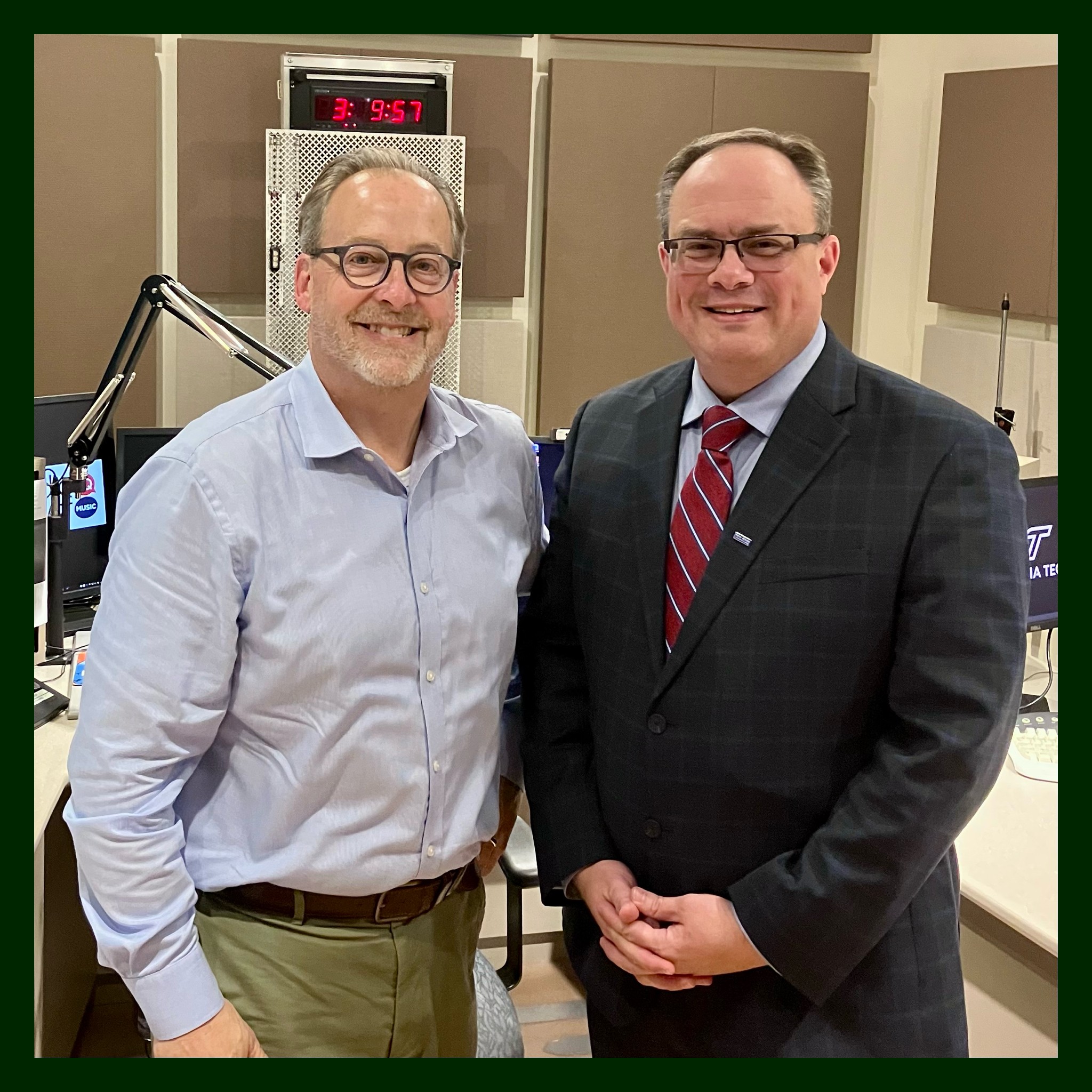
Bruce C. Bryan: My guest today on Naturally Curious is Dr. Robert Brandon. I'm your host, Bruce C. Bryan, and each week I work to bring you closer to interesting people from all over Virginia who have stories to tell or who bring value where they live. This week, we're going to talk about the position one leader took almost 18 months ago, the lessons he's learned, and what's happening at New River Community College.
We'll hear more about rural education and what NRCC is doing to address workforce development and making sure people are prepared for the future in the best ways they can. We'll learn about one leader's perspective on stepping into a new role and the impact he's had on the organization and what's happening on campus this fall.
My interview with the leader of New River Community College, Dr. Robert Brandon, is coming up next on today's episode of Naturally Curious.
Brandon Segment 1
Bruce C. Bryan: Welcome to Naturally Curious, President Robert Brandon.
Dr. Robert Brandon: It's good to be here.
Bruce C. Bryan: What an interesting career path. You were in the classroom for quite some time. I'm hoping you could tell us a little bit about that.
Dr. Robert Brandon: So my education experience teaching started in a K through eight school in rural Tennessee, Bulls Gap School.
Very rural, , very under-resourced. I also had the opportunity during my early years to teach in Bristol City Schools, which was better resourced, more suburban, wealthier communities. And, and what I took away from those that's really carried me through my entire career is in both situations, in both locations, the talent was there.
In both of those schools, there was so much talent that was there ready to go. Some of the best students I've ever worked with were in that little K through eight school, in Bulls Gap School. They could accomplish anything in their life. What sometimes was lacking in the lesser, more rural, lesser funded, more rural school system was opportunity.
And so that's really where my career has gone, to try to bridge that gap between talent and opportunity, and I really feel that's what community colleges like New River do for their communities.
Bruce C. Bryan: You had classroom time where you were in middle school. It looked like you were a middle school teacher.
That's a challenging age in any era, in any part of the country, maybe in any time in the world, right? But you probably observed a lot of interesting things during those years.
Dr. Robert Brandon: I loved teaching middle school. As a matter of fact, I had the opportunity to teach high schools and, and deliberately s- s- sought out middle school.
I, I love the middle school age because it's a period of discovery. There's some research out there that suggests that students are making their decisions about what their careers will look like, what they want to do with their lives, when they're in middle school, and those are really important formative years.
Students there are curious. They've not lost that sort of childlike curiosity that they have in elementary school, and so you're really able, I think, in those classrooms, to make a huge difference in the trajectory of student's life. There's a lot of emotion and there's a lot of energy, and that all can be very challenging, but for, for a teacher who's looking to help students find their pathway in life, I thought middle school was, was a wonderful experience.
Bruce C. Bryan: It seems like you got a lot of energy from those kids, just even from the few minutes we've been speaking. It's... I know the people that teach tend to learn the most, I think it shaped your career, but it, it seems like you fed off of their energy a little bit from what you're saying.
Dr. Robert Brandon: You know, I think that's true.
I, I love teaching, and I've always thought, , as a younger person, that I would teach forever. I loved teaching my middle school classrooms. I love teaching at the university. I love teaching at community college. I'm a teacher by heart. And there is a give and take. You do learn as much from your students as they learn from you.
It's a case where every year you walk in with new opportunity and the opportunity to sort of reinvent yourself, what you're teaching, and really, almost like a renewal cycle to s- to become a new person, , for those students. And it's something that, I miss deeply. I think it is the best job in the world, teaching at whatever level, and I'm so grateful I had the opportunity to teach those students.
Bruce C. Bryan: I think as we go through the program, we're gonna get a chance to kinda compare and contrast the teaching work that you did with the leadership work that you're doing. By the way, this is Naturally Curious. I'm Bruce Bryan. This is Dr.
Robert Brandon. And, , you were early on working in, English and student success. And I'd like to hear a little bit more about the student success part of your higher education career.
Dr. Robert Brandon: Yeah, so that was probably, those years were the early 2000s. If you look at the history of community college, which is fascinating in its own right, and there probably should be a podcast about the history of community colleges out there if there's not one.
. But community colleges were founded on the idea of access, that if we could get more students through the doors of higher education, then our nation and our communities would be improved. And I think there's some truth to that, and I think we've seen through the history of what community college has done, the impact they've made, I think we've seen the truth of that.
But really starting in probably the late '80s and running through the '90s and into those early 2000s, there was a realization in our- sector that access isn't enough. If students weren't successful, the access didn't gain us anything.
Bruce C. Bryan: That was only part of the equation.
Dr. Robert Brandon:That's, that's only part of the equation.
Bruce C. Bryan: You have to keep them involved, not just give them the opportunity.
Dr. Robert Brandon: That's exactly right. Completion is, the real goal once they've walked through the doors. And so colleges were really looking on that. And, I think partially because by that point I had proven myself as an academic leader, and partially because I do have such a, a heart for students and opening those doors for students.
The, the president of the school I was working at that time asked me to take and lead and really begin our student success division, and that was everything from advising to help students get on a clear pathway to where they wanted to go, to , what we now call, like, College 101 classes, SDV classes, a, a class that would prepare students to be successful not just in college, but in life.
And again, I think those were formative moments for me sort of in my late early career where I was working with students , and really encountering them not just as learners of composition or literature, but as people who were trying to get somewhere, but there were obstacles in their way, and it was my job to figure out how to clear those obstacles for people.
Bruce C. Bryan: What you just answered leads me to a follow-up question, and, and that is Lessons that you learned in those years, now you're onboarding employees and, leaders and teachers and professors.
Do you see a, a similar similarity between that work you did with student success, with preparing employees for success now professionally out in the work world?
Dr. Robert Brandon: I think there's two answers there, but yeah, talking specifically about people who work at the college, it's interesting you say that because one of the first initiatives, that I helped start at New River when I came, was an employee onboarding, , and also an employee leadership development with the idea people who are coming new into the institution, culture's so important, and to be successful, you have to understand the culture and the mission , and having a program to help people understand the culture and mission of New River Community College.
And so we've seen some success there. And then a leadership development, as people move into leadership roles for the first time. I think oftentimes and in many organizations, it's assumed that if you were good at doing the work, you'll be good at leading others at doing the work, and that is just not the case.
And so being there and providing not only practical advice, but also people inside and outside the organization that they can look at as mentors and in a sense of shared responsibility, I think is gonna elevate the work we're doing. So I'm excited to watch that leadership development program take off this fall.
But no, I, I think that's absolutely critical, not just in education, but in any industry, to think about how you're bringing people into your organization and how you're preparing people to lead your organization.
Bruce C. Bryan: I think we're aligned there, and it's fascinating to me that you've been able to keep and translate those lessons into the work world, and it's often overlooked.
Back to that, that first administration position, it was at, Cleveland State, right? Yes. In, , in Cleveland, Tennessee, or was there one before that?
Dr. Robert Brandon: I was at Rockingham Community College in Eden, North Carolina before, and so that's where I did the sort of department chair stuff.
I moved to Cleveland State to take my first, , sort of dean position. So that was the sort of moving out of becoming a partner, maybe first among equals in a department to actually my first real leadership job there in Cleveland.
Bruce C. Bryan: That's Dr. Robert Brandon. He is the president of New River Community College.
I'm Bruce Bryan. This is Naturally Curious. And with that first kind of administrative job, what drew you to that type of work? 'Cause that, that was a shift from what you had been doing.
Dr. Robert Brandon: It was a big shift, and it was really a natural shift for me, because when I was in the classroom, I loved it. I got a lot of energy, like we said before, and my impact was very deep.
, I could see in some students that I was making a very deep and meaningful impact in their life. But my impact was not broad. I was impacting my classes and my students, but not the larger college necessarily, and not the larger community. And as I moved into sort of those department chair roles, I found that I was making a broader impact.
So it wasn't quite as deep, but it was impacting more people. I found a lot of joy and a lot of meaning in helping other people do their jobs as well as they could. And so that's really where I had a shift in focus for my career. I moved from teaching and into administration because I wanted to have a wide impact.
Bruce C. Bryan: And you have a heart of a teacher.
So it's interesting 'cause I bet one of the reasons you're doing well, and I am hearing really good things, is because you have that mix of the classroom experience and passion, along with the passion for leading other human beings and leading an institution. I'm curious, are there resources or groups of people who are focused primarily on rural education?
Dr. Robert Brandon: There are many organizations who are focused on rural education and rural workforce development. We joke sometimes that there are so many organizations with rural in the name that it gets confusing for us to keep track of who we're talking to at any given moment. I think that's important, and it speaks to a real need in the state.
You know, we're in a moment where- The workforce is changing, and the needs of the workforce is changing, and the things that we've always done in education are creating some misalignments in the credentials people hold versus the realities of the job market, and that is most aggravated in rural communities.
I know one stat that, is pertinent to me is this idea that we're in a place where what they call middle skill jobs are vitally important. That's jobs that require more than high school but not quite a bachelor's degree. And in rural parts of the state, only about 27% of people have the jobs, and that's simply not enough, and that's why you hear persistent news about healthcare, skilled trades, advanced manufacturing.
There's just not enough people-
Bruce C. Bryan: To fill those positions
Dr. Robert Brandon: ... to fill those positions, and that's really where the community college sits right now in this moment, and it's so important for us, especially in the rural areas, to recognize that and support that both as institutions and the communities that, that's, that support New River Community College.
Bruce C. Bryan: So the region, the region you serve also has a high population area or two as well, right? , Does that make it more difficult with what you're doing?
Dr. Robert Brandon: Yeah, it's a great advantage, and I think we are really in a very unique place here. I'm gonna say the New River Valley, but understanding that also the Roanoke Valley is, is right there, and, and Roanoke and Blacksburg are very closely tied together economically.
No, you have top-flight high schools. You have top-flight healthcare centers. You have, a world-class university. You have community colleges that have been recognized nationally for their work. That is something that many areas, rural, urban, or otherwise, do not have.
Bruce C. Bryan: Don't have, and you do.
When we return, we'll hear more about the things Robert Brandon has learned since taking over the presidency and what that information has done to shape his vision for the institution now and into the future.
Brandon Segment 2
Bruce C. Bryan: Welcome back, Dr. Robert Brandon. It's kinda fun to say Mr. President. Have you gotten used to that, people calling you that?
Dr. Robert Brandon: I try my best to keep things informal. I, yeah, I, I don't l- lean on convention very much, but so I, I let people call me what they're comfortable with. I do get some Mr. Presidents or Doctors, but I like to just keep things simple, and, and Robert is perfect.
Bruce C. Bryan: So you live in Pulaski County, and that area has a lot going for it. How's the adjustment gone for you?
Dr. Robert Brandon: I've lived and worked my entire career in Appalachia, and so the, it, it feels like home. Grew up in northeast Tennessee in the Tri-City area. Worked for a number of years in Richlands and Lebanon, Virginia, and so this feels like a natural ex- extension.
I,, I tell people sometimes that y- I'm not from the New River Valley, but I was your neighbor for a long time, and so it feels like home.
Bruce C. Bryan: Those cities you listed are all a part of the listening area. So you, you might come across some people that you went to middle school and high school with who say, "Well, I think I heard you on the radio."
I, I hope so. So have, have you been able to dig into the needs of the community to use that information to help shape the work that's being done at New River Community College?
Dr. Robert Brandon: Absolutely. I, I think community colleges are unique because they are so closely tied to their home regions, and understanding the needs of the regions is ex- is exactly what we do.
And so I think for many of our students, if we take it at the first level, we have a, a large number of students who are simply worried about things outside of their education, whether that be food insecurity or housing or any of those things like that, and so we've invested heavily in resources to help those students and have a position whose job it is to wake up every day and think about how- Look out for them
they can help. Yeah. How they can help those students be successful. So I think that's one of the thing. I think students in our area are very much focused on two things right now. One, the cost of education. I think that is something first and foremost in their mind. They're looking for value. They don't want debt.
That's a very different thing than students 20 or 30 years ago who were sort of debt immune. These students are not that, and so they're very focused on, , value in education. Of course, they can find the community college, and we're focused on keeping ourselves affordable, and they're also focused on wanting to make sure that what they're doing will translate to the life they want to live.
And so that's where I think the third frontier of community colleges are. We talked about access. We talked about completion. Now we're really about the idea, and this is what we're, we're working on at New River, this idea that completion is not success. What is success is if those students go out and they transfer to the four-year institution they want to, or they get the job that they're wanting to get, that's when we've been successful.
We're not successful until the students have won at life, and so that's where our focus on building resources for post-graduation success is right now.
Bruce C. Bryan: Yeah, and that's where you are situating the students for success, and there's a lot of situational success happening at New River Community College.
This is Dr. Robert Brandon. He's the president. I'm Bruce Bryan. You're listening to Naturally Curious. And I was curious about your entry into that leadership position. A lot of leaders come into new situations with a plan, and others have big ears and take what they hear and perhaps see and, and use that to shape their direction.
How did you enter your time in the new position at the beginning of 2025?
Dr. Robert Brandon: I think culture, for any organization, is really the most important part about achieving mission. I think the culture and the mission have to be in line for an organization to be successful. I don't know who said it, but there's that saying that culture eats strategy for breakfast.
I love that, and I think it is absolutely true, and so it was very important to me. I have a mission, I have a belief, and I wanted to bring that belief to New River Community College. But I also needed to understand Their culture, their ideas, and the local mission and the local communities and the local needs.
And so I did not come in trying to make huge changes or, or upsetting apple, apple carts. I spent the first six months listening, , hearing, , responding, to ... I think we counted, over 1,000 people in those six months I sat down with, either in small or large groups, and just talked and talked, and was able to sort of come to an understanding of what it meant to work at New River Community College, to teach at New River Community College, to be a student at New River Community College.
And it's a beautiful place. It's a special place that has a heart for students, and it really, in many ways, was a, a perfect fit. The things that New River believed and the things that New River Valley needed were the same things I believe-
Bruce C. Bryan: Things that were priorities for you.
Dr. Robert Brandon: Absolutely. Yes. And so it's a perfect fit, and we've been able to sort of build strength upon strength as we move from this idea of completion into this post-graduation success.
Bruce C. Bryan: So how would you recap or even describe your first 18 months at NRCC?
Dr. Robert Brandon: It, it's been fantastic. I have found support on campus. I have found support throughout the community. I have found support, , from other institutions in the area, from employers. It's been fantastic. I'll give a shout-out to Dr.,
, Pat Huber, who was my predecessor and who was someone who was at the institution for-
Bruce C. Bryan: She was a force ...
Dr. Robert Brandon: for many, many years, and she was a force. The, s- one of the, our local political leaders calls her The General, because that is the persona that, that he saw in her. And she, she led the college to a lot of success, but one thing she also did is she helped pave the way for her predecessor to be successful.
So I, I'm very thankful for Dr. Huber , and her role in making the transition as smooth as it has been.
Bruce C. Bryan: And how are things going with, for example, Radford University, Virginia Tech, and the other colleges in the region? I'm sure you're building bridges, , with a lot of those institutions of higher learning.
Dr. Robert Brandon: It's been a, priority for me to connect with those, and one example I'll give you is, is with Radford University. Dr. Danilovich, the president at Radford University, and I were recently asked to come to Richmond to share our thoughts about higher- partnerships between universities and community colleges because the perception there was New River Community College and Radford University have developed a, a special relationship that is unlike some of the things that you see across the state.
And so they, they asked the two of us to come speak. And, so what we've done here is we've realized we could be competitors, but both institutions are stronger when we work together. And so an example of that is we now, , starting in the spring, have a shared advisor position with the idea that it's split financially between the two institutions.
She works with Maggie. She works with our students- to help them get ready to transfer, to get their pathways in order to make sure they're at class. But then in the fall, when the students are preparing to go, , to Radford for the first time, she shifts her position over there and begins to work to bring them in and welcome- To-
them to their new home.
And we- there's other things that we're working together on, but I think that's sort of, um, an example of the p- of what can happen when two institutions really put themselves together and say, "We are going to partner, not compete."
And Radford University is a great example of that, but I could do the same for Roanoke College and for Virginia Tech. We, , we have partnerships with all of them.
Bruce C. Bryan: Well, that's Mr. President, Robert Brandon, from New River Community College. I'm Bruce Bryan. You're listening to Naturally Curious. And I was curious about some of the national trends you're seeing in your industry.
Dr. Robert Brandon: So I think one of the trends is definitely towards quicker time to degree. You may have just seen that Roanoke College announced some three-year bachelor's degrees. That's, that's an example of this. That's happening a- across the country as far as bachelor's degree work. You might know, and I hope all your listeners know, that in Virginia, we have a program called FastForward.
FastForward is a community college fast-tracked degree option between, or credential option, between six Weeks and a weekend sometime. These programs designed to give people the skills they need to get back into the workplace, and we've seen some tremendous outcomes there. There's a 50% median wage increase for people who go through those programs.
Bruce C. Bryan: So it's a financially impressive and important step for people to take, right?
Dr. Robert Brandon: Absolutely, and when you look at people who are going from making, 15, $20,000 and moving their wages to 30, $40,000, that's just a whole different level of security that they can build on and th- go back for more education or raise a family there.
And those are extremely successful. It's a 94% course completion rate. And so we're seeing , a real focus on helping people get into a living wage position more quickly than we have in the past.
Bruce C. Bryan: And that fits with some of the work that you were talking about earlier in the interview. So what are you needing to do next as an institution?
Do you see the things that need to come next?
Dr. Robert Brandon: Yeah, I think th- I think there's a few things that, that really New River has to, and really community colleges across the country really need to focus on. The first thing is, as we talked about earlier, uh, we need to make sure that we're aligning the opportunities that we offer with the local workforce.
As we see more opportunity, advanced manufacturing, health technologies, uh, biomedical manufacturing. Those are the future, and we need to make sure that our students have opportunities in those areas. So I think that realigning ourselves with the, th- with the workforce and the reality of the future workforce is important.
I think, again, focusing students on post-graduation success, uh, is the work of the day, and continuing to make sure that we are, , helping students navigate a clear plan. For s- for, for many, many years, students would often come to community colleges or universities because they knew it was the next pla- the next step in life.
They didn't have a clear plan in mind. If we, if, if you and I hopped in a car and said we're gonna drive to California and we took off west, we might eventually get to California, but that plan is gonna make- Really does help. It does. And so I think helping more students plan earlier- Absolutely
and that's where the work that we do with K-12, you talked about middle school. Can you imagine a student who develops a plan in the seventh grade that carries them through high school and then into the university? I think you would see more students reaching their full potential.
Bruce C. Bryan: Well, Dr. Robert Brandon, President of New River Community College, thank you for being my guest on Naturally Curious.
To listen back to the show, to hear the full interview, and links to learn more about workforce development and community college education and more, search Naturally Curious at radioiq.org. Naturally Curious was produced and edited by Big Jim Shively with support from Sarah Hobbs and Nick Yee, and is recorded at WVTF Radio IQ Studios.
I'm Bruce Bryan. Thank you for listening.
Brandon Bonus Content
Bruce C. Bryan: Thank you for sticking around, Robert. I really appreciate you doing that. A little bit more about you this segment. So I know you're a teacher, , at heart. I was wor- wondering what kind of grade you'd give New River Community College.
Dr. Robert Brandon: Oh, I think the grade has been given by people outside of our organization, and I would give it the, the same grade.
I think New River Community College is one of the finest institutions of higher education in the country, and you may have seen that we were one of Aspen's top 200 institutions this year. So Aspen's interesting because some of the higher education awards you kind of apply for, and you write up, and you send it in to be considered.
Aspen doesn't do, do that. They look at the data, and they look for institutions who are doing something beyond the expectations for student success, and they identified New River Community College as one of their top community colleges, and I think they were exactly right.
Bruce C. Bryan: I was gonna ask you-- congratulations on the A.
I was going to ask you how you'd grade yourself, but that feels like an unfair question 'cause you can't really give the right answer. But I will say I did hear from some other folks that they would have graded you very highly. I heard a couple things about you. I was told you're very approachable. I've told you're highly focused, and you're engaged with the students, which seems to match what I heard during our interview.
I've heard you're passionate and you're understanding, and then I got this quote.
Dr. Robert Brandon: Mm. "
Bruce C. Bryan: He loves his work, and you can feel it when you talk with him." So I think other people are giving you an A. How does some of that feedback sit with you?
Dr. Robert Brandon: Well, you hope that people feel that way, and you hope that people recognize the, those things.
So it feels very good that, that people have said that, and, I'll take those compliments. I do, I, I do love this work. It's not something that, y- you know, it comes-- My work with community colleges comes from a place of conviction, and it started the first time I walked into a community college classroom, and that conviction has not lessened in the 20 years that I've been in the community college sector.
It is a special, special kind of work we get to do. We were talking earlier about how 66% of Americans will in some way interact with a community college, and I agree. And I just think that that is a unique place. No university can say that.
Bruce C. Bryan: Well, your passion definitely comes through, and I think that's really interesting to me.
, You have a very busy job, and I saw you have twins. Yikes. One kid is a handful. Two, that's an armful, right? How are things going for them as they adjust to life in the new area?
Dr. Robert Brandon: Well, it was a good time to make the switch. It is a, it is a busier job, more active job than, than any that I've had. But, you know, my son...
Well, they're twins, as you said, and they are 19 going on 20, and so we, we've made this move the time when they're also in transition in their life. They're moving to, uh, my daughter is a student at New River Community College, so she's there taking advantage of the opportunity that, , that we afford students.
And then my son has, has, has moved to a university. And so, you know, they're doing their own things. They've got their own transition going on, and I can support that at a distance while I still work on that. So it was good timing as far as that goes.
Bruce C. Bryan: I saw you like baseball. Geographically, I would guess, it seems like you might be a Braves fan, yes?
Dr. Robert Brandon: It's inter- That, that, I love this question.
Bruce C. Bryan: People ask you that a lot?
Dr. Robert Brandon: Well, I get to talk about it. Yeah, I think people... If you come into my office, you're gonna see a lot of baseball memorabilia, and so it does come up quite a bit. I lived in Northeast Tennessee in the early '80s. That's when I sort of came of age.
And, uh In those days, WGN, Harry Caray, Bozo the Clown, and the Chicago Cubs came to Northeast Tennessee before WTBS brought the Atlanta Braves in. So I became, as a young person, a Chicago Cubs fan because they were there, and Harry Caray was just something magical to me, and so they also had no lights back then on the stadium, so they played in the day.
Bruce C. Bryan: Daytime, which was great for a kid in the summers- Oh ... 'cause it gave you something to do, to watch on TV.
Dr. Robert Brandon: That's absolutely true. You would- I would go out in the morning and play with my friends, then come in for lunch, and the Cubs would be on, and I would watch the game, and then I would go back out and play with my friends.
It was a great childhood, and the Cubs were part of that.
Bruce C. Bryan: And you got to see those powder baby blue uniforms. Now, I also rooted for a team that had the kinda crazy blue uniforms, and w- when the Phillies played the Cubs and they had an afternoon game, I'd get to watch. We probably watched some of the same games back then.
But, uh, yeah, so you're a Cubbies fan. Do you ever get to go to Chicago and see them play? Have you, have you seen them in person?
Dr. Robert Brandon: Absolutely. We, we, we try to get there sometime. I'm going to Chicago in a few weeks to catch the-- They're playing the Dodgers and Yankees in back-to-back series at home in Wrigley, so that seemed to be a perfect time to go up there and see some of the greats-
Bruce C. Bryan: Well, good for you
Dr. Robert Brandon: play baseball. So yeah, exciting. , Yeah, spent a lot of time in Chicago, and it, uh, and s- it's those weird things about life. The only reason I've done that is because it just so happened to be that WGN came to Northeast Tennessee before WTBS.
Bruce C. Bryan: Yeah, exactly. That's really interesting. So with being an English teacher, I'm gonna make an assumption, which is not a, a wise thing for a, for an interviewer, but we're pretty late in the show, so it's late.
If folks are still around, then, , you know, I, I won't get too many demerits. But I'm guessing you also are a reader if you were an English teacher. Do you still get a chance to read sometimes, or are you too busy writing and working and sending emails?
Dr. Robert Brandon: It's actually been something that, especially since I have, have started this job, I've tried to be very intentional about doing that because it, it is very easy to let that be something that slips.
Bruce C. Bryan: Slides, right.
Dr. Robert Brandson: And I think it's important to keep, uh, your mind active, and I think it's important, , especially in this day and age when everything can be so quick and AI can, can do so much of the thinking for people to make sure that we're engaging our minds. And so - I've undertaken a, a, a project recently where I wanna go back through and, and the, the books that really spoke to me when I was 16 to 20.
I wanna read those now as I'm in my 50s and see if they, if they still resonate- Interesting ... or if they don't feel as good, or if they speak to me in different ways.
Bruce C. Bryan: That's a really fun... We could do a whole interview about that maybe sometime this winter when people are hunkered down- ... and thinking about reading.
But is there a book or two that you might wanna share that you've re-read or have been reading that you're enjoying that might catch somebody's ear that's listening?
Dr. Robert Brandon: So the books on that list are very, , eclectic. The one I'm reading right now is, uh, One Hundred Years of Solitude by Gabriel Garcia Marquez.
I don't know if you've ever read it. When I was a young person, what struck me was really about, it was really about... What struck me back then was really the, the way it, , it used language and the way it broke narrative structure and, and how it was kinda weird. That was what really attracted it to me. As I read it again now, , I'm really struck by how it, it's really about memory and legacy, and so I think that's one of the things that changes.
You don't pick up those aspects when you're young. And so I, I would encourage... I mean, if, if you're someone who loves to read Go back to those books that you've loved and maybe haven't looked at in, in 30 years and see if, how they speak to you now.
Bruce C. Bryan: That's a fun assignment, and I wasn't joking. I think that would be a fun, maybe, uh, sometime in 2027 you'd be willing to come back up and do another interview.
So I noticed that we both love to read, we both enjoy travel, and we're both involved in community service, and it's important for, for both of us. What sort of projects have captured your attention in the cities that you've been at during your professional stops in your career? Could be one now or ones that you've been involved with before, but it sounds like community service is something that's been important to you.
Dr. Robert Brandon: It's very important to me. Yeah, and when I was younger, , a lot of that expression came through the church. You know, one that I, , I've felt very strongly about is when I was at a institution, Southwest Virginia Community College was where I'd spent , , the eight or so years before I came to New River, and that serves Russell County, , Tazewell County, , Buchanan County, and Dickinson County, Virginia.
Every year we would have what we called a day of service, which was a day where we would take students out into the community and just give back to the community had given us so much. And, all those things stick with me. One year we, we cleaned up a playground after one of the floods had been there.
It, it hadn't been cleaned. It was sitting there, and we went and I took 10 students and we did that. Uh, one year we painted , the Chamber of Commerce, and then another year we, , painted some poles at the local high school. But w- what really gave me, , joy in those things , was not just giving back to the community, but seeing young people, the people I had with me, the students I had with me, getting that experience and sort of passing on the value of not just, you can go to college and you can be a success, but you're not really gonna be fully a success until you've also given back to your community.
Well said. And so that's been a great-
Bruce C. Bryan: Yeah, that's, that's really well said. My old boss used to say, "It's one of the paychecks in life you can't cash."
Dr. Robert Brandon: Right.
Bruce C. Bryan: That's wonderful. I've kind of carried it with me-
Dr. Robert Brandon: I'm gonna steal that.
Bruce C. Bryan: Yeah ... through my 40s. Take it. I'm sure he took it from somebody else. So, what are you enjoying about the region, the NRV and the region in general?
Dr. Robert Brandon: Oh, you've got, you've gotta love this region. It's got everything a person could want. It's got nature. We love to get out to Claytor Lake and, uh, enjoy, uh, walking around and, and water sports. It's, it, you know, it's got great restaurants. It's, it's got, arts and culture. I say sometimes ... and when people come and visit, you know, we had a, we had some visitors who were, who were coming in from, , out west, and they were talking about how beautiful the region was and how they...
this was not what they expected. I think we take for granted the beauty and the culture and the value of our communities in ways that we probably shouldn't, 'cause it is a very special place to live.
Bruce C. Bryan: And the flip side of that, do you see any gaps or maybe opportunities for Pulaski and for the area, things that you think could be built up or, I don't mean physically, or maybe that is it, but gaps that are opportunities for, for the NRV?
Dr. Robert Brandon: You know, I, I think,, I'm very much focused on, , the education gap and trying to fill, uh, to make connections between K through 12, the community college, the community college and the higher- the, the universities, and the community college and the employers. And so that's really what I focus on.
But what gives me a lot of joy, , I'm participating in a group called Lead Virginia right now, and the, and the nice thing about Lead Virginia is they, they take you around the state, and they introduce you to the regions and the people who are working in those regions and show you some of what's being done.
And we just did the New River Valley recently, and it's a lot of the people who I already knew and have worked with. But- I feel very optimistic because I see that no matter what it is, tourism, economic development, natural resources, uh, business development, there's a passionate person in, multiple passionate people in all of those areas working to make their community better.
And so we are in good hands in this part of the world.
Bruce C. Bryan: And they're driving a lot of that-
Dr. Robert Brandon: Oh, yeah ...
Bruce C. Bryan: advancement. How does Virginia stack up with other states for community college education programs and access and opportunities like that?
Dr. Robert Brandon: So I think we've done some wonderful things in the community college system.
As evidence, there are 200 top 200 schools for Aspen. 11 of those were in Virginia this last year. , That's 11 of the 23 community colleges in Virginia. There are over 1,000 community colleges in the United States, and so you can do the math that no other state has that high a percentage of top community colleges.
, Right now, Patrick and Henry Community Colleges is in the, the final consideration to be the best community college, the top community college in the United States for this next year. Hopefully, they win it. But I think it's indicative of the quality of education that's here. I do think when you compare it to some of the other states, you know, Tennessee, Maryland, West Virginia, they have the opportunity for-- Tennessee especially, has the opportunity for anyone to attend a community college free of charge.
I think that is a place where we're talking about access, and if we want that access and we want that education, we have to kinda look at those kind of things. So I would like to see us doing more with that, but you know, we're making huge impacts, and it just really speaks to the quality of people who work at those institutions and the leadership, both at the community colleges and in Richmond, that help us do that.
Bruce C. Bryan: So in your situation now in administration, a- again, one more layer away from the front line with the students, do you still have relationships with the students, and, and what's that like?
Dr. Robert Brandon: So I did something that, that I don't know how many presidents do. I know some of them do, but it's probably not-- I taught a class this last fall because I wanted to s- I wanted to-- one, I wanted to experience what my faculty were experiencing so, you know, that So that I would know what impact decisions were having or what needs were out there, and also so that I would get to know the students, 'cause students do change over time.
And so I say I taught a class. Well, one of the faculty members was really just kind enough to let me team teach the class. So she did all the hard work- You come and go ... and I just, and I would just come and go and hang out with the students. And so I don't know that teaching a class is actually what I did, but I did get to be in the classroom with students.
And, people talk about generational change, and they talk about- Kids these days ... kids these days. Those students are, were, there are very talented students sitting in the classroom. They're going, they are well poised to do great things, so we're in good hands in the future.
Bruce C. Bryan: That's good to hear. I was wondering, after all this time and all these questions, and a few I, I didn't quite get the chance to ask, was there a question you were sure that I was gonna ask you that I didn't ask you?
Was there something you prepared for that you wanna, wow your, fans and your friends and your coworkers and your, students with, perhaps?
Dr. Robert Brandon: If I could leave people with a closing thought, I, I think I don't know that people understand the scope of community college. I think sometimes people take community colleges and the community colleges in their communities for granted.
And if I could just say to them- If you look at the scope of the work, there's two numbers that really stand out. Every year, around 230,000 people will attend a Virginia Community College. If the community colleges were one institution, and in some ways we are, we are the largest institution of higher learning in the State of Virginia.
It's not Virginia Tech, it's not the University of Virginia, it's, it's not, , it's not even Liberty. It's
Bruce C. Bryan: not JMU?
Dr. Robert Brandon: It's not JMU. Darn it. It is the Virginia Community College System. And the other thing that I think is so important, I always say community colleges are there when you need them. There's a number that I like, and it may have changed over the years, but it used to be that 66% of Americans will at some point interact educationally with their community college, and it happens for all different reasons.
I'll give you three quick stories. , My father, uh, in the '70s, , was living in Buffalo, New York. It was a time of economic upheaval there, and so he came south. Very brave thing. Loaded up his car and drove south 'cause he heard there was opportunity here. I don't know that I would've been able to do that.
He found opportunity at the community college in Northeast Tennessee and, and used that education to make a great life for himself and his family. I went to a university, but found that I did not take enough classes to graduate in four years. And not wanting to cost my family a fifth year of college, I used the community college in the summers to catch back up.
So it was there for me how I needed it. And then years later, when I was working on my PhD, I w- I'm old enough to be in the cohort that if you wanted an English PhD, you had to show reading proficiency in two languages, and I had one that I could pass. I wasn't so sure I could pass the other one. The community college in North Carolina that I wandered into as a PhD student gave me enough skills that I could go pass that test.
It was there when I needed it. And then a few weeks ago, I was giving an award at a banquet, and giving the award with me was a professor, very distinguished, very, very well-known and accomplished professor from Virginia Tech. And as we were about to go up on stage, he said, "You know I'm one of your students."
And I said, "What do you mean?" He said, "I've always wanted to know how to weld, and so I came over to the community college, enrolled in a class, and I'm taking welding right now." We were there when he needed us, and community college is that. When you need us- You're- ... we will be there.
Bruce C. Bryan: You're there for them.
What was the language? I have to know.
Dr. Robert Brandon: So my two languages were Old English, which is the, the, the old Germanic form of the language, and then I didn't have a good second language, and so it was Spanish.
Bruce C. Bryan: I wondered if that were, were the case- Yeah. So I had to go back to Spanish ... especially when you listed the author and-
Dr. Robert Brandon: Yeah
Bruce C. Bryan: some of the things you... Well- I would guess that if somebody wanted a tour of New River Community College, they could probably go online and get one. , And online, not to put you on the spot, but I think it's a pretty easy URL. Can you share that with our- It is- ... our listeners?
Dr. Robert Brandon: www.nr.edu, as easy as it gets.
Bruce C. Bryan: That's about as easy as it gets. There aren't too many- ... two-letter URLs. So thanks again for being my guest. Okay. I really enjoyed our time together today.
Dr. Robert Brandon: It's a lot of fun. Thank you for having me.