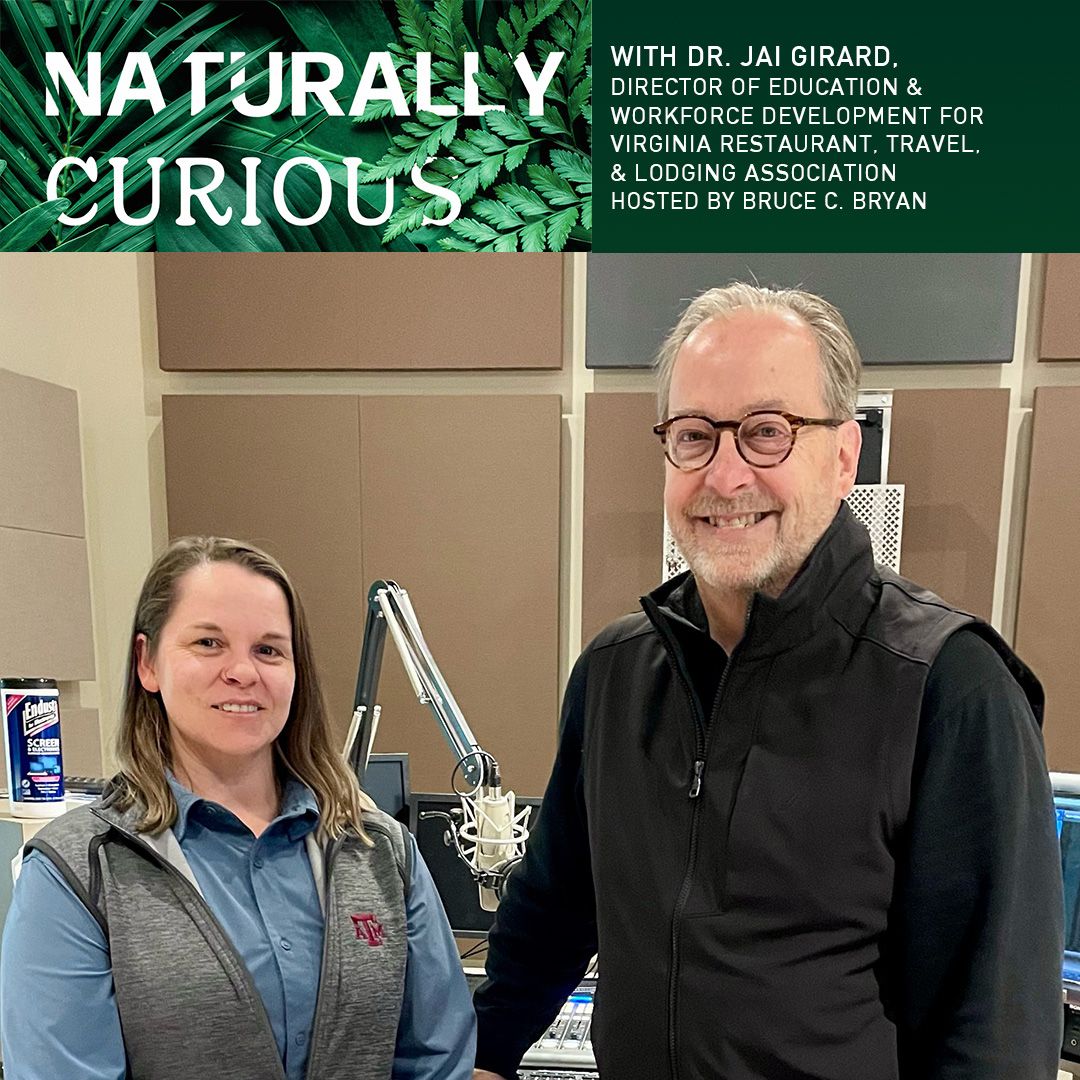
Bruce C. Bryan: My guest today on Naturally Curious is Dr. Jai Gerard. She's been in her leadership position for a few years now, and the work she leads is making a difference. We'll hear directly from her about why the hospitality industry is important to the Commonwealth of Virginia, how they're recruiting talent and the difference it's making in people's lives and for the companies where they work.
During our interview today, we'll talk about how she got her start, her decision to pursue a PhD, her time in Texas, and at JMU and what she loves about our fair state. I'm excited to talk food, beverage, travel, tourism, and our nation's younger workforce. Join me for a one-on-one session with Dr. Ja Gerard from the Virginia Restaurant Lodging and Travel Association.
Coming up next on today's episode of Naturally Curious.
Girard Segment 1
Bruce C. Bryan: Thank you for being my guest and welcome to the show, Dr. Ja Gerard.
Jai Girard: Hi, how are you today?
Bruce C. Bryan: I'm doing well. So Texas to Virginia. That's a shift. Talk about how you got to the state.
Jai Girard: Yeah. Um, so my dad is a former military guy. He ended up retiring in Virginia before getting a second job in Virginia. And he was in need of a heart transplant.
My sister is also active duty military, so she was, I think deployed in Australia or something. And so I was the only feasible option to come and get closer to him. And so there was a last minute job opening at James Madison University and I applied and had a job offer within two weeks. And it was kind of ironic 'cause it coincided a lot in the sense that my dad was in the hospital.
We knew that the heart transplant was imminent. Two days before an offer got accepted on a house for us in Texas. And then I found out I got the job at JMU I flew home to Texas to like pack a bag and get ready to come up. And. The night that I got to Texas, my dad called, saying that he was getting a heart at two o'clock in the morning.
So I literally packed a duffel bag, and came up to assist.
Bruce C. Bryan: That is incredible timing and also fortuitous. So my question is really, next question is really related to your career path, but. Understanding that timing and, and how that fit together. I, I was looking at your past and how it was kind of custom built for a position like the one you have now, and I was wondering if that was intentional or, and how you studied and pursued things or did it just kind of work out, kinda like that arrangement worked out?
Jai Girard: Yeah, so, um, the best laid plans, you know, don't always go according. And so I started working in hos. Fatality during undergrad as a way to have, disposable income to be able to do the things I wanted to do. And then I applied to grad school on a whim. I had very terrible grades. And I got in, I'm pretty sure on charisma and the only test I ever did.
Bruce C. Bryan: You muscled your way in right?
Jai Girard: The GE was easy for some reason. And so I was working already in the. Fatality industry. I had just taken on a bartending position at an Irish pub in a German restaurant, and so during my first semester of grad school, I got promoted to be the GM of this establishment, and then I continued to work 60 ish hour weeks.
Throughout the duration of grad school. Um, and so for me, hospitality was really a means to an end. And during that time, I sort of started falling in love with hospitality. And so my master's degree is actually in youth development. Okay. Um, I was asked to stay for a PhD at a and m, which is why I did so.
And then during that time I went from a variety of different topics down to the. The dissertation focus that I landed on, which happens to deal with hospitality and food waste from the consumer perspective. So really understanding and identifying why consumers waste food. And I looked at different social settings, during that time.
The department actually wasn't even a hospitality department. It was recreation park and tourism science. And of course, you know, as a grad student, you're assigned to teach classes. So I taught my first class when I was 24 years old or so. Um, so
Bruce C. Bryan: So, just barely the age of the students you're teaching,
Jai Girard: right?
Yes, yes. But I already had management experience, which is why I was. Placed in the, um, intro to tourism class. I absolutely hated it. I said that I was never gonna teach. And then they made me teach again another semester, and I fell in love with the idea of teaching. I honestly thought that I would be in academia for my entire life.
I really love working with students and helping showcase the pathways for them to find employment. And while Texas a and m was not a hospitality school at the time it is now, it was really inspiring to me to find out that there were programs across the nation that were hospitality focused. And so I started looking for jobs in teaching in on that side of the field.
Bruce C. Bryan: Well, you're listening to Naturally Curious. I'm Bruce Bryan. This is Dr. Jai Girard. And look, if you're not curious about what's happening in her life that got her to Virginia, then I'm not sure. You might as well just change the channel right now because I'm fascinated by the beginning of that story.
So you're now teaching in Texas thinking you're gonna stay in the teaching track, and you're actually, we're gonna talk a about it a little bit later, combining the educational side of things with youth workers and hospitality. But I know it's a limited time we have in the segments and sometimes doctoral, and master's thesis are very long titles.
But can you tell us like. Do you remember the title of your, thesis?
Jai Girard: Um, so my master's thesis was, I understanding identity development and military kids. And then my doctoral, dissertation was
Bruce C. Bryan: a long one.
Jai Girard: A long one. Yes. I'm blanking.
Bruce C. Bryan: I wasn't trying to quiz you. It's just I know that it's fascinating that you were probably thinking, well, I'm going down this workforce development path and then I get sidetracked by hospitality and.
You eventually connected the two together. So was the job in Harrisonburg, was that in the hospitality arena or was it still in workforce development? Yeah, so
Jai Girard: I was teaching at James Madison and I was teaching within the Heart School of Hospitality and um, sport management. And so I was teaching all in the hospitality side of things.
I taught hospitality ethics. I taught intro to tourism. I actually helped develop the course for that. I taught, um, an externship class, internship classes. I taught country club management. Basically anything that they asked me to teach, I said yes to. And if I didn't know anything about the topic, I faked it till I made it.
Um, but I also was very honest with students, which is why I think that I was very relatable to them.
Bruce C. Bryan: So the theme is that people kept asking you to come back and teach more. I always say that you don't have to be an expert, you just have to know more than the people that, and you can figure the rest out as you go.
And it sounds like that's kind of been your career. Actually, how long did you teach at JMU?
Jai Girard: Um, so I taught there
Bruce C. Bryan: full Go Dukes, by the way.
Jai Girard: Oh, okay.
Bruce C. Bryan: Class of,
Jai Girard: yeah. So I taught there for three years full time. It was a one year non-renewable contract that turned into a second. That turned into a third.
Um, and that's when V-R-L-T-A found me, which was ended up being a really good thing because it allowed my wife to move up to Virginia from Texas.
Bruce C. Bryan: So you had been doing long distance for a while?
Jai Girard: We had, yeah. I was only going. To Texas. Um, once a month for a long weekend, maybe a second weekend if I could squeeze it in.
Um, because I was still actually the GM of a nightclub in Texas.
Bruce C. Bryan: I noticed when I was looking at some of your background that you had overlapping work and I know you started a nonprofit, so we're gonna talk about all those things. I think it's kind of surprising we haven't met before 'cause we have a lot of similarities with.
Multiple, as they say, irons in the fire. So, so you get the job at JMU, you move to Virginia and you're planning to continue in academia. And then this position with the Virginia. Restaurant Lodging and Travel Association comes up, right?
Jai Girard: Yeah. So I, um, being the low man on the totem pole at JMUI was also assigned with helping the ProStart bootcamps, which ProStart is a high school culinary and restaurant management program.
Um, and so I was as. Signed to be in charge of the bootcamps and then we ended up hosting the State Invitational for ProStart. And so I had familiarity with V-R-L-T-A prior to coming on board with them. And actually I still work with my predecessor today 'cause he's on the national team now. And so.
I was talking with a high school teacher. She was, had been asking me for two years to be on her advisory board for her culinary arts program and I was like, no, no. This time I really, I can't do it. I'm not coming back for a fourth year. I don't know that I can keep doing the long distance. I was a newlywed when I took the job at JMU.
Um, so that was brought its own challenges with it. And so the president of the V-R-L-T-A had come to the bootcamp that I was hosting and overheard me say that to the teacher. Um, and a couple days later I had an email from him asking if I would be interested in the job. And it kind of spiraled from there.
Bruce C. Bryan: One of the things that happens with my guests is we're talking through things. I'm naturally curious, and again, you are listening to Naturally Curious. I'm Bruce Bryan. This is Dr. Jai Gerard. Is that their career paths take turns and their lives take turns. And to me it's just fascinating how that works.
'cause it doesn't sound like you're even really looking outside, but this opportunity presented itself and when you look at the type of work you're doing in workforce development and in the advocacy arena. It really does fit together with what you had done in Texas.
Jai Girard: Yeah, absolutely. Um, and one of the things that I used to always tell my students is that you never say no to an opportunity because you don't know where it could lead you.
Um, and so I was sort of following my own ethos with that when I said Yes, I'd be interested to learn more about the job. Um, and so it is really kind of interesting how it all sort of intertwines together and I actually. Accepted the job offer in October, but I had the rest of my teaching contract to finish out.
Um, 'cause I just felt dirty about leaving students high and dry, so to speak. And so I taught full-time from October to July at JMU while also working in this position. And so I was driving two hours to get to Harrisonburg on Mondays and Wednesdays, and then an hour to get into Richmond on. Whatever the other days of the week were.
Um, wow. So it was, it was a very interesting time. 'cause I was also finishing my dissertation during that. But working two full-time jobs is what sort of got me over the hump to finishing.
Bruce C. Bryan: And you were used to it from your days working in the hospitality industry directly. So in, in your work, you're engaging with business leaders I know.
And also, in large corporations. As well as high school and college kids. What sort of things do those audiences have in common? Ja.
Jai Girard: Um, so I think a lot of the commonalities is that from a business perspective, we all want our businesses to thrive. And the really smart business leaders, typically the ones that I'm engaging a lot more with, recognize that the.
High school students and the college students are where our future is. Um, we're not an industry that's gonna be taken over by ai. Yes, it might have some implications. However, we are the organiz or we're the business that is always going to need the human interaction. Um, we are in a, a time period where people crave that human interaction, even as like hotels start to, AI regulate in a sense of you can do digital check-in, you don't have.
To talk to anybody. It's never gonna completely erase the fact that we want the human interaction whenever we are traveling for things.
Bruce C. Bryan: So we talked about the similarities. Are there big differences generationally with the people you're talking to?
Jai Girard: Uh, yes, there definitely is. Um, there is something known as generational theory where it talks about, you know, the differences as to like what we're looking for in a work culture.
The older generation typically, they lived to work and the younger generation is working to live, and so there's a lot more boundaries being put in place by them. And some of the, older leaders have a hard time understanding the flexibility that the younger generations are asking for, and they don't understand the relationship between like mental health and stability for them in the sense that, you know, if their employees are happy, their customers are gonna be happier.
Bruce C. Bryan: Yeah. So it's not really about right or wrong, it's more about, it's different. Mm-hmm. Very different. Right?
Jai Girard: Absolutely.
Bruce C. Bryan: So I was curious also, what the general public doesn't really get. About the hospitality world?
Jai Girard: Yeah, so I mean, if we think about some statistics here, um, one in three Americans get their very first job in the hospitality industry.
Whether that is being a busboy or being a server, being a barback, um, we are all sort of exposed to the opportunity, um, and there's a lot of durable skills. Some people call them soft skills, but these durable skills that you develop as you're working in the hospitality industry. Um, things like empathy and like being able to predict when somebody needs something are super important.
Also probably one of the reasons why the hospitality industry, our higher up get picked off for other industries so frequently. Um, you know, we have those really great people skills.
Bruce C. Bryan: Well, when we come back, we're gonna talk more about the hospitality industry and about your organization and how you support your members.
on naturally curious.
Girard Segment 2
Bruce C. Bryan: More welcome back, Dr. Jai Gerard from the Virginia Restaurant Lodging and Travel Association. You were on the front lines, obviously. Talk more about those hospitality lessons that you alluded to right before the break and how they helped shape your career.
Jai Girard: Yeah. Um, so I think that whenever I started working in hospitality, as I mentioned, it was a means to an end.
And I didn't realize a lot of the skills that I was picking up from it. It made grad school a lot easier in the sense. That, during grad school I was learning some lessons and things that I was seeing in real time. Um, and so it was really interesting to be able to like learn it, teach it, operate it all like in conjunction with one another, which I really feel like gave me more of that foundational understanding and likely what led to me being a decent, dare I say, good professor at JM.
Yeah.
Bruce C. Bryan: And probably a good leader in your organization. And then those durable skills, as you said, are very translatable. And so each year you all host the VA one governor's tourism conference. It moves around the state. I know, but talk about that event.
Jai Girard: Yeah, so, um, actually my first exposure to the VA one tourism summit was whenever I was teaching at JMU, again, low man on the totem pole.
I was tasked with taking students to the conference. And so it's. Kind of full circle now that I actually put together the student programming for the conference. Um, we normally partner with the Virginia Tourism Corporation in order to go over like ideas and then it comes down to the execution. We have done a great job this the last couple of years, including even more schools for college students that wanna attend the conference.
I hopefully have some really great things that are gonna be coming up in the next two years. But this year it's gonna be in November and we're gonna be out. At the brand new Kalahari Resorts and Convention Center out over in Spotsylvania. Um, and so we're really excited about that 'cause it's, I think it's like the week, week and a half after their grand opening.
Um, so we're really gonna be the first group in that space, which is always really exciting.
Bruce C. Bryan: We won't know exactly what will happen, but I'm pretty sure Governor Span Berger will not be on the water slide. But you never know. Things can happen. You just don't know. Absolutely. So no matter the political party.
This big summit event goes on. Can you talk about the differences between the governors and the focus they have or it's really about business and about pulling everybody together? Right.
Jai Girard: Yeah. Um, and so our last governor actually did a lot of really great things for us when it came to workforce development.
I spent a. Somewhat large portion of my time working with the Virginia Department of Corrections. And a lot of that work was sort of carved into play because of Governor Jenkin's, priorities with Governor Spanberger. There was something actually recently that was signed into legislation that we worked on a bit, talking about culinary apprenticeships and their availability to more high school students.
And we did recently, last year, January got the, registered apprenticeship program approved in the state of Virginia for culinary. And we have a very special approval for the Prostar program to participate in the Youth registered Apprenticeship program, which allows them to roll into the next level up, if you will, and help them on that, that journey to get their journeyman certificate for it.
Bruce C. Bryan: So people may not understand what a big business tourism is. Could you talk about that a little bit?
Jai Girard: Yeah. So, um, tourism is one of the largest economic drivers for the state of Virginia. We, in Virginia, I found are very blessed in the sense that we have mountains and we have waterfalls and we have beaches.
And so it's very desirable for people to come and visit us and see everything that we have to offer. Also, the Virginia is for lovers, is one of the most recognizable state. Slogans only after I love New York.
Bruce C. Bryan: A really quick, left turn. My other job is at a marketing firm and about the time people wanna change, the tagline for whatever business organization it is, is about the time that people realize what a great statement it is.
So I'm glad Virginia's for lovers, probably over 50 years old, I think now, but, what are some things that surprise you about Virginia? You mentioned that, you know, you hadn't when you moved here, that some of these things. Or maybe a little unexpected or, or what?
Jai Girard: Yeah. I still can't get over the fact that Virginians think that they're, southern and that this is the South, coming from Texas, that to me is a big swing.
Um, and so it's really funny whenever I, since I travel so frequently with my job, whenever I'm in rural part. Of Virginia. I'm like, okay, yeah, maybe this is the south. But whenever I'm in, you know, bigger cities like Nova or if I'm in like the Richmond area or I travel a lot to Virginia Beach, it doesn't feel like it's the south.
So I don't really know how else to describe that.
Bruce C. Bryan: It's a transitional state,
Jai Girard: right? Yeah, yeah. It really is. Um, and I think, maybe I might be wrong with this, but I'm pretty sure I was told that Virginia is actually the founding state of macaroni and cheese.
Bruce C. Bryan: Interesting. We'll put the research team on that.
Either way. I love macaroni and cheese. So what do you, um, tell others you've come to love about our state?
Jai Girard: Um, I actually love having seasons. Being a military kid, I grew up overseas. Um, so I went from living in, um, the armpit of America.
The desert to, Okinawa, Japan, which is a tropical island to Texas. And so I had never really experienced winter. And I love the cold, so it's one of the things that I love the most is being able to see the trees, change colors and see the trees get naked and then, you know, watch them come back to life.
The allergens pollens here, whatever. Don't bother me as much.
Bruce C. Bryan: Are you talking about me right now? No, I'm, I'm, I'm joking of course, but, I'm curious, is Virginia better than Texas?
Jai Girard: I think. Politically it is, in my mind, I think that, you know, they both have a lot to offer. Texas definitely has a really big part of my heart, although I could never say that I'm a Texan or really from Texas, because they won't have that.
And so I think that Virginia is starting to feel a lot more like home, which is nice because being a military kid, you know. Didn't have a lot of places that really felt like health felt like
Bruce C. Bryan: home.
Jai Girard: Right, right.
Bruce C. Bryan: So would you talk for a moment about the Virginia Community College system? I know you work very closely with that organization.
I'd like to hear a little bit more about that.
Jai Girard: Yeah, so my work with the community college system really focuses around, um, whether or not they have hospitality programs that are either degree forward, or they just have workforce programs. And so our workforce programs for hospitality that are like nestled in the community college system, they're really designed for, um, businesses to be able to upskill their current, employees.
And the, associate's degrees that you can earn for culinary arts or for hospitality are really, um, more so for students who are uncertain as to where they want to go, what they wanna pursue. That being said, we do only have one culinary arts, college here in Virginia now. And we have, you know, a couple of the bigger universities that fiddle a little bit in that arena by having the kitchens and they do some trainings.
Um, but the Culinary Institute of Virginia is literally the only culinary school that we have in Virginia, aside from the few that we have at the community college level.
Bruce C. Bryan: You are listening to Naturally Curious. That's Dr. Jai Gerard. She is with the Virginia Restaurant Lodging Travel Association, where she is the Director of Workforce Development and something else.
Super important.
Jai Girard: Education.
Bruce C. Bryan: Education, see, and we just talked about community college. Thanks for bailing me out. What's a surprise place or region in our state that people may not know much about? I know you get to all the triangle corners if there is such a thing.
Jai Girard: Whenever I was teaching the intro to tourism class, I always started students off by talking about the things that we have in Virginia before kind of expanding their horizons with it.
And through the preparation of those lessons, I found out that we have a place in Virginia where there's actually wild horses, that you can go and. Checkout. And I think that that's a well kept secret of the state. And so I love finding out, the little nuance, interesting things like that, , I guess they're well known, but they're not well talked about.
Yeah. Um, because it just makes them feel more special.
Bruce C. Bryan: I think sometimes we get familiar with things and take things for granted, and that's true, whether it's in tourism or life or being a Virginian or whatever it might be. Regarding people who are looking for work. Are there differences in their interests or their passions based on where they live in Virginia, or are the people that are in that early careerist place.
Do they have consistency around the state?
Jai Girard: Um, so I think that not every entry level job is made equal, if you will. And so if we look at regionality in the state of Virginia, we do have a several areas that are very much a food desert. And so if people are interested or thinking about a career in the hospitality industry, it can be really challenging to find those entry level positions unless it's someplace like Subway or McDonald's.
And I'm not knocking them 'cause I would hire somebody from McDonald's. In a heartbeat. However, it does make it a lot more challenging for people to see those pathways forward and understand that it's not just a temporary job, but that it's something that can lead to a long lasting and fulfilling career.
And that also has a good family, um, environment with it.
Bruce C. Bryan: I think that leads into the next question, which is if you could talk a little bit about your work with ProStart, the culinary.
Jai Girard: Yeah. Um, so again, ProStart is a high school culinary arts and restaurant management program. It's taught in at least 44 of our high schools, and 28 different Department of Corrections here in Virginia.
As far as the ProStart program goes, it's really special in the sense that it is actually the curriculum was put together by industry professionals and not academics, which makes a world of difference whenever you're teaching kids like foundational skills
Bruce C. Bryan: because it's real actual hands-on learning.
Jai Girard: Yes, yes.
And so it's taught in all 50 states. It's also taught in Puerto Rico and Guam, which gives us, you know, some stability when it comes to the workforce. We have about 3,800 different students that are currently enrolled in the ProStart program. Um, and ProStart has been around since the early to mid nineties.
It's been in Virginia for the last 23 years.
Bruce C. Bryan: And how early can students start thinking about this kind of work? I mean, is it even middle school or is it high school? Yeah. Or after high school.
Jai Girard: So one of my biggest vices is that I don't think that there's enough. Early career exploration within the hospitality industry.
And so a lot of times people always, they just hear me saying, I need you to come to this school and like, talk to students. I need you to come to, you know, these sixth graders, seventh graders, eighth graders, whatever it might be. And just show up and tell them about your journey because when it comes down to it, you know, I love STEM as much as the next person.
But when it comes to stem, kids are getting introduced to it a lot earlier on, and, you know, teaching ProStart at the sophomore to junior senior level is not soon enough. If we really want people that are gonna be good for the industry and not just. Have it as a fallback.
Bruce C. Bryan: Fallback. Yeah, that's well said and very interesting.
Well, Dr. Ja Gerard, we appreciate you being on the show. You're the Director of Education and Workforce Development. Thank you again for being my guest on Naturally curious this week to listen back to the show to. To hear the full interview and links to learn more about why hospitality is a wonderful career choice.
Search naturally curious@radioiq.org. Naturally Curious was produced and edited by Big Jim Shively and recorded at WVTF Radio IQ Studios. I'm Bruce Bryan. Thank you for listening.
Girard Bonus Content
Bruce C. Bryan: Welcome back to Naturally Curious on our Fun bonus segment. So it's great to have you sticking around Dr. Jai Gerard from the Virginia Restaurant Lodging Travel Association. We joked earlier you have a really big business card you need.
Jai Girard: Yes, absolutely.
Bruce C. Bryan: And your title's long too. I remember. It's Director of Education and Workforce Development
Jai Girard: Development and then I'm also the pro Star coordinator for the state of Virginia, as well as the apprenticeship coordinator for the State of Virginia.
I have a lot of, um, a lot of things in my hat that I fiddle with.
Bruce C. Bryan: A lot of things that are cooking in your. Tourism brain. Um, do you hear regularly from people that are in business who comment on the lessons they learned working in travel and tourism?
Jai Girard: I, yeah. You know, it's, um, and even people that are like are in other industries now, they always reflect on their experiences within hospitality.
Everyone has a Karen story. Everyone has an amazing tip story. Everyone has a, this is when I realize that it might not be for me story, um, or this is when I realize that it is for me story.
Bruce C. Bryan: Clearly you see it as a path within your industry, but you're also alluding to the fact that it's a way to translate these, um, soft skills or durable skills, as you said, um, into other industries as well, right?
Jai Girard: Yeah. Um, you know, I've talked to a lot of recruiters that are outside of the hospitality industry and you know, at first I was really surprised to hear a lot of them say that whenever they're. Reviewing resumes, they look to see whether or not somebody has had a job in hospitality. And for them, that's an indicator as to whether or not they might be a good fit for their organization.
Um, which, you know, every, and this is everything from like the medical field to, you know, veterinary assistants and
Bruce C. Bryan: sales, sales
Jai Girard: management,
Bruce C. Bryan: which I led for a few decades. And I, I also like to look to see if they maybe were in competitive athletics in high school. Yes.
Jai Girard: Yes.
Bruce C. Bryan: Or college or whatever, because some of the same.
You know, traits apply in that arena as well. Um, I'm curious, um, Ja, what do you think is driving tourism in our state?
Jai Girard: You know, I think it's a branding thing in the sense that Virginia does a really great job marketing, um, and branding itself and really showcasing everything that we have to offer with us being a little bit more of a.
Small state coming from Texas. Right. This is a small state. Right. Um, it's a lot easier and like our feeder markets are a lot closer in the sense that, you know, like we get people that drive down from like the East coast or drive up from the Carolinas. Um, and so we understand our markets really well. Um, shout out to VTC because they do an incredible job and I do think that like their marketing campaigns are able to resonate tremendously with people and showcasing the different things and like getting people to feel like they belong and get them to feel like.
They would be comfortable here in Virginia with everything that we have to offer.
Bruce C. Bryan: So talk, if you would, for a few minutes about those early days, which for you was in college at Texas a and m, and also in graduate school when you were working in the food service business. What, you alluded to a few, but what things did you learn during that time?
Jai Girard: I think that. I, I had a lot of understanding 'cause I also have a bit of a military background. I did, I was in the corps cadets at Texas a and m and so like I understood how to like shut up when you're not supposed to talk and like how to just like take it when people like dump on you. Um, but I think it really resonated to see that that experience like military experience kind of.
Um, show up again in the hospitality industry. And so I would see young coworkers that would argue with customers and be able to pinpoint like, that's not, this is not the moment that you do that, that's not good for business. Um, I also took a lot of marketing classes when I was in grad school, and so being able to understand the implications for a business or for a brand if you were to speak out in those circumstances.
And like, you know, letting those Karens go essentially. Um, and like it was just. Kind of another like full circle moment for me.
Bruce C. Bryan: So what are some lessons that you've actually carried with you, not just into academia, which followed those? Early, um, hospitality jobs that you have, but now into this association work that, that you're doing?
Jai Girard: Yeah, so, you know, I had a difficult time whenever I was making the decision to either leave or to stay in academia or leave and take on this new role. Um, and I. I'd finally overcome in my imposter syndrome of like being a professor, which it happens to anybody who gets a PhD. Um, just to go into a new role where the imposter system was real again, um, from that perspective, I felt like I really understood education and workforce development was something that I couldn't really grasp and like fully digest.
And so I had a conversation with a colleague. Um. Within a different, um, organization. And they helped me understand that education is what I'm teaching you today so that you understand the why and workforce development is what I'm teaching you today that you can use tomorrow. And I think that once I fully wrapped my head around it, it made a lot more of my actions that I did when I was working in hospitality.
Makes sense. And it made me also understand that like I knew what it was, I just didn't know how to articulate it at that point.
Bruce C. Bryan: We talked about this early in the interview. But it, it does kind of keep bubbling up how? This job just feels like the perfect cross section of all of your experiences. So,
Jai Girard: yeah.
Um, I, you know, I really think that the function of my job is to, um, make the industry better. And so I live and breathe that every day by figuring out how do I correct or create more pathways? How do I showcase more pathways? For students, for people that are maybe looking to change careers. I love working with our non-traditional populations.
And so I do a lot, a lot of outreach work with our friends from the intellectual and developmentally disabled community. Um, I do a lot of work with the Department of Corrections, with people reentering society. Um, and so thinking about the function of like, my job is to make the industry better, I say a lot that I'm building.
Pillars so that one day I can build bridges to create those pathways. Um, and it's, you know, it's a lot of networking and it's a lot of like getting to the right opportunity and the right people.
Bruce C. Bryan: That language actually sounds like you get to combine your marketing work. We didn't get a chance to really talk about your nonprofits much, but first, what, what is your side work in your current job?
So those of you that are not in the food service business side work is all the stuff you do before the shift. Or the things you do after the shift to prepare the next group of workers or for your shift to be as successful as possible in the job you have now, what are some of the side work things that you do?
Jai Girard: Um, so some of the side works, ProStart is only actually a small portion of what I'm supposed to do on a day-to-day basis. But I am in constant communication with the teachers and I'm constantly planning trips to be able to go and like see the students and spend time with them. I've had days where I've gone and I've, I've become a ProStart student myself.
And so I've worked in the kitchen side by side with the students. Um, 'cause I sort of recognized early on that we have a bit of a branding issue with. ProStart with students not really understanding the program. Um, and, and going to college, not realizing that they've graduated from ProStart. Um, and so I spend a lot of time doing those types of side tasks.
Um, it's not, I probably have 20 or so chefs in my phone right now, and they're all high school teachers that text me on a regular basis. Um, and with them being teachers, you know, part of it is, is that I hear from them. Before eight o'clock, or I hear from them after like five or six o'clock in the day.
And so my workday never really stops. Um, it's not uncommon for me to take a phone call at nine o'clock at night because one of the teachers needs something. Um, and it's also one of the things that I love the most about it.
Bruce C. Bryan: So are you a tough customer at a restaurant? Ja.
Jai Girard: Oh, my wife would say yes. Um, I am very particular.
I look for simple things like cracked dishes, chipped cups, um, and I will not eat or drink from them. I'm not gonna lie. But, um, I typically don't send feedback. I love to give feedback, which. Sometimes gets me in hot water with my wife. Um, but
Bruce C. Bryan: we have that in common also, right?
Jai Girard: Yeah.
Bruce C. Bryan: If they're still listening at this point, they're in the bonus coverage, we will take our chances, right
Jai Girard: Yeah, absolutely.
Bruce C. Bryan: Do you find yourself always recruiting people to the industry that you, that you love so much?
Jai Girard: I do, yeah, it's um, sort of a forced habit at this point. I'm always upselling the industry as much as I can, um, and really showcasing how diverse the industry actually is because it's one thing to be like, oh, like you're gonna be a server or you're gonna work like in a kitchen.
Um, and people don't really understand the breadth of the industry in that regard because you could be a food stylist, you could be a person that gets paid to go to food festivals and like eat the food and like leave reviews. Um, you know, you could also be on the hotel lodging side of. Things And as much as my boss will kill me for saying this, country clubs are part of the hospitality industry and arguably, or arguably the best part of hospitality because that is what their actual focus is.
Bruce C. Bryan: It's really interesting 'cause we've actually covered some of these very topics in previous episodes of Naturally Curious. So, you know, little Plug, you can listen to the interview with John Park and some of the other folks. I love John that we've had. He's a lot of fun. Right. Um, so I. I've heard you're real advocate for internships.
I, I'd like to hear a little bit more about why that is.
Jai Girard: Yeah, so I tell kids still even to this day, that if you go to college and you don't change your mind about what you wanna do, your professors are doing you a disservice. Um, and so internships is one of the ways that you can flex those muscles and really identify what's a good fit for you.
'cause while you might think that it is, there's nothing like getting in there and like working hands to the ground, seeing it. Yeah. Firsthand. I hate it when kids go back to the same internship over and over again because I want them to diversify and figure out what is actually a good fit versus what they think it is.
Um, and so I think that students should have to do three internships before graduating from college in different, like different sides of the field. Um, so still within hospitality, but like food and beverage, lodging, clubs, um, some mix of that. That type of thing so that they can fully understand like what they actually wanna do.
Bruce C. Bryan: So I'm curious, uh, do the fancy joints around the state roll out the red carpet when you and your coworkers are staying there, or are you considered working folk and you kind of get what you get?
Jai Girard: I very much operate like I'm working folk and so like I always look for like the best hotel deal and, you know, areas that like I'm somewhat, um, unfamiliar with 'cause I like having those new experiences.
Um, and so I try to be as lowkey as possible when I travel. I don't know about the rest of our staff. But, um, that's how I operate.
Bruce C. Bryan: Travel though, is also about comfort. And it's gotta be hard because you're mixing in, John and I talked about this, uh, a few episodes ago. You're mixing in the new experiences that you wanna have, but then the comfort of that familiar thing that you need when you're on the road as well.
Right.
Jai Girard: I mean, that's why there's Burger King and McDonald's, right?
Bruce C. Bryan: That's right. So are you allowed to vacation outside of Virginia or do you and your fellow leaders have to keep those trips off social media and stay quiet?
Jai Girard: Uh, we don't have any restrictions like that. I'll, I'm happy to say.
Bruce C. Bryan: Okay. Well, I appreciate you being on the show.
And, um, if people wanted to follow you personally or professionally, what are some ways they could connect with you?
Jai Girard: Yeah, so, um, I am on LinkedIn. It's, I'm pretty sure Dr. Ja Gerard on LinkedIn. Um, I'm also on Instagram. I rarely get on there though 'cause I mostly on there to do the social media managing for random profit for other people.
Right. So, yeah.
Bruce C. Bryan: Yeah. Oh dude. Tell about the nonprofit. I think you said you had. One, but then another one bubbled up. You have two in Texas that you still are connected to.
Jai Girard: Um, yeah. So it's just, just one.
Bruce C. Bryan: One.
Jai Girard: Okay. Um, but I am also the executive director of Six Kittens Rescue, which is a neonatal, um, kitten rescue, um, in College Station, Texas.
We've, my wife and I founded it back in 2018, um, because somebody from the community needed help. We were already sort of helping in that sphere. Um, and the six kittens is a nod because the day that we went out to help this community member, we took six kittens from his mother's property. We went back and got six more the next day.
However, um, that's sort of the nod to how we got our start.
Bruce C. Bryan: Got you. Um, would people be interested in a website for that? Yeah,
Jai Girard: yeah. Um, sure. So it's, um, www.sixkittensrescue.org. Six Kittens Rescue on Facebook and Instagram. Um, we are actually, we're part of the Orphan Kitten Club. Um, gr who is program? Who
Bruce C. Bryan: is that?
I mean,
Jai Girard: yeah, yeah, yeah. Um, and that's from the Kitten Lady. So we're very blessed in that sense.
Bruce C. Bryan: Okay. So I think we covered all the turf today during the show, so I appreciate you being my guest and, uh. Thank you again, Dr. Ja Gerard.
Jai Girard: Thank you. I appreciate you guys having me.