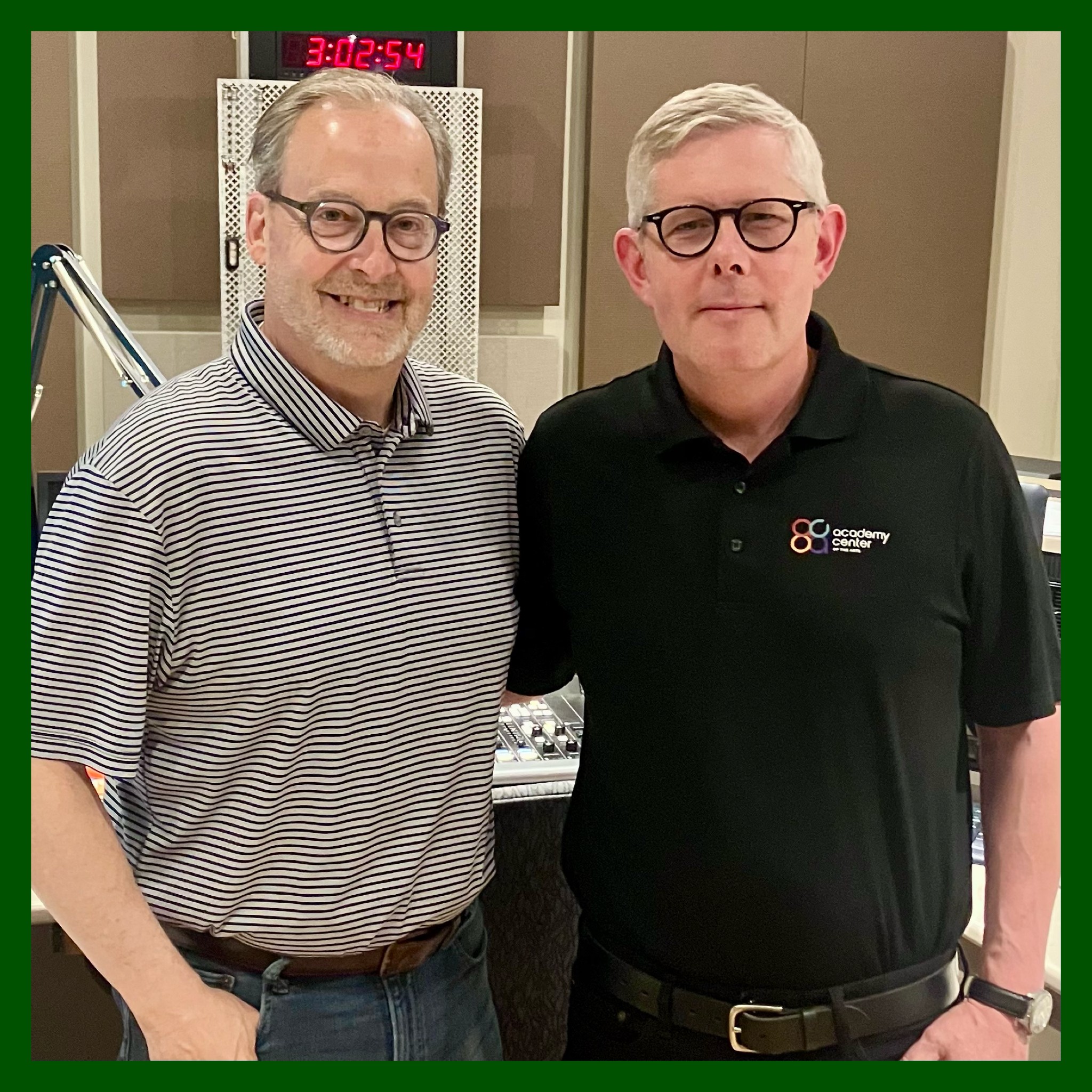
Bruce C. Bryan: My guest today on Naturally Curious is Cyrus Pace. When discussing the music industry and its draw with others, I've often quoted Cyrus. I remember him saying nearly 20 years ago that people should get into the music business because they can make tens and tens of dollars. Music is so much more, especially live performances, but there's an element of business that's a part of that same conversation.
Today, we'll talk about Lynchburg, sustaining live music, and the arts. Cyrus's job as the new executive director of the Academy Center for the Arts and his vision for taking this very successful entity forward. We'll get a chance to hear about upcoming events and dive into his story too. My conversation with leader, music expert, and talented musician Cyrus Pace is coming up next on today's episode of Naturally Curious.
Pace Segment 1
Bruce C. Bryan: Cyrus Pace, thank you for being my guest on the show, and welcome.
Cyrus Pace: Hey, thank, thanks. I feel good about being here. I feel young, inspired, upbeat, energetic
Bruce C. Bryan: And all that right at the beginning of the show. Yes. So 460, you're getting a lot of experience on that, speaking of joy, on that joyful highway these days, right?
Cyrus Pace: Yes. Yep.
Bruce C. Bryan: What was your first day like at the Academy Center for the Arts in Lynchburg?
Cyrus Pace: Well, you know, like leaders do, you get to know people, you figure out where the bathrooms are, and you do a tour of the- ... of the buildings and, and start knowing what it is you're gonna be working on. And I mean, you know, that...
kind of like everybody else's first day. You know, figure out where the coffee maker is and, and, uh, be excited about it- They're- ... which, which I am.
Bruce C. Bryan: They're asking you to make big decisions, and you're trying to find the drinking fountain.
Cyrus Pace: Yeah, exactly, exactly. I, you know, luckily, had gotten to know the organization through my good friend Jeff Kirschner, who was the outgoing executive director.
So I felt like I started with some good backstory on, uh, on the organization and what its, uh, opportunities were. So it felt good to, to start there finally.
Bruce C. Bryan: And are you getting the lay of the land there at the Academy Center and also in Lynchburg?
Cyrus Pace: Totally. Um, I mean, I'm in my third month. I feel really good about, about the work.
Haven't seen anything at all that, that worries me about the organization, how it's structured, you know, how... what the balance sheet looks like, the people involved. It's a really, really strong organization with strong community support. And Lynchburg is interesting in that there, there's a lot of theater companies, maybe more than any city of that size.
Um, so there's a lot of theater happening there, but in terms of venues, right, the Academy is the place. So we don't have the kind of redundancy maybe in Lynchburg that we get sometimes in Roanoke, where it seems like everybody's fighting for the same ticket sale or the same donor dollar. Um-
Bruce C. Bryan: It is the place.
Cyrus Pace: Yeah.
Bruce C. Bryan: And a wide range of acts and, and things happening there. And I, I do wanna spend some time a little bit later in the show talking about the Academy Center and the programming and those kinds of things. I'm curious, right, like, how many employees, board members, sponsors, and all that- Sure ... are you kinda keeping track of these days?
Cyrus Pace: Yeah, sure. So, uh, Academy Center has 25 full-time employees, and of course, like any organization that does a lot of live music or performing arts, we have a lot of education programs there. You know, we have an art gallery, so a lot of part-time folks, too. So, you know, 50 to 70 part-time folks, depending on time of year.
Currently, I hope I don't get this wrong, but, uh, 21 board members, I believe. I
Bruce C. Bryan: think nobody's gonna quiz you on the exact number. Yeah.
Cyrus Pace: Yeah. It's like
Bruce C. Bryan: around 20
Cyrus Pace: works. Around 20 board members. Yeah. And, um, sh- lot, a lot of shows. It's a $4.5 million budget, and- So
Bruce C. Bryan: that place is busy. It's busy You're doing many, many shows.
Two, three a week, or does it vary? Is it
Cyrus Pace: some- Mm. I mean, the- two or... Probably. There, there is Fridays and Saturdays where there are three events happening on one day.
Bruce C. Bryan: Wow.
Cyrus Pace: So one, one in the historic theater One in the warehouse theater and one at, at the music hall, which is a 100-seat venue.
Bruce C. Bryan: By the way, you're listening to Naturally Curious.
I'm Bruce Bryan. This is Cyrus Pace. He's the executive director of the Academy Center for the Arts. Cyrus, has anything kinda surprised you so far?
Cyrus Pace: No
Bruce C. Bryan: Not really,
Cyrus Pace: huh? Not, not in that sense. I mean, I, I mean, pleasantly surprised might be the way to think of it.
Bruce C. Bryan: That's fine too. Yeah. Yeah.
Cyrus Pace: Um, I've been really inspired by the level, level of support in Lynchburg for Academy Center.
Um, I've been really fascinated by downtown Lynchburg, which, um, you know, I hate to say it this way, but I was su- it's surprisingly cosmopolitan. There's a lot of things to do. I'm living in downtown Lynchburg when I'm there during the week. A lot of restaurants.
Bruce C. Bryan: It's a great vibe.
Cyrus Pace: It's a great vibe. It really is.
Yeah. The, you know, the, the green spaces, the ability to get anywhere. I park my car as I arrive, and I generally don't get back in my car until I pull out, so it's pretty, pretty great.
Bruce C. Bryan: So what things for you, I, I know it's a similar position, but what things for you are different about the position you're in right now?
Cyrus Pace: Sure. Uh, I mean, you know, scale is bigger, Academy plays a pretty important role in the visual arts. So pottery studio, art studios, a lot of outreach in the visual arts world. Um, there's a lot of theater. And so, you know, that, that's different. Structural differences, the building doesn't belong to the city of Lynchburg, right?
Jefferson Center belongs, the building itself belongs to the city of Roanoke, so that's different. Meaning the foundation of the academy is responsible for sustaining it and coming up with business planning that, you know, allows it to sustain, and that's a slightly different conversation, and we don't have to get too in depth on that.
Right. But it's just a different conversation. That,
Bruce C. Bryan: that's been, I guess, well documented. Mm-hmm. Um, but before going deeper into your work at the Academy Center, I wanted to talk about your time at Roanoke's Jefferson Center. You were there for over 10 years. Do you have a favorite memory from that time?
Sure, but
Cyrus Pace: so it's actually fif- a little over 15 years.
Bruce C. Bryan: I was gonna say closer to 20. Yeah. I mean, I... Yeah. Yeah. But it's been a while.
Cyrus Pace: Yeah. It was- Had
Bruce C. Bryan: been a while ...
Cyrus Pace: 15 years. I mean, it, it, it's the moments in the music lab, the education program where someone like Chris Thile or Derek Trucks or Branford Marsalis reached kids, you know.
And
Bruce C. Bryan: you could just see the kids- Yeah ... respond in that moment, right?
Cyrus Pace: Yeah. It was those moments. It was, you know, Emmylou Harris and Buddy Miller in the hall. That's one of the top five performances I've, I've seen in my life. It was the small room performances by cutting-edge New York City musicians who would come and, and be in Roanoke for a night, a 7:00 set and a 9:00 set, giving this community, giving the Roanoke community access to, you know, to, to arts that would, you know, be very difficult to see unless you got in a plane and flew to New York City.
Bruce C. Bryan: Yeah. And so you immediately went to the performances, which makes perfect sense- Mm-hmm ... as a lover of music. Are there any kind of behind-the-scenes things you're particularly proud of from your time, the 15 years at the Jefferfson Center?
Cyrus Pace: sure. We invested deeply in capital You know, we really did a good job or the best job we could do at taking care of the building, millions and millions of dollars raised and invested in the building.
Um, so it was important to us that we did our best as stewards of that historic space. I'm proud of that work. I'm proud of the community of donors who, who, you know, believe in it and wanna see it sustain and understand the important role it plays for culture. You know, that, that I'm proud of. I'm also proud of the fact that we took quality very seriously.
We booked things that were good and super high quality, and then we made sure that the experience that people had when they arrived w- was also of quality. It's everything from what was the parking scenario like, how long did it take you to get a drink at the bar, how much did you pay for the drink, and then once you were sitting in your seat, were you comfortable, and, uh, what kind of experience did you have in the room?
Did it sound good? You know, people may not rationally reflect on that or it's not a logical feeling they may have in the room, but if it's too loud or too soft or just the fidelity isn't very high, people won't come back. And in the arts business, you have to fight really, really hard to retain people.
You can't afford not to ensure super high quality.
Bruce C. Bryan: Well, super high quality is what was produced at so many, uh, times during your 15-plus years at the Jeff Center. You didn't ask me, but I loved the Amos Lee show. I think I say shows 'cause I think I saw him twice there. Yeah. And, uh, a lot of other things that you and your crew, and, you know, brought to Roanoke.
You mentioned earlier about Jeffrey, and, uh, very well and highly regarded leader at the Academy Center for the Arts. By the way, I'm Bruce Bryan. This is Cyrus Pace. We're talking about live music and about the Academy Center for the Arts in downtown Lynchburg. You know, is it hard to follow somebody as highly regarded?
And even though things are going great, do you see things that you can build and expand upon? Are you encouraged by that?
Cyrus Pace: Uh, I, I... The DNA is really good there I mean, the culture is great. The board is engaged. The community supports. Um, so I found that to be refreshing. You know, it's, it's just as possible for me to have inherited something that was toxic where, you know, things just weren't working and people weren't communicating, and that's not what I found.
Bruce C. Bryan: This isn't that.
Cyrus Pace: This isn't that.
Bruce C. Bryan: And yet, um, though it's not any c- close to anything like a turnaround, there are obviously a new set of eyes sees, see different things. Do you see where you're gonna be able to help the organization go even further?
Cyrus Pace: Yeah, primarily the first stage is helping the community define through consensus what they want it to be five years from today.
Maybe three. Depends on, you know, how, how far our vision can go into the future in the strategic planning process. But asking the question, you know, let's be honest with ourselves about what we're doing well, what maybe we aren't doing very well. What are some things we should stop doing because they just don't work, or there isn't a need for them even though we might have a relationship to them?
And then what are some things we should start doing? And, and having those conversations with the community and creating a vision for how it can improve. It could be just as practical as we'd like more money in our capital endowment so that in five years from today we know have, we have the money to replace the roof.
Okay. Let's talk about how to do that and how to-
BruceC. Bryan: How do we get there?
Cyrus Pace: How do we get there? Or it could be bigger. It could be we wanna be a celebrated performing arts town. Maybe the best performing arts town in America. Oh. Okay. Let's talk about what that could be. And, you know, even if the definition of what that is may not be as clarified and sometimes not as actionable as we want it to be, that vision of how it can be better helps a community be inspired and keeps them engaged and moving forward with it.
Bruce C. Bryan: So you have other people booking the shows there at the Academy Center, but do you have a say or any input in that? Or how does that work?
Cyrus Pace: Sure. So, um, you're right. There's a, uh, outside promoter who we basically engage to help us find shows that might be touring. Uh, but yes, obviously for me, you know, 35 years in the music business and 15 years at Jefferson Center, those are the, m- you know, really important meetings for me to attend, and we're guiding those conversations.
And I am, at the end of the day, making determinations on which offers gets, get placed and which don't. And, you know, talking about risk tolerance, which of these shows do, you know, are people comfortable taking a risk on? If we're doing 50 shows, of course you normalize the loss and benefit of profit margins- Range
in those shows. Yeah, the range. If you're trying to make your nut on one $75,000 offer, then you're gonna be really panicked about whether that works out or not
Bruce C. Bryan: Cyrus, how does the calendar work? In other words, people might be surprised to know how far ahead you're looking at booking these artists.
Cyrus Pace: Sure. So in a performing arts center environment everywhere in America, it's the calendar, the calendar's the hardest part, right?
So what you do l- generally is you build in your legacy resident partner organizations like Lynchburg Symphony or Opera on the James, Charlottesville Ballet, which is a resident partner at the Academy. And you, you take those organizations, get them in the calendar first, and then you start fleshing out your education program, and then you've got a group of key dates that, that you, you know, you put out to your promoter and say, "Listen, here are the key dates that we're trying to get things done."
It's a smart question, Bruce, because in the music business or the performing arts business, there's a lot-- There's no mystery to it, actually. You gotta understand the market you're in. Don't inflate what you think people wanna see. Be real honest about it. And then is the artist touring, do you have the right size venue and money to pay them, and do you have the date?
That's pretty much-
Bruce C. Bryan: That's the formula ...
Cyrus Pace: that's the formula.
Bruce C. Bryan: Well, let's get your insights on the music business and talk in more detail about the Academy Center for the Arts when we return
Pace Segment 2
Bruce C. Bryan: Welcome back, Cyrus Pace. So how long do you think you'll be the new guy at Academy Center?
Cyrus Pace: Ooh, what a great question. Um, I probably, again, in my third month, it's probably enough looking back at this point. Now it's a question of what contributions I'll make moving forward. Uh, can't use the honeymoon period as an excuse anymore for things.
I will say it's, it's a complex organization. It's well Uh, well run, incredibly well operated, really key, the right people are in key positions. Um, but I probably still have a, you know, few weeks of understanding some things.
Bruce C. Bryan: I'm not gonna put words in your mouth, but I bet you have another six months as the new guy.
But you'll be walking around Lynchburg in 2028, and they'll say, "Aren't you the new executive director of Academy Center?" Chris Morrow was the new city manager in Roanoke for about a decade- He- ... the whole time he was there.
Cyrus Pace: It'd be interesting. It might be good if they keep saying that because it means I haven't worn them out.
There you go. You know, lead, lead... One of the key leadership concepts that I keep reminding myself is you have to be very conscious of how you turn up the heat on change and over what period of time it takes to do those things. And so right now, the changes that I think would be beneficial, it's really just fact-finding and figuring out what's gonna w- work.
And then you get clear pretty quickly on who, who's comfortable with change and what, what processes might work out and what may not work out based on people's reactions to those things. Thus far, I've found everyone on the board and the staff to be infinitely open about their perspectives on the impact of those changes, and some of which we're just not gonna implement, and others we will.
Bruce C. Bryan: Man, I think we could do a whole show on that last 30-second topic. That's right. And it's really interesting, and I noticed during... I kind of did a lot of change management, um, back in my broadcasting days, and I'd go in and say, "Well, why do we do this?" And if they could tell me why, that was one thing. If they say, "Well, it's just the way we've always done it," then it's like, okay, well, it's, maybe it is the great way to do it, but let's figure it out.
But, uh, I never liked leaders that walked in implementing their system before they kinda got the lay of the land.
Cyrus Pace: Yeah. Well, well said. And what you find is, again, I, I work in the arts, so people assume that nobody's risk averse, that it's creative work all the time, new ideas are flowing out of everybody, and everybody's like, "Yeah, let's do that.
Let's do that. Oh, what about this? Let's do that." But, but the nonprofit sector is not that because the definition of success on a financial side is often can we break even this year? We budget the number of contributed and earned revenues that makes sense for the expenses you have and try to get to zero.
And if you're try- fi- constantly trying to get to zero, it can create a, a weird kind of risk aversion. So how are we building risk tolerance? Where are we talking about, uh, where it makes sense to take risk, and frankly, where it doesn't make sense to take risk? Don't take risk in quality, for example.
Always do things that sound good and feel good. 'Cause if you're not getting that part right, people will stop coming.
Bruce C. Bryan: Man, that's some wisdom right there from Cyrus Pace at Academy Center for the Arts in Lynchburg, downtown Lynchburg. cultural mecca of Central Virginia. How's that? And I'm Bruce Bryan. This is Naturally Curious.
Most everyone loves music, Cyrus, so they think they can do what you or your team does. Do you get a lot of you shou- you shoulds? You should have this person, you should have that act, you should do this, you should do that, right?
Cyrus Pace: Yes. And it really, you know, their ideas are not necessarily bad, it's just not of scale.
It can be, "Hey, I love this artist so much And I just know they'll do well here. And I love that they're, you know, invested th- but it's, it's just not the way that's gonna work out.
You don't wanna sell 70 tickets in an 800-seat venue. That's not how you want that to feel. Um, and then on the other side of the scale, which is, you know, this is an artist that sells... Y- you know, Billy Strings is one everyone wants to talk about now, right? Why don't we do Billy Strings? Well, because he'll sell 10 thou- he sold 10,000 t- tickets at the Roanoke Civic Center in about two hours, right?
You're gonna do 10,000 seats, he doesn't wanna play 800 seats- Right ... you know?
Bruce C. Bryan: Right.
Cyrus Pace: And his case, he has such a neat model which says, "I wanna s-" if I can play a 10,000-seat venue, he wants to do it, not just because he gets to reach more people, but because the ticket pricing is affordable for his fans. It's a beautiful thing.
Bruce C. Bryan: So the model works- Yeah ... for him. But somebody that's not in the business on a daily basis may not be, be as tuned into that.
Cyrus Pace: Yeah, well, the, you know, not to stir up any drama here, and I don't intend to do that, but where we see this go wrong oftentimes is amphitheaters, right? Municipalities that own amphitheaters will say, "Well, we, we're gonna get into the music business."
Or they hire a promoter who they're hoping can make sense of, uh, keeping that space programmed. And, you know, it's a, it's a complicated business, and it's complicated to try to find someone that is competent to do that work.
Bruce C. Bryan: Yes. That, and that, that makes perfect sense. Cyrus, how would you describe the place to people who are not familiar with it?
Cyrus Pace: Sure. Um, uh, first I'd say it's a beautiful version of saving the history of your community in the most visible possible way. So in 2025, the venue celebrated 120 years.
Bruce C. Bryan: Wow. So it's been around.
Cyrus Pace: Yeah. 60 of those years it was dark.
Bruce C. Bryan: Okay.
Cyrus Pace: Broken down and unused. So Lynchburg is an example of a community that decided that that was not okay, and raised $30 million along with the city of Lynchburg.
The municipality itself supported this, you know, this campaign to ensure that it remained as a key cultural asset to the community. And just like they hoped would be the case, it defines Lynchburg. It reminds people what it feels like to come to a place that cares about the past, believes in what the arts can do today, and thinks about the future.
I like to tell people that it- You know, it's beautiful. I mean, it's really, really beautiful. What's surprising to people is there's also an additional theater, the Warehouse Theater, behind it where I can put 500 people. Then, you know, we have a- all these other art spaces. So they'd be surprised to see how much is going on there and how much actual space is available for the important work happening in that community.
Bruce C. Bryan: And so it's a little bit of a matching game depending on the act or the type of performance where it might go.
Cyrus pace: Exactly.
Bruce C. Bryan: So it's, it's a lot for your team to keep an eye on. What are you hearing people love about Academy Center?
Cyrus Pace: Um, the history of it, again, is part of it. They, they just are very, very proud of figuring out a pathway for it to survive and sustain and do what it does.
When they come to a show, they're blown away by how beautiful the hall is. I mean, it's a real old opera thea- opera hall You know, that of course was transitioned into a music-- I mean, to a mu- movie hall at some point. They all were. Uh, so it's three, you know, three floors, two balconies.
Bruce C. Bryan: Wow.
Cyrus Pace: And so the historical nature of it just is overwhelming.
And people are excited, again, as long as you book something that they wanna see, you know.
Bruce C. Bryan: Which is the perpetual challenge. Uh, I'm curious, does it matter that you were a musician first? And people that may not know you, talk a little bit about your music background.
Cyrus Pace: Sure. So, um, I have a master's degree in jazz guitar from Manhattan School of Music in New York City.
Undergrad's strangely enough is sociology from Roanoke College. And-
Bruce C. Bryan: Go Maroons.
Cryus Pace: Yeah, exactly. And so I, you know, did my first gig at 15 at the Hotel Roanoke. That paid 100 bucks, which was pretty good in 1987. I joined the Navy right out of high school so I could play in the Navy band. Um, I mean, I-- You know, music has always been a pathway for me to learn about the world and frankly generate some income.
And, um, so you've asked an interesting question, which is, you know, d- does that side of the music business in, um, inform the other side, right? So the selling of the, the music as a, as a musician or artist.
Bruce C. Bryan: To donors, to artists, to ticket buyers.
Cyrus Pace: Well, I mean e- To everybody ... I mean, even as a player, right? Mm-hmm.
Someone calls me to play their wedding, you know. So being on the sell side of the music, does it inform anything about the buy side? And, um, I'll just be real honest with you, probably not very much because my trio is gonna make 1,000 bucks on a Saturday, and we're buying $60,000 acts for the hall, right? So it's just- I mean,
Bruce C. Bryan: it is apples and oranges, but I just wondered if part of the narrative is understanding-
Cyrus Pace: That part is right
Bruce C. Bryan: how musicians might approach things and what things you can appeal to as they're touring and why. Like, for example, you talked about the music lab earlier. Sometimes there's artists that might really love to come to a venue because they know they can interact with students or- Yeah ... whatever it might be.
Cyrus Pace: No, no, you've asked the quest- a really good question, and you're right. My tie-in is the fact that I can say, "This is really, really, really good art. This matters. This is something the community should see." Right?
Bruce C. Bryan: Interesting.
Cyrus Pace: And then, or, "This is not something we necessarily wanna affiliate with our brand.
The damage that can be done by presenting this It's
Bruce C. Bryan: brought- Might
Cyrus Pace: not
Bruce C. Bryan: fit ...
Cyrus Pace: it may not fit, and it could destroy your relationship with donors, and that can happen.
Bruce C. Bryan: I talked to somebody about you behind your back.
Cyrus Pace: Mm-hmm.
Bruce C. Bryan: They described you as a cool cat. And I think that that fits right, especially with your love of jazz, right?
How do those traits, or how does that trait fit with you as a leader?
Cyrus Pace: Huh. Well, I gotta think about the, you know, cool cat. I mean, I don't know. Uh, cool-- I hope cool means, uh, you know, thoughtful in decision-making. I hope it means, uh, someone who wants to see the people around me do well. Wa- I wanna resource them so they can do well, and I hope that they would say that I'm kind in leadership, even when the leadership decisions or management decisions are tough.
May not be easy. Yeah. Which, you know, can include someone no longer being on the team. That happens. Um, or big changes which can affect people's understanding of what they do on a daily basis, you know? They-- Sometimes we forget that these folks spend 40 or 50 hours a week with us, working with us, and, and that's more than they probably get to spend with their family, frankly.
So why not create a culture of kindness where people feel good around each other, um, there's mutual respect and a m-mutual willingness to talk about whether we're getting it right or not.
Bruce C. Bryan: Well, you hit on a lot of great subjects, and I really appreciate that. I'm looking forward to talking to you more.
Cyrus Pace, executive director of the Academy Center for the Arts. Thank you for being my guest on Naturally Curious this week. To listen back to the show, to hear the full interview, and for links to learn more about music, leadership, or other topics we covered, search Naturally Curious at radioiq.org.
Naturally Curious was produced and edited by Big Jim Shively and recorded at WVTF Radio IQ Studios. I'm Bruce Bryan. Thank you for listening.
Pace Bonus Content
Bruce C. Bryan: Thanks for sticking around, Cyrus. A little bit more about you. We were talking about leadership earlier, and we had a really fun kinda n-nose into it, and then we started talking about other things Do you have any words that would describe your leadership style? You talked about being kind in leadership, which can still be decisive, obviously.
But how would you describe your style?
Cyrus Pace: You know, it's funny when you get that question because you-- a good leader would automatically think how they'd describe it, and then, you know, sort of your question from before, which is how would other people describe it. So and, and being, being clear, this is a little philosophical, but being clear on whether they're the same thing.
What I hope it is is high empathy and high expectations. But I, but I-
Bruce C. Bryan: Those are two big Es.
Cyrus Pace: Yeah, but I'm not a hundred percent sure that, you know, not... that that's the way it always comes across to people. I don't know. But leadership implies a willingness to consistently ask yourself that question. Am I doing this well?
Am I, am I following my own pathway and values? Am I making the world around me better in the ways I know how to do it? And not being... If you can't reflect on it that way, you should not be in charge of people.
Bruce C. Bryan: Well said. Do you help or mentor others? I mean, e-even outside of the people that work for you.
Cyrus Pace: Yeah. So, um, I teach at Virginia Tech.
Bruce C. Bryan: Okay.
Cyrus Pace: Yep. I've got-- I teach two graduate courses in arts leadership there, one in, uh, nonprofit finance and one in board governance and nonprofit leadership, so that's like the legal structure- Mm-hmm ... of the nonprofit sector and the work that we get done in there, and then the finances that make, you know, hope-hopefully make sense of the nonprofit sector.
And then, um, I, you know, my favorite thing, frankly, is to meet other young arts leaders who are trying to, you know, do their work better. I've done some consulting recently for nonprofit leaders, not just in the arts, but others trying to make sense of some of the challenges that exist in the nonprofit sector, and I really, really love it.
Bruce C. Bryan: Yeah, because they are consistent. Whether you're in the arts or health and human services, board challenges and other kind of leadership challenges for nonprofits are across the board consistent.
Cyrus Pace: Yeah, that's exactly right. I'll tell you a couple. W-w-number one would be the information deficit that exists between a board of directors and executive leadership, right?
And we all like, "God, they don't know. The board doesn't know enough to, to make these decisions," right? And the, and the organ-- then the board is feeling like they don't know enough to make these decisions. And that tension, if it doesn't result in good dialogue, then everything falls apart, so accepting that would be one.
And the other I kinda mentioned earlier, which is just the financial struggle of trying to figure out how to define financial success. Jim Collins of the "Good to Great" world- Mm-hmm ... right, wrote a book for the nonprofit sector, for the social sector that said that for-profits define success as money in and money out to shareholders.
Nonprofits define it not qualitatively or quantitatively. It's just money in, services out. And that's a very different type of math, and it takes a different kind of conversation.
Bruce C. Bryan: So you mentioned Jim Collins. I also know people always help us as we go through our leadership journeys and as we evolve as leaders, uh, and in our work lives.
Who's helped you as you've grown through your career?
Cyrus Pace: Sure. You mean specific names?
Bruce C. Bryan:Yeah. If you want. Sure. It's up to you. Sure. I mean- You can say generally or you can say specifically. I-
Cyrus Pace: I mean it-
Bruce C. Bryan: I ask the question, you get to decide how you wanna answer it.
Cyrus Pace: Sure. Oh, I mean, I can be pretty specific.
Honestly, um, first would, would've been Dr. Rita Bishop, who's the superintendent of the Roanoke City School System s- that hired me, you know, before I had the job at Jefferson Center. Watching her make sense of the difficult work of prioritizing kids and their experience and their education while also figuring out the politics of doing so, and her support of me and my potential to learn those things was key.
Uh, secondly, I've always had really good board chairs throughout my time at Jefferson Center, and the, the one at Academy right now, Jim Wright, is exceptionally g- good and exceptionally nice, and it's a great relationship. Um, and lastly, I'd say, you know, in terms of my leadership concepts, I would mention Kathryn Fralin, who I'm sure you know.
She, you know, she works with a lot of young leaders and helps, um, create cohorts where we can sit around and talk with one another. In fact, I still interact with a lot of those folks and, and, um, you know, if I had not learned those concepts, I could be doing damage now rather than good. Than
Bruce C. Bryan: helping.
Cyrus Pace: Yeah.
Bruce C. Bryan: Yeah. Kathryn's amazing, and she's agreed to be a guest later in the year, so that's gonna be-
Cyrus Pace: That's
Bruce C. Bryan: very cool ... great. Um, what was some of the best advice you've gotten from some of those people?
Cyrus Pace: Well, one of them, uh, here's one, uh, which, uh, you know, I'm not sure exactly f- uh, where I got this from, but that, that politics is not a dirty word.
It's just a realization that what you say and how it's heard by others are two different things. So we're all playing politics in our, whatever, sorry, but in our marriages and our friendships and everywhere. At work. We're thinking about... Yeah. We're thinking about what, what we say and, and then realizing that's not how it might have been heard by other people.
Um, you know, that, uh, that in any organization, if you find people who are trying to find excuses, it's probably the folks that are failing the quickest and the most, um, and that you need to be Pretty assertive about how to make that change for people and encourage them to think about it differently or, or frankly, get them off the bus pretty quickly.
Because if someone is just hell-bent on finding a reason to fail, they're probably gonna continue to fail and try to figure out how to, you know- How to help fix that ... help, help fix that. It's a lot of energy. Yeah. And then also, again, being very decisive if it's clear that that person might succeed somewhere else, you know?
And-
Bruce C. Bryan: Well, if you're sticking around this far, you know this is Cyrus Pace from Academy Center for the Arts in Lynchburg. I'm Bruce Bryan. This is Naturally Curious. Big Jim does all the heavy lifting behind the scenes, and he makes all the magic happen here on Naturally Curious. And now for our first time ever, Big Jim has the question, and Big Jim's question is: Who's your favorite or couple favorite jazz guitarists?
Cyrus Pace: Sure. So I'll answer, uh, living Uh, versus passed away. Okay. Okay. Seems weird to say dead. Yeah. But yeah. Um, living would be, uh, y- my favorites are George Benson-
Bruce C. Bryan: Oh ... You had him in- once
Cyrus Pace: Yeah ... once.
Bruce C. Bryan: I remember that show ... uh,
Cyrus Pace: and Pat Metheny. Mm-hmm. M- I was lucky enough to record with the organ player that was all, on all of George Benson's first records, Dr.
Lonnie Smith, and, you know, so that, that's kinda my world. Um, there are a lot of young guys that I love right now too, but the, um, of the players that have passed away, those no longer with us, I would say the obvious ones, Wes Montgomery and Grant Green, and maybe m- someone that people don't think of a lot, unless you're a jazz guitar player, someone like Tal Farlow.
Uh, and then of course Django Reinhardt, a great French gypsy guitar player who redefined what could happen on the guitar, particularly given he only had two and a half working fingers on his left hand, you know, so.
Bruce C. Bryan: Wow.
Cyrus Pace: Yeah.
Bruce C. Bryan: Okay, so I'm thinking about playlists and favorites. I had Sam Calhoun on from Floyd Fest this spring, and he shared some of his favorites.
It doesn't have to be in the cool cat jazz arena, or it can be, but, um, who are you listening to these days, Cyrus?
Cyrus Pace: Sure. Um, I spend a lot of time listening to Tim O'Brien, a great bluegrass and Americana artist. I spend a lot of time listening to Madison Cunningham, who, you know, she's, I think 30 now, so it's not exactly young, but young in terms of the music business and young compared to me.
Gr- unbelievable songwriter, unbelievable guitar player and singer, and, uh, that, that's really, really good stuff for me. Also listen to a lot of Afrobeat. I love the old school funk stuff from everybody from James Brown to Parliament. Um, I've been going back and listening to a great drummer that a lot of people I'm sure have never heard of, named James Black, who recorded with Yusef Lateef.
He's a New Orleans drummer who also recorded a, a solo record that's very funky and fun to listen to, so.
Bruce C. Bryan: Man this is great deep cuts. Yeah. People are getting whole revitalized playlist opportunity here.
Cyrus Pace: Yeah. I've got a young... A, a new student, guitar student too, so I've, um, really enjoyed working with him and hipping him to stuff that really defined, uh, for me what I think great art is.
And, um, I've gone back now and I've started listening to Bartók string quartets again, which I spent time studying when I was in graduate school. Um, you know, I'm, I'm thinking a lot about, uh, you know... It's some jazz you'd think I'd be listening to, but, you know, I listen to anything that has soul and spirit, anything that just feels really, really good.
Um, anything that I listen to and go, "Man, that, that, that, you know, that's just inc- exceptionally well done." I'll add one more thing to that, which is it's, it's people who are craftsmen. We, you know, we talked a bit about Billy Strings. The most important thing about him isn't that he's figured out how to sell 10 or 20,000 tickets to Bluegrass.
That's a big deal though, but the real big deal for him is the fact that he's a craftsman. He knows how to play the guitar. He's taken it very, very seriously, and he can really play.
Bruce C. Bryan: Wow. That's great. I, I love hearing your angle on things and, uh, jotted a few down, and I'm gonna get to listening. I have four really quick kinda rapid-fire questions.
Sure. Did you ever make a mixtape, or are you too young?
Cyrus Pace: No, I'm... Yeah, I was born in '72, so in the '80s I did a lot of mixtapes. In fact, you know, I had to y- At those days, you had to capture the song on the radio when you heard the first... So you, you know, the mixtapes never had the first five seconds of the song, right?
Bruce C. Bryan: Unless you had a quick trigger.
Cyrus Pace: Yeah, a quick trigger.
Bruce C. Bryan: How about burn a CD, uh, of music? Did you do that for people?
Cyrus Pace: 100%. All right. As soon as I knew I could either do that, I had thousands of them
Bruce C. Bryan: This is the hardest question you're gonna have to answer. I'm gonna, you know, ask you to open up your heart and expose if you'll tell me a few of your music guilty pleasures.
Cyrus Pace: Sure. Um, yeah. And I... People probably aren't gonna f- find them to be particularly guilty, I would guess. Um, I absolutely love The Eagles. I love everything Joe Walsh has ever recorded. So what Joe Walsh, myself, and The Eagles, and people are like, "Oh, you know, it seems like soft rock." It's not. It's the best songwriting.
It's amazing. The best performing, the best singing.
Bruce C. Bryan: I think I grew up in a time where I got tired 'cause I played them on the radio all the time, and I watched the documentary maybe 10 years ago, and I loved them again after that. Yeah. So if you ha- I... My little encouragement, check out that document. It's gotta be really old by now, but-
Cyrus Pace: Oh, I've, I've seen it, and I loved it.
My other one would be Billy Joel. I love Billy Joel.
Bruce C. Bryan: Getting ready to watch his documentary-
Cyrus Pace: Yeah. I did. I- ... 'cause same thing ... it's really good, too. Okay.
Bruce C. Bryan: Well,
Cyrus Pace: good. Yeah. That's good to hear. Any... Again, you're talking about crafts- craftspeople, people who have figured out how to write great songs, took the process very seriously and their performance very seriously.
Bruce C. Bryan: So part of what you do involves new music, and with new students is new music, but I'm curious, do you think you'll ever get tired of listening to new music, Cyrus?
Cyrus Pace: Gosh, I hope not.
Bruce C. Bryan: Me too. Yeah, that'd
Cyrus Pace: be- I hope the
Bruce C. Bryan: same ...
Cyrus Pace: that'd be too bad.
Bruce C. Bryan: What are you gonna do if your child wants to get into the music business?
Cyrus Pace: Um, I would, uh, w- you know, both my kids play instruments. Louis was named after Louis Armstrong, and he plays the trumpet.
Bruce C. Bryan: That's awesome.
Cyrus Pace: You know, Cecilia plays trombone. And Cecilia, of course, is the patron saint of music. Evidently she was burned at the stake, though. I just learned that. That's not great
Bruce C. Bryan: Let's not see the ending. We'll just- Yeah,
Cyrus Pace: exactly ... let's carry
Bruce C. Bryan: on with the rest of the
Cyrus Pace: Yeah, exactly. Um-
Bruce C. Bryan: Left turn on that one.
Cyrus Pace: Yeah, sorry about that, Cecilia, but the, uh-
Bruce C. Bryan: That might've been related to the Paul Simon, you know, version.
Cyrus Pace: Yeah, well- Simon & Garfunkel ... you know what that was about? He, he was saying to her, "I c- I can't, I'm, I can't f- I've got bl- a mental block.
I can't write songs. Please come to my room and help me write this song."
Bruce C. Bryan: Okay. Finally.
Cyrus Pace: That's what the song's about.
Bruce C. Bryan: I'm this many minutes old before I knew that. Yeah. So thank you. Yeah, yeah. I learned something. It's- My, my late mother used to say, "You can't go to bed till you learn something new." So now I can work on sleep- Yeah
which is one of our other off-the-air subjects. Yeah,
Cyrus Pace: but if they wanna go in the music business, I mean, I'm, I, I'm not gonna dictate in any way whatsoever what they do. College, not college, military, not military. Anything that they're inspired by where they think they can, you know, be their best selves and do their best work, I'll, I'll support them.
You know?
Bruce C. Bryan: Cyrus, you ha- have a brother who was a touring musician. Is he still touring, or ...
Cyrus Pace: Um, you know- Do- ... he lives in Southern France now.
Bruce C. Bryan: Okay.
Cyrus Pace: So he's on the French artist visa, which means he gets, uh, as long as he plays 50 or 52 gigs a, a year or something, it's, you know, he gets paid through the French government to continue to be an artist and do his work.
And so he's playing a lot, you know, in France. Not, not what we'd consider to be a standard tour, right? Like, where you get in the bus- But playing a lot ... and you go away for six- Yeah ... you know, six months at a time. Do you
Bruce C. Bryan: get to see him much in the States, or do you have
Cyrus Pace: to go to France- No, usually- ... to see him?
usually once a year, and we try to book a couple things when we, when he's here. Fun. And it's fun. And then I've been there. We took the family, and I played three or four dates with him there, which is fun, 'cause European artists are very into jazz, as you may know, and so it's fun.
Bruce C. Bryan: You're a hero on foreign shores, right?
Cyrus Pace: Yeah, exactly.
Bruce C. Bryan: Always hard to be a prophet in your own hometowns- It- ...'cause you have two hometowns now.
Cyrus Pace: Right. As, uh, Tom Waits would say, "I'm big in Japan." Or is it Zappa that said that, maybe? "Big in Japan." I don't know.
Bruce C. Bryan: Anyway. So Cyrus, as we wrap up, I could keep going. I have so many things I wanna ask you, and you've been such an interesting guest.
But what does the cool cat have to say about what's cool in Lynchburg? And, uh, I was just up there for a, a, a, a couple days and had a great visit, but, um, w- what should people do in downtown
Cyrus Pace: Lynchburg? They should come downtown, park Stay, maybe stay at the Virginia or the Crockett Terry Hotel and find- Walk
Bruce C. Bryan: about
Cyrus Pace: and, and choose among 15 different restaurants, and then walk to Academy Center and go to an art show that's probably start... This art opening that starts at 6:00. Walk down to the Music Hall and see a, a singer-songwriter that might start at 7:30, and then over to the main theater to see a, you know, a main act show.
I mean, it's, there's that much stuff going on in Lynchburg. Um, and it's a community super, super invested in the cultural health of its c- uh, you know, of the people that live there, the population. And I couldn't be any more excited to be there.
Bruce C. Bryan: Well, Cyrus, you've represented your city well, and I appreciate you spending time on Naturally Curious and sharing your story.
And I don't think I've ever given a homework assignment, but I would love for you in passing to think about who else I should be talking to from there, and maybe you can send me an introduction, 'cause I'd love to talk to more Lynchburger folk.
Cyrus Pace: I'll do it.
Bruce C. Bryan: Thanks for being my guest.
Cyrus Pace: Happy to do it