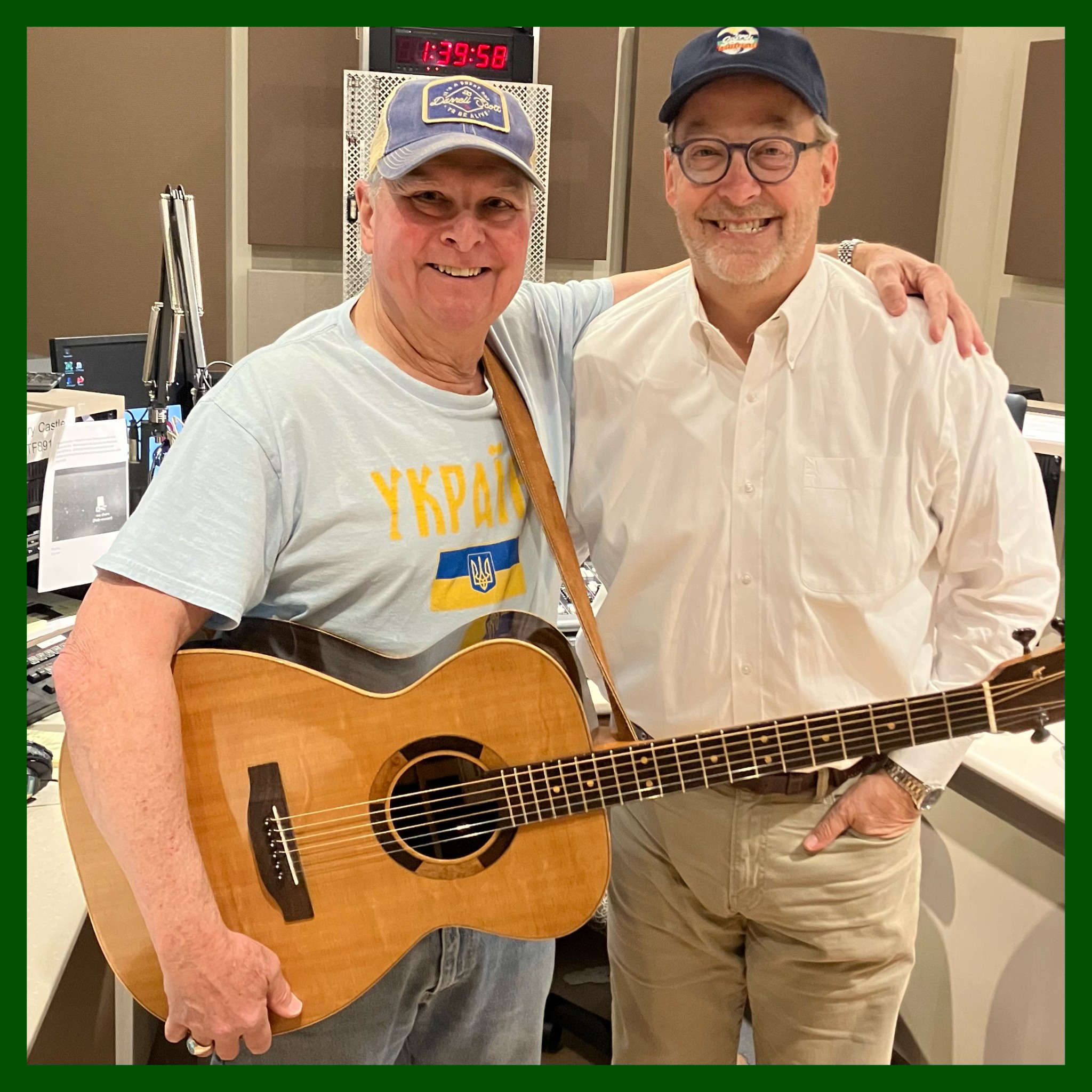
Bruce C. Bryan: My guest today on Naturally Curious is Bob Schmucker. It's hard to pin a label on Bob, but you need some adjectives, and that'll provide a measure of context. Bob is dedicated, helpful, talented, funny, and above all else, kind. That's quite a resume, but alone probably doesn't qualify someone to be a guest on a regional radio show.
Let me go further. Bob Schmucker leads the soon-to-be non-profit Third Street Coffeehouse in the Old Southwest neighborhood in Roanoke. He's also a regular writer, one of the founders of Virginia's Veterans Parade, and a lot more. Beyond that, I transparently share Bob as a person I consider my friend.
Listen to this show and you'll learn more. You'll be pulled in, your spirits will undoubtedly be lifted, and you'll get to know the first person to play music in the studio with me on Naturally Curious. Join me for my conversation with Third Street Coffeehouse's Bob Schmucker, coming up next on today's episode of Naturally Curious
Schmucker Segment 1
Bruce C. Bryan: Bob, thank you for being my guest on the show, and welcome.
Bob Schmucker: Thank you, Bruce. I appreciate it.
Bruce C. Bryan: So many of my guests, Bob, are people I've met or known, and some are leaders I've never met before, and I'm gonna break an age-old radio seal at the start of the show and communicate that we are friends. So before talking about our friendship, I'd like our listeners to kinda hear a little bit about what you're doing now and what you're up to in the community these days.
Bob Schmucker: Well, since I retired, uh, from Optical Cable Corporation last summer, uh, I've been pretty busy, uh, in a lot of different things. Uh, writing is one thing that I've been doing a lot of, and I really appreciate the time to do that. I've been taking care of family issues. Uh, my wife's mom, Alice, is 86 years old, and, uh, I'm primary caretaker for her along with my wife.
Bruce C. Bryan: I think there are a lot of listeners that can identify- with that.
Bob Schmucker: And, uh, I'm also getting to do some things that I haven't done before. I'm, uh, working with Beth Macy's campaign and of course running the coffee house and d- doing a lot of music-
Bruce C. Bryan: You say, "Of course, running the coffee house." Yes. But let's talk for a second- Sure
about the Third Street Coffee House. Tell everybody a little bit about that.
Bob Schmucker: Well, Third Street Coffee House, we are now in our 40th year, which is quite an amazing accomplishment. Started in April of 1987, and it was ... It started with Trinity United Methodist Church as kind of an outreach to the community.
And, uh, for a long time, the, it was run by the church folk, but sooner or later they got a little tired of it, and so they turned it over to the songwriters in the community. And, uh, it's been running along ever since, and I've had the good fortune to be able to be associated it and, uh, associated with it and run it for the last 10 years-
almost.
Bruce C. Bryan: 10 years Okay.
Bob Schmucker: And, uh, it's just an amazing thing to be able to be part of that scene.
Bruce C. Bryan: I can hear your energy for the Third Street Coffee House. Of all the things that you kinda listed, I'm gonna ask you a hard question- Sure ... and say, what are you involved with that's bringing you the most joy right now?
Bob Schmucker: Well, right now it's- Just being a part of that community, uh, being a part of the songwriter community in Roanoke, uh, being able to greet, uh, you know, the songwriters that come in every week, and it's just really a good thing, a really neat thing. It nourishes my soul. It's something I haven't been able to do while I was a part of corporate life as much as I've been doing it now.
Bruce C. Bryan: And we're gonna talk a little bit about that. But, but first I wanna find out how you got involved in these various different, I'm using air quotes on the radio, but hobbies. Like for example, how did you get involved with writing?
Bob Schmucker: I've been writing for as long as I can remember. Uh, a long time in the corporate world, a big part of what my job included was writing, whether it was, uh, business correspondence or writing specifications or any number of things, and I've always enjoyed writing.
And recently in the last few years, I've started up the blog, and, uh, it's been a way for me to just kinda be creative. Uh, it's like songwriting.
Bruce C. Bryan: They are very clever. We're gonna get a chance to talk about that later, later in the show in the bonus segment as well. How about, uh, the music? How, how did you get involved with that?
Bob Schmucker: Oh, I've been playing since I was a kid, and, uh, I played a lot in high school and college, and I wrote some songs in college which are long forgotten. Probably a good thing. Once I got into adult life af- after, uh, graduating college, I didn't write for about 30 years. And then, uh, one time about 15 years ago, my wife had a stroke, my wife Denise, and I tried a number of things to deal with the stress that came with that, and none of them worked as well as pulling out, uh, a rusty old, a rusty stringed old Yamaha that I had in the closet that I hadn't played in years.
And at that time, it was very soothing for her to hear the music. And-
Bruce C. Bryan: So it's interesting- Yeah ... what drove you back in-
Bob Schmucker: Yeah ...
Bruce C. Bryan: to the music. Wow.
Bob Schmucker: I, I was her primary caretaker for a long time, and, uh, it was pretty stressful for, obviously for her and for me.
Bruce C. Bryan: Well, you're listening to Naturally Curious. I'm Bruce Bryan.
This is Bob Schmucker. We were just talking about, um, how you got back into music through your family, basically through your wife- Yeah ... Denise, and, um, the caregiving that you provide. Back to the writing and the music, did these, uh, let's call them extracurricular activities, support or, or kinda clash with your professional responsibilities that you had throughout your career?
Bob Schmucker: Uh, I think they complemented it- Okay ... in a way. Uh, I, I felt like certainly writing songs and, uh, you know, writing, uh, fiction or nonfiction i- is kind of a nice cathartic thing to do, and it helps you deal with the stress of corporate life, and I'm sure you're familiar with that. And you need to have an outlet, and writing and singing, uh, are two things that don't cause hangovers and generally are considered pretty healthy.
Bruce C. Bryan: A way to release.
Bob Schmucker: Yeah.
Bruce C. Bryan: Right? Yeah. So before your time at OCC, what kind of work did you do?
Bob Schmucker: I've been in defense, uh, since I got out of the Air Force.
Bruce C. Bryan: Okay.
Bob Schmucker: And, uh, before then I worked for... Before OCC, I worked for ITT Night Vision.
Bruce C. Bryan: Okay.
Bob Schmucker: I worked for, uh, Fibercom, which made fiber optic communications here in the Valley.
And way back in 19- from 1985 to 1988, uh, I worked, uh, in, uh, Chicago for a small business there called Sonicraft, and that's where I initially got into the defense business.
Bruce C. Bryan: And so you alluded to your time in the military. Yeah. Um, we met through the parade committee. Yep. The Virginia's Veterans Parade, which happens the Veterans Day Saturday- Mm-hmm
in downtown Roanoke, televised on, uh, one of the local TV stations. Thank you for your service. Bob, can you talk a little bit about that part of your life and then- Yeah ... how that led into the, the parade work you
Bob Schmucker: did? Absolutely. Yeah. I-
Bruce C. Bryan: You were one of the founders.
Bob Schmucker: I am. Yeah. Way back, oh, I guess it was about- 12, 14 years ago, whatever.
I was working at ITT, uh, Night Vision with Lapthe Flora, who in civilian life, he was a great engineer, worked for ITT, but he also had a dual career path with the National Guard. And he's VMI graduate. Uh, he had come to America as a refugee. He was one of the Vietnamese boat people, and just has an amazing story for that.
But I got to work with him, and we got to be close because we both had the military background and things like that. I was actually working at OCC by the time he called me up one day and said, "Hey, uh, we're starting this veterans parade thing, and I'm kinda leading it up. I'd like you to come along." Lap Day is the kinda guy you couldn't turn down.
Bruce C. Bryan: He just- If he asks you to do something- There's- ... you do it.
Bob Schmucker: That, i- yeah, he's that kinda guy, and, uh, I respect him completely. Uh, he retired from active duty Army service as a major general a few years ago, and I got to go to his retirement service-ceremony.
Bruce C. Bryan: Oh, that's impressive ...
Bob Schmucker: Yeah. And that was just amazing.
Bruce C. Bryan: Well, and the other part of that is, if I'm not mistaken, he was the first Vietnamese American to become a general- That's correct ... in the United States military, right? Yes. And he- a lot of his career was here in Roanoke, right? Yeah. That's- Or was all of it or just most of it? His, uh-
Bob Schmucker: Well, most of his Guard service was, but he also did a couple of, uh, long tours overseas.
Okay. And, uh, you know, I think he was, It was the second Iraq War, and he did about a year over there. And, uh, he had other long commitments overseas as well. And so that's, he had earned every bit of- Oh, man ... his rank.
Bruce C. Bryan: He- so our listeners can probably Google him, I would imagine.
Bob: Schmucker: Please do.
Bruce C. Bryan: But if you ever get a chance to meet Lapthe Flora, I would agree with you, Bob. This guy is a person, if you're in his presence, you're kinda blown away just by his very being. Yes. You're listening to Naturally Curious. I'm Bruce Bryan. We're talking about Lapthe Flora, but my guest today is Bob Schmucker.
We met through the Virginia Veterans Parade group, which has been about 17 years now, believe it or not.
Bob Schmucker: Has it been that long? They've been doing that. Wow.
Bruce C, Bryan: Time flies when you're starting a parade. For sure does. It sounds like you were volun-told to do it, and, and willingly said, "Yeah. Yes, I will do it." Um-
Bob Schmucker: Absolutely, without a doubt.
Bruce C. Bryan: W- what was it like in those first few years? And now you get to watch it on TV or go in person like everybody else. What, what's that transition like?
Bob Schmucker: Well, it's, it's been amazing to be a part of the local veterans community, and, uh, certainly that was something that, uh, was sorely needed. Uh, there were a lot of veterans who came back, especially Vietnam guys, who really didn't get much of a welcome home or any sort of appreciation at the time.
So it was kinda long overdue. And to be able to see the community turn out as it has every year for this parade and, you know, just- To go down to City Market building before the parade and see all the old veterans that are, are coming from, you know, like the VA or, you know, if they're retired around here, they come, and be able to shake their hands and recognize what they've done for their service for the country, it's just an amazing feeling.
Bruce C. Bryan: And to thank them, and again, Bob, to thank you again. Thank you for your service.
Bob Schmucker: You're welcome. Thank you.
Bruce C. Bryan: So you're no longer even on the organizing committee as a founder, and in fact, I think only one or two of the half a dozen founders are involved. What a leadership transition. Can you talk a little bit about that?
Because it's still going on, and it's going well, and they've probably taken and made it even bigger. But perhaps you could talk about that leadership transition some. Is that connected to the military leadership background you all have?
Bob Schmucker: Well, I think it, it, it, in a way it does because in a military organization, people are always, you know, either retiring or separating or transferring, and somebody else is gonna take up the responsibility.
And in the last few years, we've got some younger guys from the community involved, and they've really taken the reins of the operation and are making it bigger and better every year. Uh, whether it's by orchestrating flybys or, you know, just getting more and more groups involved. Uh, the outreach is amazing.
The partnership with Channel 10 is amazing, and to be able to be a part of that, I think it's the biggest veterans parade in the state.
Bruce C. Bryan: So when we come back, I wanna discuss Ukraine and the Third Street Coffee House, but I'm gonna warn everybody, this next segment will go really quickly.
Stick around and hear more from Bob Schmucker after the break, including a song.
Schmucker Segment 2
Bruce C. Bryan: Welcome back, Bob Schmucker. Bob, I'm wondering, have you ever heard the description, the family you choose?
Bob Schmucker: Yes, absolutely.
Bruce C. Bryan: So I know you have a family. You've already talked about Denise and about your mother-in-law, but talk a little bit about the bonus family you have and how that all came together.
Bob Schmucker: That was an amazing thing.
Uh, I remember clearly one Sunday morning in late November of twenty twenty-one, uh, I opened up the Roanoke Times back when everybody did get hard copies, and the first thing I saw on the front page was a picture of this woman and a young child, and a big story by Heather Rousseau that talked about Jenya and her son, Igor, how they had come from Ukraine as refugees and had landed in Roanoke.
And it was an amazing story. And I texted Heather and I said, "Wow, that is really an amazing story you wrote." And we texted back and forth for a while, and I asked her, I says, "You know, I know refugees come to America with very little of their own because of the situation that they left." I said, "Is there anything Third Street Coffee House can do for them?
Maybe give them a gift certificate or something like that." And, uh, so she asked Jenya, and she had texted her, I guess. And Jenya's response was, "I don't need anything. Um, it would be nice if you could get my son, Igor, a little stuffed toy or something like that, a little stuffed animal." And I thought, "Oh, man."
And then, and then she went on and said, "I just wanna meet some friends."
Bruce C. Bryan: Yeah, new in a country, new in a city. Yeah.
Bob Schmucker: Right.
Bruce C. Bryan: No connection.
Bob Schmucker: Right. And so we started talking about, you know, how does somebody meet friends in a new city, me and Heather. And I thought, "Why don't we just use Third Street Coffeehouse and have a Christmas party for them, and invite a bunch of 30-somethings, and, you know, people like Heather with kids, and, you know, maybe they could meet a few people and get to know people?"
And so long story short, uh, we did plan that, and the whole community came together and bought all sorts of things from gift cards to tickets to sporting events, uh, theater events, uh, hockey, and all sorts of things that we were able to fill the space under our Christmas tree at the coffee house with a mountain of gifts.
Bruce C. Bryan: And those gifts went to handful of Ukrainian refugees, right?
Bob Schmucker: They ended up, yes. Uh, and a lot of them were for Igor and Jenya, but there were a lot of kids there. And so we actually had a second Christmas party, and we had gifts for everybody there. But that came about because we had this Christmas party, and that was on December 17th, I believe.
At the end of that, I met Anna and Ina, who were also members of the, uh, local Ukrainian community. In fact, Anna was Jenya's cousin. And they had told us that they, as a community, no longer had a place to meet because they had formerly met at the Russian Orthodox Church in Salem, and they didn't feel welcome there because most of the congregation was Russians, and they were pro-Russian.
And they asked if they could celebrate their Christmas, Orthodox Christmas, on January 7th at the Coffee House. And-
Bruce C. Bryan: So you made that happen.
Bob Schmucker: The... Yeah. I mean, it was easy. They said, "All you gotta do is open the doors, and we'll come. You know, we'll do everything."
Bruce C. Bryan: Take care of the rest.
Bob Schmucker: And they did.
Bruce C. Bryan: Well, you're listening to Naturally Curious.
I'm Bruce Bryan. This is Bob Schmucker. You know, Bob, we are already an in- an international show, but now we probably have some listeners in Ukraine, so, um, do you wanna say anything to your friends and family in Ukraine?
Bob Schmucker: Slava Ukraini.
Bruce C. Bryan: Okay.
Bob Schmucker: Yeah.
Bruce C. Bryan: I think a lot of us see the big news, and I'll just keep it at that, as it relates to what's happening in Ukraine, and, and frankly, it can be a little bit overwhelming.
People, I think, sometimes can get frozen. Um, when our listeners hear this, and some decide they might want to connect or help or support folks in Ukraine or in the greater Roanoke community, h- how would you in- advise them to get involved, maybe not as deeply as you have, but how could they get involved?
Bob Schmucker: Well, the first thing I would suggest is that for those who have not known any Ukrainian people before, and maybe are, are a little like, "Well, I don't know anything about Ukraine. How do I do this?" Ukrainian people are just like us. Uh, they have the same emotions as us. They have the same values as we do.
Uh, everybody I've met from the local Ukrainian community here is just a wonderful person, and they've accepted me as a part of their community, which, you know, I'm continually blown away. Uh, and it's just so nice to know these people and to have these relationships with them. And so I would suggest if you know any Ukrainian people in your community, reach out to them because they're all suffering right now as they go through this awful war.
And, you know, just drop by like you would any other friend that's going through a tough time. Like- Give 'em a hug, and maybe i- if you happen to, you know, be close to one, you know, maybe bring 'em, uh, a cake or some dinner, something. Just reach out. They're just like us.
Bruce C. Bryan: Just like you did. Yeah, just like they- Just like us
just like we are. Right. So Bob, we're getting a little short on time, and, but you brought a guitar, right?
Bob Schmucker: Yeah.
Bruce C. Bryan: So before talking about the Third Street Coffee House, I'd like to have you play a song, okay?
Bob Schmucker: Absolutely.
Bruce C. Bryan: So Bob, what are you gonna play for us?
Bob Schmucker: I'm gonna play a song called Charlie the Catfish, which comes from a little fishing trip that I got to take with Igor one day when we caught a big old catfish.
He caught a big old catfish, and we named him Charlie. Couple months later, they were back in Ukraine, and I needed a birthday present, and so I wrote a song for Igor. This is called Charlie the Catfish. I was sittin' in a boat just the other day. Tried to close my mind and drift away. Just 'bout time I was fallin' asleep.
Came a tap, tap, tap from underneath. Who's there? Who's there? Who dares disturb my nap today? Who's there? Yeah, just 'bout the time I was fallin' asleep. Came a tap, tap, tap from underneath. And I just wanna know who's there
I looked in the water, didn't see a thing. So I closed my eyes and started to dream, about a boy and his mom back in Ukraine. Then a tap, tap, tap came round again. Who's there? Who's there? Who dares disturb
my nap again? Who's there? Yeah, I was dreaming about a boy and his mom in Ukraine. And then a tap, tap, tap came round again. And I just wanna know who's there.
I looked in the water and to my surprise, a familiar face looked back at my eyes. It was Charlie from the catfish clan. He was smiling big as he tapped his tail. I'm here. I'm here. Looking for my buddy Igor, so I'm here. It was Charlie from the catfish clan. He was smiling big as he tapped his tail. It's good to see you, Charlie, again.
So Charlie and I had been friends ever since we'd gone fishing with Igor, and Igor caught this big old catfish named Charlie. But Charlie was there to see Igor, not me, so I had to tell him that Igor wasn't there. And here's the story. Well, you know that boy went back to Ukraine with a big fish story that he'll tell his friends.
And I'll never forget how you pulled and tugged, came out of the water like a jitterbug. So thank you. Thank you. You made his day last summer, so thank you. Yeah, I'll never forget how you pulled and tugged, came out of the water like a jitterbug. It's good to see you, Charlie, again
Then Charlie said with a wave of his fin, "I miss that boy and I hope you'll send happy birthday from his catfish friend." Then he smiled and he danced on the top again, and he sang, and I sang, sang happy birthday Igor in Ukraine. So remember me and the fun we had. Yeah, hope we'll meet on the lake again. So happy birthday, Igor.
Happy birthday, Igor. Happy birthday, Igor in Ukraine
Bruce C. Bryan: That was the first ever live cut of music, live in air quotes, from n- on Naturally Curious. I knew I could trust you to break the seal, Bob. Thank you.
Bob Schmucker: Thank you.
Bruce C. Bryan: So it's a great transition from Ukraine into Third St. Coffee House. Is that the kind of music people would hear at Third St. Coffee House?
Bob Schmucker: Yeah. We, we focus on a lot of acoustic, uh, some blues and, uh, mostly folk and Americana.
Bruce C. Bryan: So how often is Third St. Coffee House happening?
Bob Schmucker: Our feature shows are every Friday night. Doors open at 7:00, and the show starts at 7:30, and we generally have a local or regional opener, and usually a regional or national touring artist is our featured performer.
Bruce C. Bryan: Okay, I'm gonna take a stab that it's on Third St.
in Roanoke. Is that right?
Bob Schmucker: That, yes. It's on the corner of Third-
Bruce C. Bryan: Tell everybody where... I'm sorry to interrupt you- Uh- ... but tell everybody where it is.
Bob Schmucker: It's on the corner of Third St. and Mountain Avenue. The address is actually 305 Mountain Avenue Southwest in Roanoke, Virginia, and it's under what used to be the former Trinity United Methodist Church.
It's now Trinity Commons, which- Which
Bruce C. Bryan: our listeners might know- Yes ... 'cause Isabelle Thornton was just a guest- Yeah ... a few weeks ago.
Bob Schmucker: Absolutely.
Bruce C. Bryan: Um, so, and, and a website also.
Bob Schmucker: Yes. We, we actually have a Facebook page. We're developing a website.
Bruce C. Bryan: Okay.
Bob Schmucker: And we hope to launch that in the fall.
Bruce C. Bryan: So people can find you on social media- On
Bob Schmucker: Third-
on Facebook. On Facebook, yes.
Bruce C. Bryan: Okay. Yeah. And that, I a- they already answered the question about what's next at Third St. Coffee House, and hopefully folks can stick around and hear a little bit more. So that probably takes us to the end of the show. There's so much more I wanna talk about. Thank you for sticking around for the bonus segment online afterwards.
Bob Schmucker from, among other things, the Third St. Coffee House, has been our guest on the show today on Naturally Curious. To listen back to the show, to hear the full interview, and links to learn more about live music, Bob's engaging blogs, or the other topics we covered, search Naturally Curious at radioiq.org.
Naturally Curious was produced and edited by Big Jim Shively and recorded at WVTF Radio IQ Studios. I'm Bruce Bryan. Thank you for listening
Schmucker Bonus Segment
Bruce C. Bryan: So thanks for sticking around for our bonus segment. A little m- little bit more about you, Bob, and about your, what you just shared with the music. What is it about music? What do you think it is that makes music so impactful for people?
Bob Schmucker: I know for me, it just is a tremendous stress reducer.
And to be able to listen to music and, you know, just leave all your troubles behind, whatever's going on in your life, and we often advertise Third St. as a place to get away from all the stress of the week and- and the day, and I think that's what most people enjoy about it.
Bruce C. Bryan: So what have you seen it do firsthand, maybe even at Third St.?
Bob Schmucker: Third St. is a place of miracles, and I don't say that lightly. We've had a lot of people come to Third St. that have real issues, whether it's veterans dealing with PTSD, my wife dealing with a stroke Or, other sorts of things that, most people would be sidelined with. And they come to Third Street, and because of the fact that it's kind of a family atmosphere, it, it's like being in a, in a big living room, and y- it's so intimate with the songwriters, people just relax and all their stress just melts away.
Bruce C. Bryan: And it's comfortable- Yeah ... for people.
Bob Schmucker: Yeah.
Bruce C. Bryan: So, you are involved with other nonprofits. I know you've supported and helped The Spot on Kirk. You've done things, as you've mentioned, with the Ukrainian community. What other nonprofits are you connected with at Third Street Coffee House?
Bob Schmucker: We, we are big supporters of Feeding Southwest Virginia.
And one of the things we did during COVID, we started a little program called Tuesday Tunes for Feeding Southwest Virginia. And it started small. It was just, we'd have a local performer come on stage and do maybe 20 minutes. Of course, it was an empty room because it was during COVID times.
But we'd put a little button there to make a contribution for Feeding Southwest Virginia. And we did this every week, and over a period of 18 months, we raised over $32,000 for the food bank.
Bruce C. Bryan: Wow, Bob ... That's amazing
Bob Schmucker: It, it was amazing. And, uh, you know, like I said, it's a place of miracles. Uh, we did another show for Feeding Southwest Virginia last, December.
And, uh, the Panini Brothers, well, actually Larry and Mike opened the show, and then Keith Goggin was our, feature performer for the night. But we raised over $4,200 in a single night, and that was 100% matched by the board of Feeding Southwest Virginia. So that, the total of that night's, income for Feeding Southwest Virginia was over $8,000, which does a tremendous lot of good, you know, especially in the holiday season, for the folks who need the food bank.
Bruce C. Bryan: That had to have felt good.
Bob Schmucker: Oh, man. I am, I am so proud of what this local community does for, you know, our neighbors around us and how generous they are. And, uh, it, it just brings a tear to your eye.
Bruce C. Bryan: Well, you're listening to Naturally Curious. I'm Bruce Bryan. This is Bob Schmucker. We're in the bonus segment.
You've made it a good way through the show, but, I wanna let our listeners know, I asked someone who knows you well, Bob, it wasn't me, to give me some words to describe you. And he said you were dependable, cheerful, so very helpful, and above all else, kind. How does that track for you, Bob?
Bob Schmucker: Wow. I need to hire this person as a publicist.
But yeah, it's- I, I guess that I get some of the shine from the, the music community at Third St. And since I'm kind of the face of the organization, you know, I g- I get to reflect a lot of that. But, , it's just an amazing community that's really all those things that, whoever this was, check's in the mail.
Bruce C. Bryan: Well, you can't send him a check. You don't know who it is. Or her a check.
Bob Schmucker: Right. But it, but it r- but it really reflects the whole community, and, uh, it's just an amazing thing to be a part of.
Bruce C. Bryan: So Bob, I'm kinda sad that we're this far into the interview in our bonus online segment, and we're just now talking about you and your kindness.
I'm hoping people have stuck around so far and get to hear a little bit more. So I told this person that I was talking to you that when I met you, I didn't believe you could be as kind as you are, and yet now that I've known you for well over a decade, I can actually confirm through firsthand account that you consistently are that way.
So I'm curious, Bob, what buoys you? What lifts you?
Bob Schmucker: Well, you know, I think it's just the way I was raised. , The time that we were all raised, . i was born in the '50s, and in the '60s I was raised with the values that you support your neighbors, you support your community. You know, when somebody's in need, you help them out, you reach out.
And those are community values that, uh, I think a lot of us share together. I know you do as well.
Bruce C. Bryan: Well, and that you've carried them with you through your career. I'm- Yeah ... I'm hoping that you'd play another song for us. Would you be willing to play another song?
Bob Schmucker: Sure. Absolutely.
Bruce C. Bryan: So yeah, go ahead and, get situated.
All right. And I'll just say that for me as, as I listen to what you're saying, that you put all these pieces together, and it's really interesting 'cause we get to the end of the interview and I see the veteran and your service to the military, the professional and career success that's gone well into your 70s,
The writing. The friendships that last. Well, it's going to. Well. And, , a commitment to people that were once strangers that are now, you know, friends. But through it all, I think the through line is live music, and that's one of the reasons I'm really excited for you to play another song for us, Bob.
Bob Schmucker: All right, so this song, I told you before that i- in the in the second segment, I think it was, that I wrote a birthday song for Igor. And, uh, few months after that was actually Jenya's birthday, and, uh, so I figured if I don't write a song for Jenya, I'm gonna be in trouble. So this is a different kind of song.
All right. When, uh, I first met her and, and got to know her a little bit, we were talking about family, as people do when they're first getting to know each other, and she told me about her mother, and her sister, and her grandmother, and on and on, and but I noticed she never said anything about her father.
And I asked her one day, as gently as I could, "You know, what about your father? Is he a part of your life or whatever?" And she went quiet for a little bit, and, uh, kinda looked away, and then she told me that her father had passed away suddenly when she was just 16. And, you know, she was totally a da- a daddy's girl, and, uh, it had obviously left a big hole in her life.
And, uh, she showed me pictures of him and things like that. So this is the song that came out of that. It's called Jenya's Song.
I was half a world away from the place that I called home. Missing all my family and feeling all alone. Thinking back to better times, feeling kinda sad. I wish I could go back in time and hold my father's hand. I miss you, Dad. I wish you were here today to guide me through the hard times and chase my pain away.
Your pictures and my memories are with me still today. I hold them close inside my heart to make it through the day. I miss you, Dad
You know dads can fix anything. Take the pain away. When you skin your knee or bruise your heart, they know just what to say. Sometimes they just have to go, and you just have to stay. And memories are all you have to make it through the day. I miss you, Dad. I wish you were here today to guide me through the hard times and chase my pain away.
Your pictures and my memories are with me still today. I hold them close inside my heart to make it through the day. I miss you, Dad
A father's love never ends even when they're far away. You send me all the love I need to make it through the day. Like a rainbow in the sky after dark clouds filled with rain, I know that I still feel your love to make it through the day. I miss you, Dad
I love you, Dad
Bruce C. Bryan: Bob, thank you. This radio show and this podcast is for a big, wide audience, but even that being the case, I feel like the last three minutes was for Jenya and Igor, and, I think that's extra special sending that message and that love literally halfway around the world.
Bob Schmucker: Yes, it is.
Bruce C. Bryan: Thanks again for being my guest on Naturally Curious and for being my friend.
I appreciate you, man.
Bob Schmucker: Thank you, Bruce. Me too, man. Goes both ways