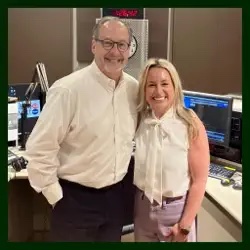
Bruce C. Bryan: My guest today on Naturally Curious is Bailey Medeiros. I'm your host, Bruce C. Bryan, and like so many weeks, we're gonna be talking about a challenging subject and the work being done to address it in Virginia. Bailey Medeiros is the director of the Roanoke Valley Collective Response. The RVCR focuses on root cause analysis, evidence-based practices, community education, and creative support networks to build resilient communities.
Their work promotes recovery and wellness and provides the healthy life pathways for those that are affected by addiction. This is a deeply personal and intense work that's being done, and I'm convinced you wanna hear more about what's being done by law enforcement, healthcare, government leaders, people in education, and the communities at large to address these challenges.
Hear more from RVCR director Bailey Medeiros coming up on this week's episode of Naturally Curious.
Medeiros Segment 1
Bruce C. Bryan: Thank you for being my guest on the show, and welcome, Bailey Medeiros.
Bailey Medeiros: Thank you so much for having me. I'm really excited to be here.
Bruce C. Bryan: So the work you do is fascinating to me, and I'd love for you to tell our listeners more about Roanoke Valley Collective Response.
Bailey Medeiros: I love talking about the Collective Response because I'm so, so proud to be a part of it.
We are a regional collaborative that brings together what we like to call the recovery ecosystem. So we run the whole gamut of the hospital system, first responders, community members, folks with lived experience, which I'm really passionate about, um, treatment centers, and to, to address the addiction epidemic because when we stay in our silos, only one type of work gets done, and when we come together, we get to move our mission forward in a really, really powerful way.
Bruce C. Bryan: So it must be pulling together these resources in neutral territory and getting them to share stories and talk about how you can, um, get better at helping, right?
Bailey Medeiros: Yes, and that's what is so special about it is we get to be the convener, but it's the people that come into the room. I get paid to be there, and no one else does.
And so they all come to the room together out of their giving and passionate hearts for this work, and that's where the work happens. I just call a meeting every month and bring folks to the table, and they do all the good stuff.
Bruce C. Bryan: So you talked generally about the people that are a part of the Roanoke Valley Collective Response, but can you talk specifically about some of the entities or organizations or even people that are a part of it?
Bailey Medeiros: Absolutely. So, um, what might be a good example is, um, the Prevention Council, which is now called the Partnership for Community Wellness, and they work in the school system to talk to our youth and the community at large about, um, preventing the use of substances. And we also have folks at the table who do harm reduction, so folks much more further down, um-
Bruce C. Bryan: Like after somebody's gotten into a hardship or after they've had a crisis-
Bailey Medeiros: Exactly
Bruce C. Bryan: they're talking about what do you do now.
Bailey Medeiros: Yes, and so they are-- Harm reduction is really boots on the ground speaking and delivering services to folks who are in active addiction, so really from way, way downstream to way, way upstream. We also, um, serve a lot of nonprofit organizations. We have folks at the table from our local community service board, which is Blue Ridge.
Um- First responders-
Bailey Medeiros: which is a really, really big piece because they are seeing the consequences of addiction in our community, and, um, local businesses because hiring folks in recovery is a really, really great move, and we want more folks to be doing that.
Bruce C. Bryan: And helping them find that permanent employment and that, and that place and placemaking must help them professionally and well, obviously personally as well.
Bailey Medeiros: Absolutely. It's great for the bottom line for businesses, but also employment is a huge part of, um, the likelihood of staying in long-term recovery.
Bruce C. Bryan: So it must involve a lot of cooperation and involvement from a mix of people, right?
Bailey Medeiros: Yes, lots of different folks. Like what I just explained, the Partnership for Community Wellness and Harm Reduction, those in a lot of other spaces can have conflict 'cause they're doing really, really different work.
We are such a unique, um, locality and area. Um, I just got to walk into this. This isn't benefit of me at all, but, um, they all came to the table together a really long time ago and work in tandem instead of against one another.
Bruce C. Bryan: Well, you're listening to Naturally Curious. I'm Bruce Bryan. You're hearing from and listening to Bailey Medeiros.
She is the director of the Roanoke Valley Collective Response, and by definition, Roanoke Valley must mean it's kind of geographically bound, right?
Bailey Medeiros: Yes. So we serve nine different localities, um, Roanoke Valley, Allegheny Highlands.
Bruce C. Bryan: Okay.
Bailey Medeiros: Um, so we began in Roanoke, so that's where a lot of our work is concentrated, but we would like to expand that footprint to, um, Craig County, and, um, Vinton, and Salem, and those are all the folks that we have invited to our table, and we go out into those communities and try to serve them as well.
Bruce C. Bryan: So are there people, these experts, that are willing to hear from, I'm using air quotes on radio, but other experts, or does it often get territorial in, in your specific situation?
Bailey Medeiros: Roanoke is where I've mainly worked and had my career here, but when I go out into other places of the country and talk about the collective response, um, we are often praised for how our locality does that work.
So we have lots of different experts that are all respectful and encouraging of one another.
Bruce C. Bryan: That's, that is encouraging, and I see that a lot in this region. But it actually leads to another question I had. There, there must be similar organizations in other parts of the region and maybe the state. Or is it just certain parts of Virginia?
Uh, t-talk a little bit about how the work you do looks and fits in other parts of the state, if you could.
Bailey Medeiros: We would like to be the blueprint for how you can convene and bring folks together. Um, but different localities need different things. If you go out into an area that's all really rural, um, they're not gonna be able to get together every single month or see their clients or bring folks with lived experience to the table as frequently as we are.
So I think in other areas it might look different. Um, we Are able to get together, we are able to see one another. Um, but another area might have more, um, virtual meetings or a different look. Um, I know that there are other, um, collaborative organizations that maybe cross, like, state lines, and so they get together maybe once a year.
We get together every month, so that's kind of unique.
Bruce C. Bryan: So we have listeners all over the state of Virginia 'cause it's a big footprint for RadioIQ, and, uh, so it may be that there are other people that hear this that say, "I wanna do this in my area." Is that something you, you and your organization help, uh, collaborate to, to help equip other areas to do similar work, or is that out of the scope, but would you ever consider doing?
Bailey Medeiros: We, and I in particular, I love talking about the benefits of collaboration like this. Um, what we really like to talk about is our successes, and if s- something that came out of our convening or something that came out of the collective response, if it has worked in our area, that's what we like to go and talk about.
So for example, um, we have something very powerful called the Peer Recovery Network. Okay. And I can talk about what peer recovery- Please do ... specialists are. Yeah. But they, um, we-- that is a really, really special, important profession that is evidence-based and really, really on the rise. And, um, so we created a network to support the supporters.
Um, so it's the Peer Network of Roanoke Valley, and we get together every month and, um, do professional development and networking, and that has been a huge success. It started in a park with a couple folks eating pizza, and now we have a Listserv of over 200 people. So that is an example- Mm ... that we would love to take to other communities, and that they may want to emulate because they have their own peer recovery specialists.
Bruce C. Bryan: Well, you're listening to Naturally Curious. I'm Bruce Bryan. That's Bailey Medeiros. And it's almost like you know the questions I'm gonna ask- ... next 'cause y- you keep setting me up perfectly. Oh, good. So thank you for helping me. Uh, you know, I need all the help I can get. But I was curious what you're actually trying to do with the RVCR, and you sort of- Mm
alluded to that with the Peer Recovery Network. Is that the only or the best example? Or like, what are you trying to do, Bailey?
Bailey Medeiros: Mm. Um, one of the biggest pieces of our work, which takes, again, the whole recovery ecosystem, which you may not expect, but we're trying to reduce overdose.
Bruce C. Bryan: So you pretty much summarized it in two words and did it very well. So you're using all the tools you can f- find to help reduce overdose.
Bailey Medeiros: Yes, absolutely.
Bruce C. Bryan: So this, I n- know this isn't just work for you, Bailey. Talk a little bit more about that.
Bailey Medeiros: So I am a recovering heroin addict, which some folks may not like to use that word 'cause it's really scary and ugly.
I chose a long time ago to use that word specifically to sort of take that negative energy out of it, because using a certain substance does not take away your humanity, does not take away your value, and it kept me really sick for a long time keeping that secret. So now I use that word, um, so that people know that we can recover, and that what you might think, um, a heroin addict or an addict looks like is, um, it can be anybody.
It happens to all of us. It happens to people that come from nice homes. It happens to people that, that don't. Um, it really- addiction is not, it does not discriminate.
Bruce C. Bryan: It's across all socioeconomic and all geographic kind of barriers, and I've, I've seen that in the episodes that we've done where we've talked to people that have been in similar stories, uh, as to what you just shared.
It has to be an ongoing thing from what little I know. Um, but how fascinating to be able to take this thing that was a binder and kind of turn the table, if you will, and, and use it as a weapon for good. I don't know if that makes sense. But ta- t- talk a little bit about how you apply where you've been.
You used the word earlier about people that had, uh, I forget the name, of the people that are on the RVCR that are, uh, had formerly had addiction.
Bailey Medeiros: Uh-huh. Folks with lived experience- Lived experience ... we like to say.
Bruce C. Bryan: Thank
Bailey Medeiros: you. Yes. Yeah. Yes. Um, that is also really special to me because I did not grow up or even use in Roanoke.
Um, I came here by way of my own recovery and probably a universal or God magic thing that happened. Um, Roanoke is truly one of the epicenters of the addiction, of the opioid epidemic. Anyone that's had the opportunity to read or see the series Dopesick, that is an author that came from Roanoke. And so, um, it's special to me because this is where I did my recovery journey and continue to do my recovery journey, that I get to pour back into the community that so freely gave to me, um, my opportunities for recovery.
Bruce C. Bryan: And how long have you been in Roanoke?
Bailey Medeiros: I've been in Roanoke since 2020.
Bruce C. Bryan: Okay.
Bailey Medeiros: And, um, so what is that? Six-
Bruce C. Bryan: It is
Bailey Medeiros: six- ... six years now.
Bruce C. Bryan: Yeah. ... plus years. That's right. Um- Beyond your own personal experience, have you seen practical ways this work has made a difference?
Bailey Medeiros: Hmm.
Bruce C. Bryan: You mentioned about, um, uh, the, uh, the network and some of the other things, but I'm just curious if you'd- Mm-hmm
seen other ways that the work had made a difference.
Bailey Medeiros: I know a lot of, um, folks in, in different positions will say it's, we need to be careful how we celebrate this, but overdoses are down in our area and throughout the country, which is really significant. Um, I've also seen just locally, um, I've seen what...
There was a big reduction in services, um, during COVID, have now come back to life, um, have been more fruitful or have expanded, which is really significant. I've seen more people come to our table that maybe were hesitant or stigmatized to come to the table before. Um, and I've seen, I've seen just with my own eyes and in the work that I do that's more client-based, I've seen people come back to life just individually, and so that's really significant.
Bruce C. Bryan: Yeah, that's gotta be fascinating and encouraging and empowering. I wanna talk about places of recovery. I think we're gonna have to do it after this break. Okay. So when we come back, we'll talk about places of recovery.
Bailey Medeiros: Awesome. Thank you.
Medeiros Segment 2
Bruce C. Bryan: Welcome back, Bailey Medeiros. I was hoping you could talk about Places of Recovery.
Bailey Medeiros: I love, um, talking about Places of Recovery. It is a campaign that we started a couple years ago for National Recovery Month, which is in the month of September, and we just interviewed basically some friends of mine that, um, are in recovery with, um, a free local camera guy that, that we could get to come do it.
And I should've known better, that people with lived experience or in recovery would amaze me, but I just asked the question, um, "What is your place of recovery?" And I thought people would say, "Oh, I went to Mount Regis in Salem, and, you know, I went to rehab." And people answered in these beautiful, remarkable ways of where their recovery exists and it, where it comes from.
And so we got to pour into this project and now have bigger and better partners, and we don't have to borrow the free camera anymore because this thing just grew in this amazing way and people wanted to see more of it. So we try to do one a year where we highlight a different locality in our area and talk about why that is a good place, um, to find your recovery.
Bruce C. Bryan: Are you willing, Bailey, to share a little bit about your particular place of recovery? And if not, that's okay. Maybe you can share for our listeners, with our listeners somebody else's example of a place of recovery.
Bailey Medeiros: Yeah, I don't know that anyone has ever asked me that question. I've asked a lot of people where their place of recovery is, but, um, my place of recovery, it's changed a lot over the last now almost seven years.
Um, right now my place of recovery is in a yoga studio. I do a whole lot of yoga, hot yoga, so I sweat it out and, um, get grounded and-
Bruce C. Bryan: That is so awesome ...
Bailey Medeiros: all of that in one. Yes.
Bruce C. Bryan: Big Jim and I do hot yoga usually right before the show. Oh, okay. So we have a lot in common. Yeah.
Bailey Medeiros: That's why you were in those outfits when I got here.
Yeah,
Bruce C. Bryan: that's exactly right. Right, right, right, right. It's radio, so nobody'll know. But so hot yoga for you is your place of recovery.
Bailey Medeiros: That's been a surprising place of recovery for me, but that's what's so interesting. It doesn't have to be these, um, traditional spaces, but I will say other people have much more beautiful answers than I have.
Um, they have found their recovery with their children, or they've found their recovery under a bridge when they were unhoused, or they find their recovery up at The Star when they are doing some meditation. So people have had these really incredible, um, what we like to say people, places or things that have helped them find their recovery.
Bruce C. Bryan: And there's a randomness to that, but the consistent through line is the recovery part, obviously.
Bailey Medeiros: Yes, and you would be so surprised at where, um, people find that. It's just so remarkable.
Bruce C. Bryan: You might have partially answered this, but th- this work must be exhausting at times. Mm. I, I was curious, do you get weary?
Bailey Medeiros: That is a really, um, powerful question. I like to ask people also do they still have hope? Are they doing this work because they still have hope or because maybe they don't, so they're working really hard to get it back? Um, I think I do become weary. When I used to be in more direct client services, that can be really challenging to talk to folks who are having a really hard time, and you can't always find them the help that they need on that day in that moment, and that can be, um, really traumatizing, to be honest.
Um, now I've-- I'm a little bit further removed from serving clients directly. I more support the supporters. Um, but so that has been more energizing, I would say.
Bruce C. Bryan: So- Besides hot yoga, what do you do when you get tired? Uh- Mm ... how do you recharge yourself, being in a situation where you're constantly looking out for other people?
Bailey Medeiros: I think that, um... So all of-- Most of my, my people, I like to say my family, is all still in California. That's where I grew up. And so I definitely recharge by going to be around them, and just, um, being in a new place. Sometimes getting away from your office is just the prescription. Um, but I have two nephews in California that are the loves of my life, and so when I get to go see them, that is, um, that fills my cup for sure.
Bruce C. Bryan: Well, that's great. And of course, this is available online, so they can listen to Aunt Bailey,
Bailey Medeiros: right? Yes, to Auntie Ba- Or is it Auntie Bailey? They also call me Auntie Bailey or Bailey Boo. My birthday's on Halloween. Okay. And so somehow that... And so to be named is such an honor. So yes- There you go ... they'll be able to hear Auntie Bailey Boo.
Bruce C. Bryan: And then, and people give out candy in honor of your- Yeah. ... your birthday as well. So you have government people, healthcare- Mm-hmm ... people in recovery, educators, and others. That's a huge mix of talent and perspectives. I think my experience has been that's how the best work gets done. But it also must be challenging.
Will you, will you talk a little bit more about that?
Bailey Medeiros: It's, um... We've been really lucky that our, those particular groups for us in this area have already wanted to come together, I think because the problem was so big that the motivation behind it was also really big, thank goodness. Um, but it's also just hard to get people in the same room at the same time.
These are, um, a lot of folks, like I have mentioned, direct client services. That means you need to be with human beings when they're awake and your office is open. And so coming to meetings and meeting with, um, emergency room addiction specialist doctors who work all through the night and are maybe trying to sleep at 8:00 AM on a Wednesday, it's differ- it's difficult just to bring people together in, just logistically can be hard.
Bruce C. Bryan: Well, you're listening to Naturally Curious. I'm Bruce Bryan. This is Bailey Medeiros or Bailey Boo. Halloween birthday. How cool is that? Um, with all these gifted people, um, you've probably heard some things that have helped you professionally. What things have you learned that you can apply to your work?
Bailey Medeiros: Mm. One thing that is, um, a big piece of the whole recovery ecosystem is what's called trauma-informed care, and that is to boil it down into a sentence or two, acting as if or, um, interacting with people assuming that everyone that we meet has their own story and their own journey. They've experienced probably some trauma, which does feel pretty true of the human experience.
And that can be not just in treatment like you would think really traditionally. It is in any interaction that you're doing with people. So once I became trained in trauma-informed care, it really, um- It was an adjustment to how I treat any human being that I come across- Any interaction ... even at- Right
the grocery store. And so that has been, um, I can't recommend that education enough.
Bruce C. Bryan: Well, I think that's really helpful advice, and I think one of the things that's interesting that I see and I talk to my team about is we know what we're going through, but we don't know what the other person's going through.
Exactly. And I haven't been through the training, but it sounds like it's going down that road, right?
Bailey Medeiros: Exactly. One of my favorite s- um, sort of philosophical stories is there's... And this h- this is very similar to addiction groups, but, um, a bunch of people were sitting around in a circle, and they all put their biggest problem in the middle to kind of trade that they didn't want anymore, and by the time it got back to that person, they took their problem back.
And
Bruce C. Bryan: they're like, "Mine's not as big as I thought it was." Yes.
Bailey Medeiros: How- Exactly.
Bruce C. Bryan: Yeah, that's really interesting, and it's, um, fascinating to me because I was gonna ask if there are things our listeners might be able to latch onto and use to help them professionally or personally, but I think you've kind of already answered that question, right?
And, and that's what I hear so much when I talk to people like you. I hear through lines that totally apply to everybody, no matter what kind of work they do or who they work with.
Bailey Medeiros: Yeah, absolutely. And I think, um, to live, especially if you live anywhere in or around Roanoke, um, that is to either love someone or know someone who's been affected by addiction.
So even there's the, there's the bigger humanity piece that is to, like you said, to treat people as if you don't know what they're experiencing. Um, but also to live and work in this area is to, whether you have, you know it or not, is to know someone that has experienced addiction.
Bruce C. Bryan: As just a figure. It's something that is-
Bailey Medeiros: Absolutely
Bruce C. Bryan: in- ga- involved in somebody's life. Mm-hmm. So is, is this work that has an end date, i- or is it perpetual?
Bailey Medeiros: Oof. Um...
Bruce C. Bryan: I mean, I know what you want to answer- Mm-hmm ... but also a, a little bit of, I, I don't even wanna say job security 'cause that sound, but it feels like this is something that isn't going away necessarily.
Bailey Medeiros: Right. And even I think, um, let's say we got to zero overdoses in a year, and that would be such a win and a celebration. Um, but there's a lot more to it. We are now experiencing probably the third generation of, um, families that have been affected by addiction. We lost so, so many people when the prescription epidemic first started happening, and now their kids and grandkids are existing with that trauma that they lost their parents, or they were raised by their grandparents, or, um, they saw, they lost a bunch of people that they went to high school with or whatever it is.
And so we still are in service to those folks who were affected by addiction in different ways.
Bruce C. Bryan: It must be a wild mix of rewarding and overwhelming at times. Can you talk a little bit about that?
Bailey Medeiros: It, um, will keep me up at night, that's for sure, trying to think of All the facets and areas where I might be of service.
Um, and that's why the collective response is really significant to me because it can be so exhausting thinking of all the different categories where you wanna help. And if nothing else, we're trying to bring together all those different areas, um, and at least trying to check those boxes of, um, like I've said before, the recovery ecosystem, all the different, um, folks that should be together, working together in it.
Bruce C. Bryan: And you're seeing that in this area, but it sounds like that isn't as common in other areas.
Bailey Medeiros: I think, and that's what I have heard. It, it seems as if we, which is really great, we are further along than other areas. There's, um, a lot of folks may have heard about the opiate ab- opioid abatement settlement funds that came, are coming down through, um, throughout the whole country.
And the way that John, John Hopkins University set sort of a standard for the OAA, for the opioid abatement funds, and, um, it's to check basically these five boxes, one of which is to come at the work collaboratively. And so there's a lot of people maybe not necessarily scrambling, but really trying to get together those groups so that we can properly spend this, this money and put it where it belongs.
And here in Roanoke, we already had all those folks at the table. Kind of
Bruce C. Bryan: rolling forward together. So that
Bailey Medeiros: gave us a... Absolutely. We already had a head start.
Bruce C. Bryan: What's a big misconception from the public regarding addiction?
Bailey Medeiros: There's so many. I think that the way we-- It's still horrendously stigmatized, and that's one reason that I, um, find it important to talk about.
But we think that an addict looks a certain way, and that's just not true. Or we think that, um, X, Y, and Z means that this person is going to enter addiction, or once someone is in addiction, that they're never gonna find, um, peace and health after that, and all of those things just aren't true.
Bruce C. Bryan: Well, there are questions I'd still like to ask, so people are gonna have to stick around for the bonus section to hear more.
Bailey Medeiros from the Roanoke Valley Collective Response, thank you for being my guest on Naturally Curious this week. To listen back to the show, to hear the full interview, and links to learn more about Bailey Medeiros and the RVCR's work with the opioid crisis, search Naturally Curious at radioiq.org.
Naturally Curious was produced and edited by Big Jim Shively, with support from Sarah Hobbs and Nick Yee, and is recorded at WVTF Radio IQ Studios. I'm Bruce Bryan. Thank you for listening.
Medeiros Bonus Content
Bruce C. Bryan: Bailey, thank you for sticking around. A little bit more about you in this segment, okay?
Bailey Medeiros: Okay. I'm so grateful. Thank you so much.
Bruce C. Bryan: So I asked a few people about you, and I was told a couple things. I was told you're a champion overcomer, that you steward your story really well, and that you inspire others, and in doing that, equip them.
How does that feel?
Bailey Medeiros: Well, you didn't tell me that part before you just said that, so I might start crying a little bit. That is so... I'm so honored to hear that, and, um, oh my gosh, I don't really know what to say to that.
Bruce C. Bryan: Well, then you're really not gonna like the next question, because somebody else said that you are passionate, eager, earnest, which I love that word.
Mm. That's a good word, right?
Bailey Medeiros: Mm-hmm.
Bruce C. Bryan: Kind and empathetic. How do you think those kind of descriptions align with the kind of work that you do professionally?
Bailey Medeiros: Mm. Well, I don't know why, but kind really stuck out to me. Um, I'm really, um, honored that someone said that about me. But I think if we, if we move-- if kindness is at the forefront, we can't really go that wrong.
We can try our hardest, and if we're doing it with kindness, um, it's okay to mess up. But, um, if we do-- If we're working with kindness at the forefront, then, um, we can't really be messing up that much, I don't think.
Bruce C. Bryan: I like that approach. I love interviewing people who have a cloudy line between themselves and what they do professionally- Mm
um, for a lot of different reasons. Do you think that describes you? I'm starting to feel like it might, um, that your personality just happens to naturally mix in with the work that you do.
Bailey Medeiros: I, um, I love my work and my job so much, and excuse me, have been so honored to serve as the director of this space.
And so I do carry it into a lot of different spaces in my life. Yeah.
Bruce C. Bryan: Yeah. That's powerful, and it's evident in what you do. Um, I can't help but just pick just a tiny bit more at this because I am quite curious about how you describe yourself as a person. Mm. And I know that's a hard question, but it would be really-- I think it'd be-- people that are listening would be really interested to hear how you describe yourself.
Bailey Medeiros: Oof. I hope people listening, that it's also difficult for them to do because maybe- It is ... maybe it's, um... I hope that I am-- that I have humility. I think that is something. Humility to me means you're coachable and changeable. And if you have-- if I have that, then hopefully I can adapt and have adapted to a lot of different circumstances.
Bruce C. Bryan: No, it sounds like you've integrated that rather well. Um, I-- It was interesting. I had a question that you've already answered that I was really wanting to ask, and you did such a good job answering it because I said, "Well, how would you explain to people that are curious about what you do? How would you simply explain it?"
But everything you do is about reducing addictions or eliminating addiction, right?
Bailey Medeiros: Yes.
Bruce C. Bryan: Um, and you've been in Virginia for about a little more than half a decade now. Mm-hmm. Um, what kinds of things do you like to do in our state? Like, um- Either as a tourist or traveling about or for fun or whatever.
Bailey Medeiros: Mm. I love being in community here in, well, in Roanoke and in Virginia.
Um, that was something that's not as common, at least in Southern California where I grew up. I have just met so much kindness, to use that word, so much kindness here. And so I love to be in community and talk to other people. I love being outside. There's not a better place in the world, I don't think, than to enjoy hiking and biking and doing all those things than here.
Bruce C. Bryan: Except people in Virginia are thinking about Southern California- Right. ... and how beautiful that is, right? So it's- I
Bailey Medeiros: probably sound a little... Yeah.
Bruce C. Bryan: It's kinda like, well, it just depends on your perspective. Right, right. But I can get behind that. I think we take, uh, or overlook the beauty of the area that we're in, and I think that's probably true of almost wherever you're from.
Yes. But it is definitely a beautiful area. Um, have you made some friends? I, I think the answer is yes, but have you made some friends through this line of work? And maybe talk a little bit about some of those relationships that you've-
Bailey Medeiros: I have made some really great friends, but what I've really found along the way are mentors, particularly women who have worked in this space a really long time, and it has not made them weary, like we talked about earlier, and they are still inspiring.
Um, a couple come to mind who have been executive directors of their spaces and, um, Jody Anderson is a huge mentor of mine who has opened up, um, recovery residences all over Roanoke, which is, was a huge, huge need. Janine Underwood, who serves as the executive director of the Bradley Free Clinic here in town, which I don't have to explain how significant that is, um, and Nancy Hans, who just retired as the executive director of Partnership for Community Wellness, and these women come to, to this space with, um, with such hope and, um, keep doing the work, which is really remarkable.
Bruce C. Bryan: They're heroes in a lot of ways. Yes. Absolutely. What things have you pulled from them? When you're talking about them being mentors, what things, uh, have you latched onto professionally or personally?
Bailey Medeiros: Mm. Um, Jody Anderson, for example, when she sees, um, gaps that are, that exist, she doesn't wait around for someone else to fill that.
She just steps in and does it herself, and that has been so astounding to watch because it's like she's creating something out of nothing.
Bruce C. Bryan: That is fascinating. And, um, the Bradley Free Clinic, um, Janine?
Bailey Medeiros: Yes.
Bruce C. Bryan: Let her know she's on my list. Okay. To- I'd love to- Oh, I
think that would be great ... tell her I'm, I'm gonna find her. Okay. So if she doesn't find me first. So this is a position you've taken over in the last few years. How have you grown professionally because of the work that you're doing?
Bailey Medeiros: I, I hope I have grown professionally. I, um, what used to take me, let's say, two weeks now maybe takes me a little less than two weeks.
So just in the logistics of working, I think I've grown up a little bit. Um, professionally, I've grown in confidence. I can enter some more spaces and know that, um, I, it is me that is serving as the director of the Collective Response, and that is... I get to steward that in a really exciting way. And, um- How else have I grown professionally?
I hope that, um, I have been a good leader too. I have an amazing team, um, that I didn't have when I started, and so I hope that they, um, have been better in some way, shape, or form from having worked with me.
Bruce C. Bryan: That's part of the goal of doing the work that you do, is to equip other people to go beyond where they've gone.
And it sounds like some of these women that have spoken wisdom into your life have also impacted you in a variety of ways. So I think that's... So often it's the relationships that we make professionally that cross over into the personal side of things, right?
Bailey Medeiros: Absolutely. I could go on and on about the people that inspire me in this area.
Bruce C. Bryan: Well, you sort of answered this, but maybe there might be another one. What other organizations do you admire, and, and why do you admire them?
Bailey Medeiros: I admire, well, um, all of Jodi Anderson's sort of umbrella of what she does. They are all, um... The whole staff are people with lived experience, and that is, um, that's actually somewhere that I received services when I first came to Roanoke.
Okay. So I, I can tell you firsthand how powerful that is to, um, to have all the professionals that are kind of developing your treatment plan have been there before. That is... It provides so much hope, but it also, um, brings your walls down a little bit. There's another organization called On Our Own, and they are also completely peer-run.
And so those are the places that I really like to champion.
Bruce C. Bryan: So people who have listened to all of this, and h- I'm sure have been moved, like both you and I were, if they wanna learn more, do you have websites that you send people to, or check out this, or go learn about what's happening in greater Roanoke this way or that way?
Where do, where do you send people, Bailey?
Bailey Medeiros: I think, um, rvcollectiveresponse.org is our website, and so that's a good place to start. You can find a lot of these other organizations that I mentioned are linked on our website, also the Places of Recovery campaign is there. But I also just want to, if you're listening to this and any of it feels true about your own struggles, the 988 hotline is available 24 hours a day.
And so that's a really important plug that I think, um, we should shout out.
Bruce C. Bryan: That's a great reminder, and I'm sure Big Jim will put that on, you know, some of the podcast messaging as well. Fabulous. So thank you for reminding to that.
Bailey Medeiros: Yeah.
Bruce C. Bryan: So Bailey, what do you wish I would've asked you? Like, you, I know you did your homework.
You're a prepared person. What were you thinking, "He's gonna ask me this," or what did you, what did you want me to ask you?
Bailey Medeiros: I feel like, um, you know what you're doing. And you... I think I wanna ask who said those nice things about me.
Bruce C. Bryan: Oh, that's fair. '
Bailey Medeiros: Cause I owe them some money.
Bruce C. Bryan: They're good people that think that you're a kind person.
Okay. I can't wait. The journalist would say, "I can't reveal my sources." My sources. But I'm proud of you for asking. You should ask. That's a great question. Thank you, Bailey, for being my guest on today's show.
Bailey Medeiros: I'm so grateful to have been here. Thank you so much.